An invoice is an unromantic place to find a company. Nils Schneider found a reason to build one there anyway. His agency needed email accounts to reach potential clients. The outreach services it used charged for each account. Add more accounts, pay more money. Success came with its own little surcharge.
By February 2022, he had something to offer the other people facing that arithmetic. Instantly would let customers connect multiple email accounts through one subscription. In his launch introduction, Schneider gave the central word an extra nudge: “unlimited, yes unlimited”. The repetition did the work of a raised eyebrow.
The proposition was easy to understand because the complaint was easy to understand. Agency operators wanted to run campaigns for clients without watching every additional inbox become another line on a software bill. Schneider and his fellow founders had been among those operators. They built from inside the inconvenience.
The invoice came first
Schneider is now a co-founder and CEO of Instantly.ai, the sales engagement and lead intelligence business founded in 2021. His early pitch had the specificity of someone who had used the alternatives. He described an agency paying thousands of dollars a month for outreach services, with separate charges attached to sending accounts and account warmup.
The distinction matters. Email software can sound interchangeable from a distance. Inside an agency, the difference between paying once and paying repeatedly affects what a client campaign costs to run. A pricing rule becomes part of the daily work, as familiar and unwelcome as a squeaking chair.
Instantly’s public introduction on AppSumo was addressed to “Sumo-lings”, an amiable greeting for people looking for software deals. The offer began at $59 for lifetime access. That was a launch offer, with the peculiar economics of an early software marketplace. It put the product in front of buyers willing to try something new.
A company assembled across the internet
Schneider’s professional profile places him in Zurich and lists the University of Zurich. The business he helped assemble is distributed rather more widely. Instantly names four founders: Schneider, Raul Kaevand, Reio Suun and Sumit Kumar. Kumar is identified as the co-founder and chief technology officer.
Schneider and Kaevand met through Reddit’s co-founder community. There is a pleasingly practical quality to that beginning: two people looking for someone to build with, finding each other in a place explicitly designed for the purpose. Their working relationship eventually became part of a company whose product also helps strangers begin commercial conversations.
The agency’s clients became the first 20 users. Later, the founders closed the agency to concentrate on the software. That decision changed the nature of their work. A service business delivers campaigns for customers; a software business must make the same work possible for people who bring their own methods, expectations and mistakes.

The courtesy of a smaller question
His public writing offers a useful way into the person doing that work. On X, where he uses the handle @nils100km, Schneider has published lists of cold email calls to action. The scale of the lists is almost comic: 27 possible endings in one thread, 17 in another. Apparently the final sentence of a sales email can support a small publishing programme.
The examples favour a modest next step. Instead of demanding a meeting immediately, a sender might ask permission to share available times or offer to send something useful. The ambition of the business is large; the suggested first request is often deliberately small. Someone at the other end must still choose to answer.
His feed also records conversations with practitioners such as Eric Nowoslawski, Nick Abraham and Ken Allen. The subjects include relevant targeting, agency operations and the mechanics of outreach. Read together, these posts resemble a working notebook: talk to someone doing the job, collect what seems useful, pass it along.
That interpretation comes from the form of the posts themselves. Schneider repeatedly introduces an operator, explains what they discussed and turns the discussion into a set of observations. It is a social use of expertise, with other people’s experience visibly left in the picture.
The message still has to earn its reply
A May 2022 guide under the Nils byline gets down to the plumbing: domains, sending accounts, authentication and a central inbox for responses. The vocabulary is dry enough to require its own glass of water. It is also the kind of detail that occupies a person responsible for making campaigns run.
Then the guide stops to make a more interesting admission: “no technical tactic can save a campaign.” For someone selling infrastructure, that is a useful limit to state. The apparatus can help a message travel. It cannot supply a recipient’s interest by itself.
“no technical tactic can save a campaign.”
Nils · Instantly blog · May 2022
Later writing on lead intelligence follows the same concern from another direction. A name, company and job title provide basic information. A relevant company development or a clear indication of what the prospect needs can give the introduction a reason to exist. Personalization requires more thought than placing a first name neatly between two brackets.
There is an everyday human problem underneath the software vocabulary. The sender has something to offer. The recipient has other things to do. Schneider’s educational material keeps returning to that awkward little meeting of interests. It is where the campaign eventually becomes a conversation, or ends without one.
- 01Find a relevant prospect
- 02Write a useful introduction
- 03Deliver the message
- 04Handle the reply
A classroom full of agency questions
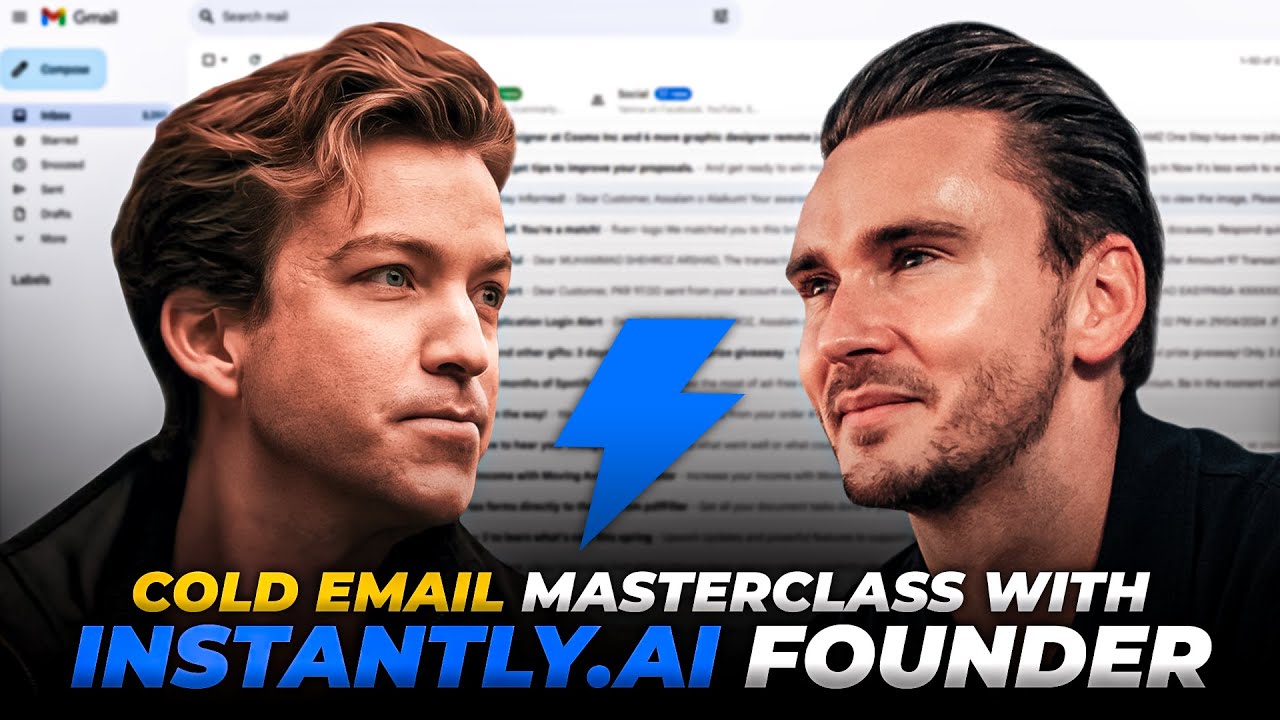
Schneider has taken those concerns into live teaching as well. In a cold email masterclass hosted by James Blackwell, the audience’s frame is recruitment: finding clients, reaching decision-makers and making the machinery manageable for an agency.
The discussion moves between data, verification, warmup and sequencing. Schneider explains the appeal of bringing these tools together rather than asking an operator to assemble a collection of separate services. Later questions turn to technical setup, spam-folder problems and the wording of email copy.
A webinar is an unforgiving format for an abstract product claim. Someone can always ask what happens when the account is configured incorrectly or the campaign stops working. This one puts Schneider in the role of an operator explaining the work to other operators, with their particular frustrations allowed into the room.
Forty-two ways to listen
In 2024, Schneider announced a website where customers could submit feature requests, feedback and bug reports. He invited people to help shape Instantly around what they needed. Software users rarely need much encouragement to explain what is missing. Giving those explanations a home is a more consequential step.
A subsequent post supplied a tally: 42 completed features, ten in progress and six planned. Those were the figures he shared after the request site had been running for a few weeks. The count made a broad invitation more concrete. Customers could see the work described in units they recognized.
It also fits the origin of the company. Schneider had started as a dissatisfied buyer of someone else’s tools. Now other buyers were telling him what his own product needed. The position had changed; the usefulness of a precise complaint had survived the journey.
Features reported in his public update; a snapshot of that moment.
From teaching the steps to removing them
His more recent ambitions move further into automation. In a March 2026 LinkedIn announcement, Schneider described an AI Sales Agent that begins with a company’s website URL and handles prospecting and meeting booking. He said the team had spent months building and experimenting before it began booking calls.
Schneider reported more than 150 sales opportunities for the internal account executive team over two weeks. That is his own account of an internal result. The larger proposition is to make a complicated sequence of tasks accessible through a much simpler starting point.
Another post stated the ambition plainly: “Every company should be allowed to build pipeline.” He included founders, agencies and small teams, regardless of their sales sophistication or ability to afford a sales development representative. The customer he described sounds close to the customer in his original launch: someone trying to win business without acquiring an expensive new burden.
There is a tension here that makes the next chapter worth watching. Schneider’s early educational work showed people how much there was to learn. His agent pitch promises to take more of that learning and execution off their hands. The product has to carry the complexity its user is being invited to set aside.
Meanwhile, the person receiving the email still gets a vote. They can reply, ignore it or decide the offer has arrived at precisely the right moment. That small act of judgment remains at the centre of Schneider’s business. He began by changing the cost of reaching the inbox. His continuing task is to make the journey worthwhile for the people on both sides of it.
Keep the conversation going
- Instantly.ai ↗
- Nils on LinkedIn ↗
- Nils on X ↗
- The Nils writing archive ↗
- The February 2022 introduction ↗
- The public feedback announcement ↗
- The feature update ↗
- The AI Sales Agent announcement ↗
- The pipeline ambition ↗
- The company’s background ↗
- The May 2022 infrastructure guide ↗
- Lead intelligence and relevance ↗
- Archived outreach threads ↗
- Instantly on YouTube ↗