The office had seemed too big. When Azzan Al Kindi and his colleagues moved into Rihal’s premises in 2021, they wondered whether they had taken more space than they needed. Three years later, the company doubled its floor space. Headcount had nearly tripled. An anxious question about empty rooms had become a more agreeable question about where to put everyone.
There are grander ways to describe a technology company’s progress. Al Kindi has numbers for those, too. But the office story has something a growth chart lacks: the memory of being wrong in a useful direction. Before the enlarged team, before the regional recognition, someone had looked around a room and wondered whether the ambition had got ahead of the furniture.
Al Kindi is Rihal’s co-founder and chief executive, based in Muscat. His working life has included mechanical engineering, an overseas oil-services career and the construction of a business around data. The intriguing part is how often his public story returns to learning: learning a trade, learning how to build a company, and occasionally learning why a computer refuses to cooperate.
An engineer before the executive
His technical education began early. At 11, he joined the Royal Guard of Oman Technical School. Later came mechanical engineering at Sultan Qaboos University. The sequence matters because it places the workshop before the boardroom. His interest in making things had years to develop before it became a company’s commercial proposition.
University also gave him responsibilities beyond his own coursework. He became president of the Society of Mechanical Engineering and represented his cohort. Those are modest titles beside chief executive, but they belong in the same biography: technical work accompanied by the task of speaking for other people.
After graduation, he went abroad to work in oil services. In a later reflection, he counted six years at SLB and realised that his time at Rihal had already overtaken that chapter. The comparison is revealing without needing a dramatic conversion scene. He had spent a substantial period in an established engineering business before spending another substantial period helping build his own.
The oilfield remained part of his professional memory. Rihal’s early work included managing data for oil and gas engineering. His previous world supplied a practical setting for the next one: organisations with technical records, operational demands and information that needed to become more useful.
The trouble with an attractive dashboard
A client asking for a dashboard sounds like a client who knows what to buy. There is a screen to design, a set of figures to arrange and something presentable to show at the next meeting. Al Kindi’s advice introduces an inconvenient pause.
“Giving the client what they think they want won’t solve the actual problem.”Azzan Al Kindi
That observation, shared by a Rihal colleague, captures a useful tension in his business. A technology company earns its living delivering things. Its judgement is tested by deciding which things deserve to exist. The polished display is easy to admire; the decision it improves requires a harder conversation.
Rihal’s own description of its work follows the less glamorous route through an organisation’s information. Documents become digital data. That data is cleaned, sorted and processed. Automation and machine learning can then become useful, and people need a way to understand the result. The sequence puts preparation ahead of spectacle.
For Al Kindi, that makes the move from services into products particularly interesting. In 2023, his stated goals included expanding into Saudi Arabia and turning services into products for clients. Bespoke work teaches a company where the awkward problems live. A product asks whether the lesson can travel.
- 01DigitiseMake documents usable
- 02OrganiseClean and structure data
- 03AutomateConnect repeatable work
- 04UseSupport a decision
A bigger company, measured carefully
In April 2024, Rihal placed third in Deloitte’s Middle East Technology Fast 50 ranking, with revenue growth of 2,441% over the measured four-year period. The percentage is striking. The qualification matters just as much: it describes a particular period and a particular ranking, rather than an eternal position on a league table.
For a founder, such recognition changes the scale of the conversation. An engineering business in Oman was being assessed alongside technology companies across the region and Cyprus. Rihal appeared behind Capital.com and Salla in that edition. The comparison gave the Muscat company a place in a wider commercial discussion.
Then came capital. In September 2025, Rihal announced a $7.5 million first close toward a targeted $15 million Series A, led by ITHCA Group. The stated uses included developing its own data and AI platforms and expanding across the GCC and internationally. Half of a fundraising target had been secured; the ambition extended further.
Al Kindi put the emphasis on the team and sustainable growth when discussing the investment. Money could support the next phase, but the business still had to build and deliver. A funding announcement buys room to attempt things. Customers eventually decide whether those attempts were worth the trouble.
The work has to stay in the building
The product direction now has recognisable forms. Iqraa extracts information from structured and unstructured documents, with models that can be customised and results that users can review. It addresses a familiar office predicament: information exists, but someone must still coax it out of the document before useful work can begin.
Siraaj approaches another part of the same problem. Rihal presents it as an enterprise AI productivity suite for governments and large organisations, with search, document questions, meeting assistance and workflow automation. Arabic and English support, along with on-premise and private-cloud deployment, are part of its offering.
These details locate Al Kindi’s company in a specific working environment. A government agency or large enterprise needs more than a persuasive demonstration. Information has permissions, internal systems have histories, and a useful tool must fit those conditions. Rihal’s current team of more than 300 works across AI, data and automation in precisely those complex settings.
The product list therefore gives substance to the earlier ambition to package services. It also keeps the founder’s story tied to practical questions: who needs the information, where can it be processed, and what task becomes easier once it is available?
A classroom belongs in the story
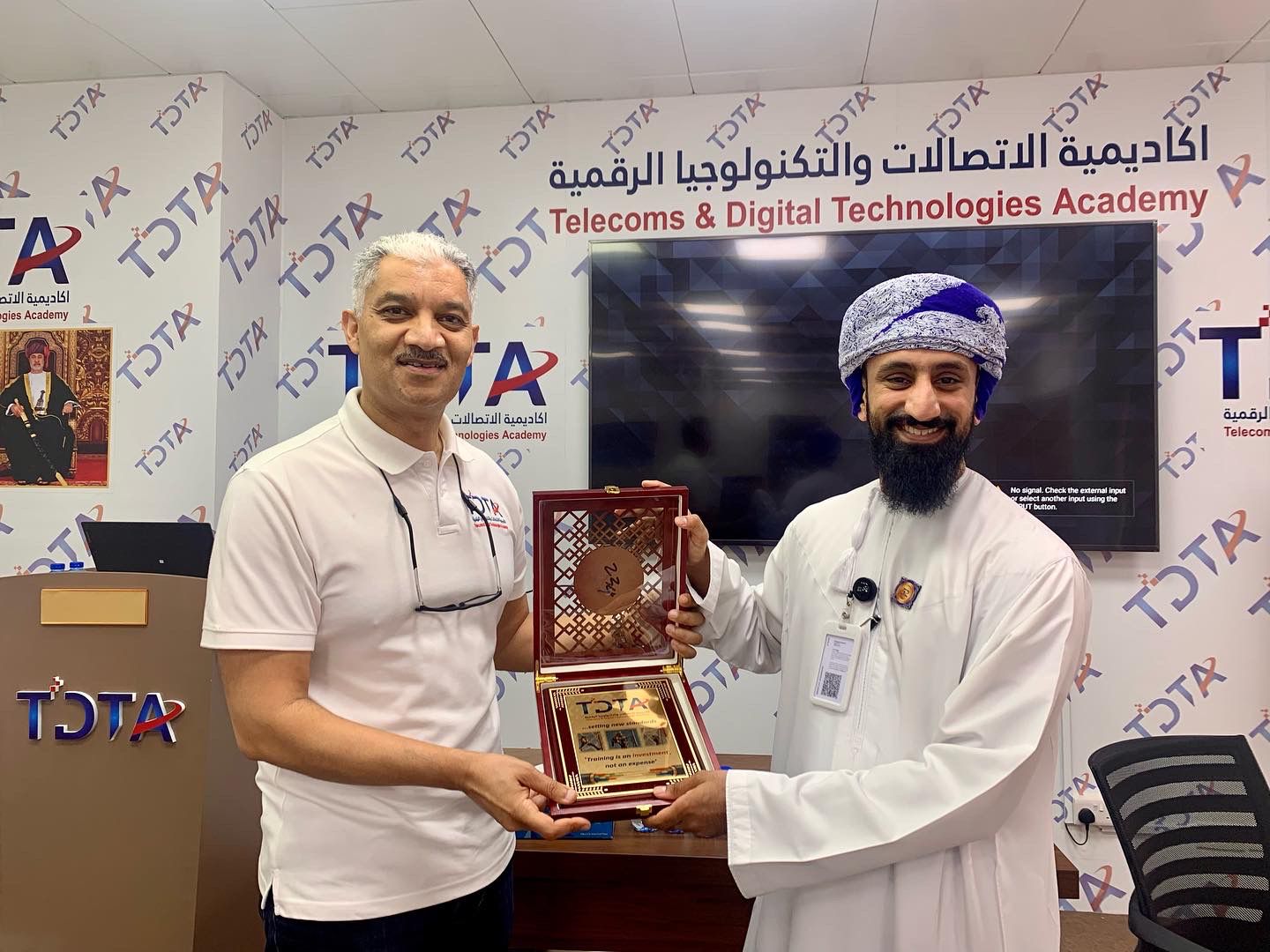
Al Kindi’s public work repeatedly leads back to younger engineers. At the Telecoms & Digital Technologies Academy in 2022, he met participants in a tower-erection project-management course and talked through his professional journey, its difficulties and its successes. The setting was a classroom, with trainees preparing for technical work.
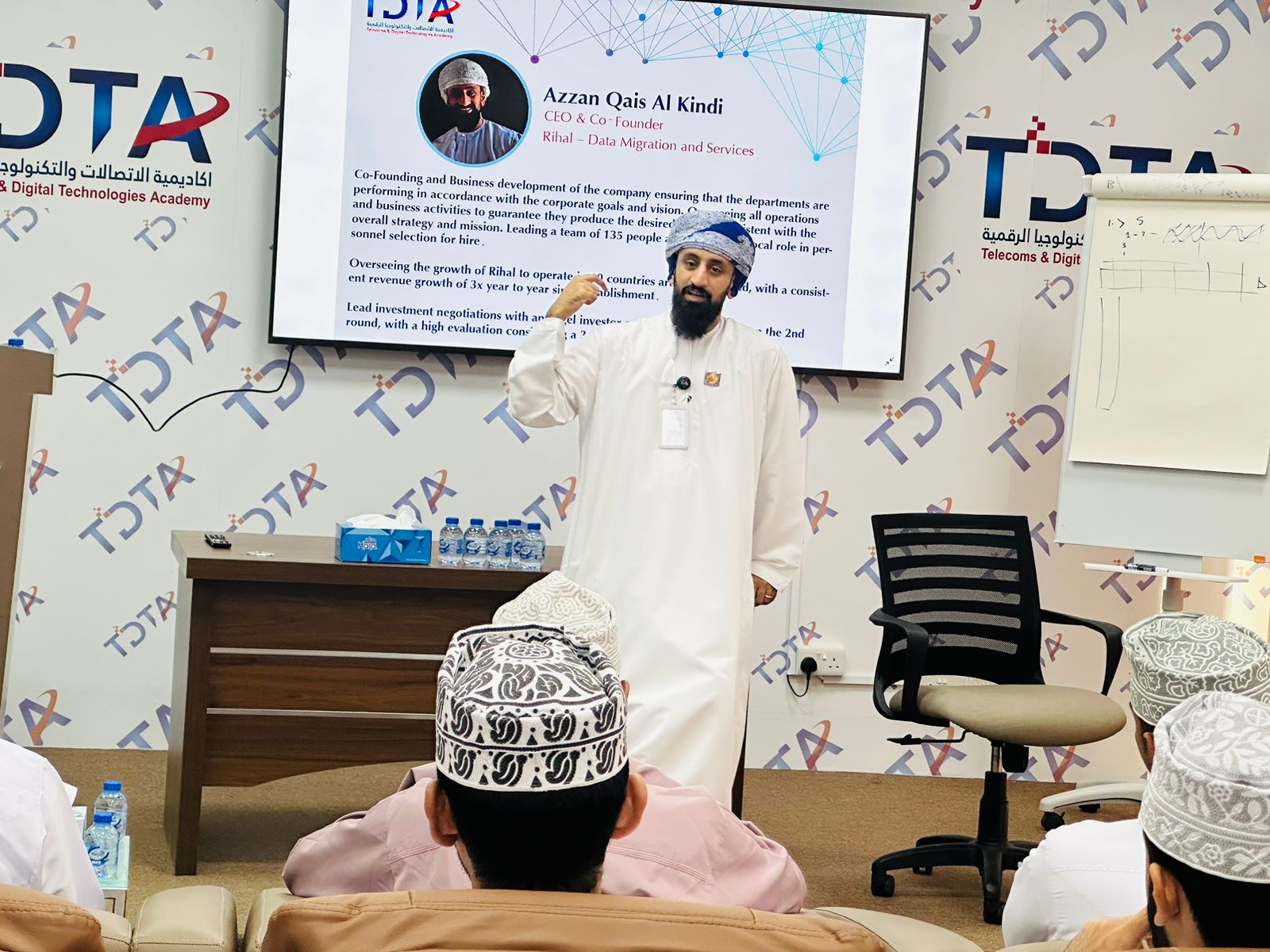
There was an institutional version of that commitment, too. Rihal and Omantel agreed to cooperate on training participants in Omantel’s Generation Z programme in robotic process automation. Al Kindi signed the memorandum for Rihal. The proposal connected a technology specialism with a route for young Omanis to gain practical experience.
His 2024 GPCA Forum biography also listed a seat on the steering committee of the National Employment Committee, Tashgheel. That places the employment question alongside his commercial responsibilities. Growing a company and widening the pool of people able to do its work are closely related tasks.
He has defended Omani technical ability with a characteristically concrete anecdote. When a businessman questioned whether Arabs wanted technical careers, Al Kindi recalled opening a repository to show Omani engineers’ code contributions, including commits at two in the morning. The point was the work itself: an answer that could be inspected.
By May 2026, he was back at Sultan Qaboos University, speaking at its graduation-project showcase. He discussed initiative, perseverance and teamwork, drawing on his own project experience. He urged students to develop their ideas and defend them, while using AI to attempt more ambitious work. The former student society president had returned with a company’s worth of reasons to take student projects seriously.
The chief executive meets the stubborn computer
His own experiments provide a welcome complication to the executive biography. In April 2026, he described trying to build Mushtara, a traditional Omani card game, using AI coding tools. Progress involved frustration, more than 300 prompts and advice from co-founder and CTO Waleed Al Harthi. Even the direction of play became an argument with the software.
In a separate debugging account, he spent six hours chasing a problem before discovering that clearing the cache was the answer. He used the experience to argue for structured checks on AI-generated work. The amusement is familiar to anyone who has lost an afternoon to a computer: an elaborate investigation can end with a very small correction.
There is something useful about a chief executive admitting that sort of apprenticeship. It puts his enthusiasm for AI beside the experience of trying to make it behave. The larger story keeps returning to the same demand: build something, examine what happened, and learn enough to make the next attempt better.
Continue the conversation
Explore his writing, public appearances and the work at Rihal.