The humble calendar has excellent public relations. It presents itself as a grid of obedient squares, each waiting to be filled. Aviram Hinenzon has spent much of his working life studying the trouble concealed inside those squares: two people, two sets of constraints, one reason to meet, and several ways for software to misunderstand all of it.
At OnceHub, where he is Chief Go-to-Market Officer, Hinenzon now works on the border between scheduling and conversation. The company began with booking links and expanded into routing forms, chatbots, and phone-based AI. The technology has changed. His recurring question has not: how do you turn complicated machinery into a useful moment for the person on the other side?
It is a question with an engineer's shape. Hinenzon earned a bachelor's degree in electrical engineering from the Technion in Israel, then entered enterprise technology in 1998. His early work covered systems engineering and product management at the Israeli Ministry of Defense, ECI Telecom, and TTI Telecom. By 2005 he was Vice President of Products at Wadago. A year later he joined ViryaNet, where product direction and outward-facing marketing began to converge.
Learning to speak both dialects
Enterprise software has two native languages. One belongs to the people who build it: architecture, requirements, integrations, edge cases. The other belongs to the people who buy and use it: time saved, risk reduced, work completed. Hinenzon's career has been an extended exercise in translation between the two.
At ViryaNet, he worked first in product management and later oversaw marketing and product capabilities. The company made software for mobile workforces, an environment where an elegant dashboard is only as valuable as the technician, dispatcher, or customer decision it improves. His articles from that period focused on field-service data, performance management, productivity, and customer satisfaction. The emphasis was operational: measure what happens, identify the source of friction, adjust, and measure again.
ViryaNet became part of Verisae, where Hinenzon served as Senior Vice President of Marketing. By 2017 he was Vice President of Marketing at Accruent. These were not abrupt reinventions so much as widening circles around the same problem. Products have to work. They also have to be understood, adopted, and fitted into organizations that already contain habits, politics, and an impressive number of spreadsheets.
The progression also made Hinenzon bilingual in a way job titles rarely capture. Product leaders begin with the constraints of the system. Marketing leaders begin with the change a customer is willing to make. He had occupied both seats. A feature could be technically sound yet awkward to explain; a persuasive promise could collapse when it met an actual workflow. His work sat in the narrow passage between those failures, where customer language had to inform the roadmap and product reality had to discipline the message.
Product and systems roles at ECI Telecom, TTI Telecom, and Wadago.
Product and marketing leadership through ViryaNet, Verisae, and Accruent.
Independent strategic marketing, plus operating and advisory work with Milkman Technologies and Sagely Health.
Marketing and go-to-market leadership at OnceHub.
In 2019, Hinenzon started his own strategic-marketing company. He later served as Head of Marketing at delivery-software company Milkman Technologies and advised Sagely Health on marketing and operations. The consulting interval added another vantage point: instead of improving one machine from inside, he could compare several machines and see which problems kept returning.
The public recommendations from that period describe the human side of the method. Former colleagues recall a manager who invited earnest feedback, changed course when market conditions shifted, and kept the team involved through company transitions. Those are not ornamental leadership qualities in enterprise software. A go-to-market plan touches product, sales, support, content, operations, and customers. Curiosity is useful because no single department owns the whole truth. Candor is useful because polite silence can survive several quarters longer than a bad idea deserves.
A booking is a tiny negotiation
Hinenzon joined OnceHub in 2022 as Chief Marketing Officer and now leads go-to-market. The title puts him in charge of global market strategy, customer acquisition, and growth. The more revealing part of the job appears in his public writing, where scheduling becomes less clerical and more psychological.
“We see every interaction as a series of ‘scheduling moments’ or ‘micro-negotiations’ where we can connect with a client.”Aviram Hinenzon, 2025
Micro-negotiation is a wonderfully fussy phrase for making an appointment. It is also accurate. A useful booking settles more than a timestamp. Who is asking? What kind of meeting do they need? How long should it be? Where will it happen? Which time zone governs the answer? What information will make the first ten minutes productive? What should the guest expect next?
The four-checkpoint booking test
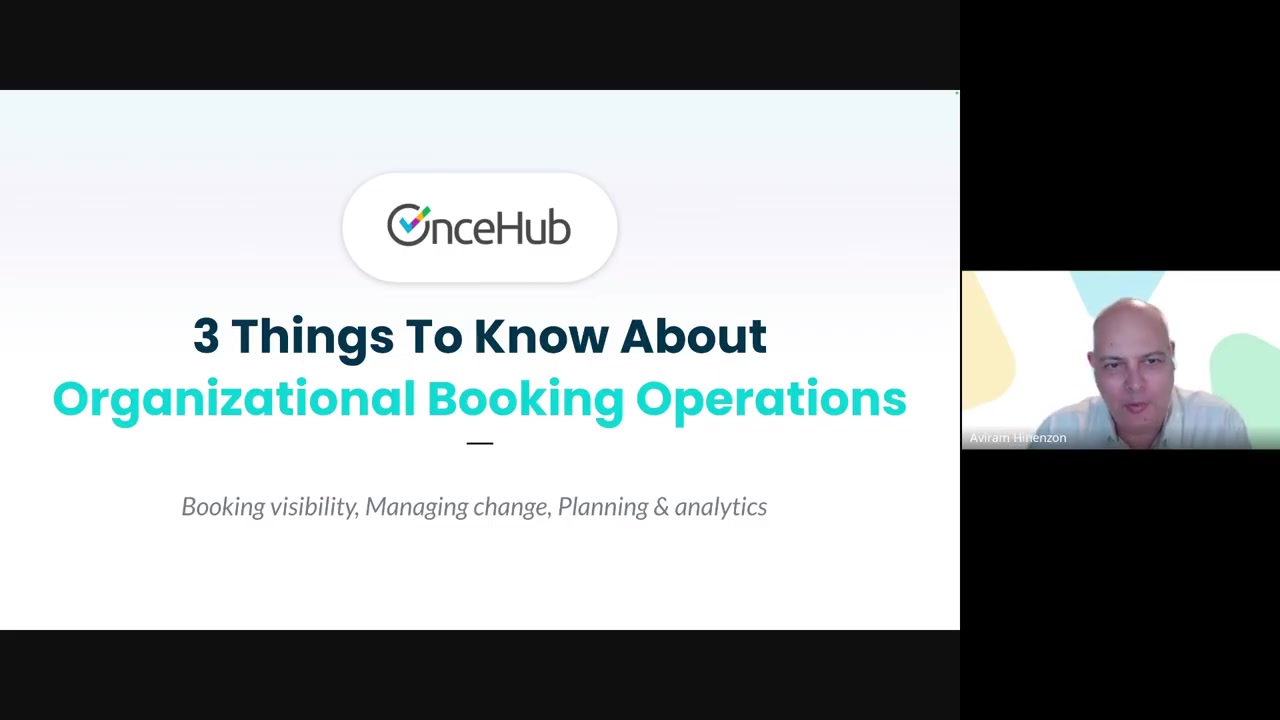
In August 2026, he offered those four checkpoints as a way to judge AI receptionists: context, preferences, preparation, and communication. A demo that stops when the slot appears on the calendar has completed only the most photogenic part of the work. The less glamorous details determine whether the meeting begins with momentum or with five minutes of remedial administration.
The phone refuses to disappear
The latest turn in Hinenzon's thinking begins with an apparent failure. Booking links were designed to end email ping-pong, and they did. Chat and forms offered still more ways to move a customer toward a meeting. Yet the telephone survived every prediction of its irrelevance. People continued to call.
Hinenzon's explanation is grounded in OnceHub's scheduling experience: callers are often close to an important decision. A phone call is not merely an inefficient interface. It can also be a request for reassurance, immediacy, or a person who will recognize the stakes. Removing the friction without removing that meaning is a more interesting product challenge than replacing a receptionist with a synthetic voice.
“High intent and ‘wants a human’ turned out to be the same signal.”Aviram Hinenzon, 2026
That insight suggests a division of labor. AI can answer at any hour, retain availability rules, take a message, transcribe it, summarize it, or put a meeting on the calendar. A person can provide judgment, expertise, and the confidence that comes from being heard. The useful system does not ask one side to impersonate the other. It makes the handoff faster and more informed.
This is a less theatrical ambition than the fully autonomous receptionist often shown in demonstrations. It is also easier to test. Did the call get answered? Did the system apply the correct booking rules? Did it preserve what the caller already explained? Did the right person receive enough context to continue without forcing the customer back to the beginning? Each question points to an observable outcome. The voice may sound natural, but Hinenzon's standard is what happens after the greeting.
Hinenzon's channel map
OnceHub's Phone Booking product grew from this view. In a 2025 interview, Hinenzon described an early attempt at a more elaborate AI conversation. The team changed course. The breakthrough, in his account, was allowing the phone agent to use booking settings customers had already configured. Availability and questions did not need to be rebuilt in another interface. Complexity stayed in the machinery, where it belonged.
The operator at the chessboard
OnceHub's management biography includes one personal detail: Hinenzon enjoys online chess. Public chess profiles under his name stretch back more than a decade. It is tempting to turn the hobby into an elaborate metaphor, so let us exercise the restraint that both chess and enterprise software occasionally reward. Still, the fit is neat. Both involve timing, constraints, incomplete information, and the consequences of the next move.
Colleagues writing public recommendations describe a leader who encourages candid feedback, adjusts as conditions change, and combines technical judgment with team building. His own LinkedIn summary begins with curiosity. Those descriptions align with the career record: an engineer who moved toward the market without abandoning the engineer's habit of inspecting how parts connect.
His published interests have also shown unusual continuity. In 2012 he argued that the value of field-service data depended on its impact, not just its volume. In 2014 he wrote about measurement and iteration. In 2016 he examined artificial intelligence in field service. In 2023 he addressed scheduling privacy. Today he is writing about voice agents, routing logic, and the cost of a wrong answer. The nouns keep changing. The verbs remain: observe, translate, test, improve.
The aspiration visible in his current work is not an all-purpose machine that performs humanity on command. It is more practical. Give AI richer context. Let it handle nuanced availability. Enable it to recognize urgency and reach an available person. Make setup light enough that customers actually use the thing. Preserve the relationship hidden inside the transaction.
A calendar square will continue pretending to be simple. Hinenzon's career is a reminder to be suspicious of that little blank box. It may contain a sales opportunity, an anxious client, a field technician, a missed call, or a professional whose time is the product. The software has one job: understand enough of the situation to help the right people meet. Everything else is decoration around Tuesday at two.