The support desk, rebuilt for a world where customers live in Slack, Discord and their WhatsApp threads - and where an AI can answer before an agent even opens the tab.
The Atlas brand mark. It looks like a logo. It behaves like a thesis: that support - fast, informed, a little bit magic - is the product, not the afterthought.
Here is a slightly heretical idea, which Atlas has built an entire company around: your customers are not churning because your product is too expensive. They are churning because the one time they needed help, help was slow, confused, and made them repeat their order number four times. Atlas - the company at atlas.so, legally Atlas Support, Inc. - treats that as the central problem of software, rather than a support-team chore to be minimized on a spreadsheet.
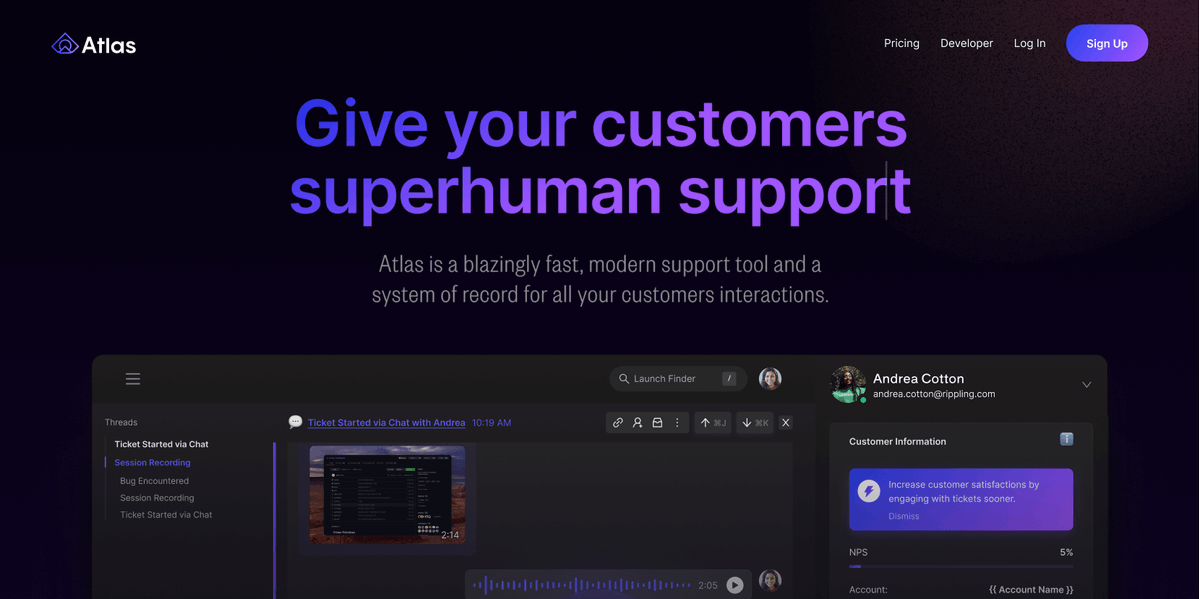
The product is an AI-first customer support platform positioned squarely as a replacement for Intercom and Zendesk. It bundles the things support teams normally cobble together from four vendors: a ticketing inbox, an omnichannel router (chat, email, WhatsApp, SMS, Slack Connect, Discord), session recordings so an agent can see what the customer actually did, a self-maintaining help center, and a pair of AI agents named Autopilot and Copilot. One resolves the routine tickets on its own. The other sits over an agent's shoulder, drafting replies with citations so nobody has to guess.
That line is Atlas's stated mission, and it is doing a lot of work. It reframes support from a cost center - the department every CFO wants to shrink - into a growth engine that turns frustrated users into evangelists. Whether that reframing is genuinely true or merely a very good way to sell support software is, pleasantly, the same question either way: if it works, it is true.
Team size reported in the ~18-25 range. Figures compiled from public sources; treat small-company headcount and funding numbers as approximate.
Atlas's bet is that support agents lose more time switching tabs than solving problems. So it put the context in one place and handed the busywork to AI.
An AI agent that resolves customer issues on its own, running multi-step actions across channels with tone, tools and protocols you define. It handles the routine so humans handle the hard stuff.
Drafts on-brand replies with cited sources, writes an automatic context brief for each ticket, and suggests next actions - a refund, a credit, a scheduled call - so agents stop tab-switching.
A unified inbox that folds chat, email, WhatsApp, SMS, Slack Connect and Discord into one queue, each ticket wrapped in a customer journey timeline.
Screen and session replays attached to tickets, so an agent can watch exactly what a customer did before they hit "contact support" - no more "can you describe what you clicked?"
Articles auto-generated from resolved tickets, organized in a knowledge graph, with automatic conflict detection that flags when two docs quietly contradict each other.
A unified view of each customer's events, history and product usage, synced from tools like HubSpot, Salesforce, Linear and Sentry to reduce the guesswork in every reply.
Atlas's pitch, distilled, is a consolidation play: take the categories support teams already pay for separately and merge them. Roughly, it wants to be Zendesk plus Intercom (ticketing and chat), plus LogRocket (session replay), plus a slice of Linear (issue tracking) - with AI stitched through the middle. The bars below sketch how much of each category the platform reaches for; they are illustrative, not audited.
Competitive set: Intercom, Zendesk, Front, Gorgias, Help Scout, Plain, Pylon. Bar values are editorial estimates of product breadth, not benchmark scores.
Jon O'Bryan is co-founder and CEO. He describes himself, memorably, as a "recovering physicist" turned serial entrepreneur - the kind of origin story that suggests a comfort with systems that misbehave. Rahul Asati is co-founder and CTO, running the technical side of a product that has to ingest every message a customer has ever sent and make it instantly useful.
The two started Atlas in 2021 and took it through Y Combinator's Winter 2022 batch. The company keeps a small footprint - reported in the high teens to mid-twenties in headcount - which fits a product built on the premise that a lean team, well-equipped with AI, can out-support a large one that isn't.
| Legal name | Atlas Support, Inc. |
|---|---|
| Founded | 2021 |
| Accelerator | Y Combinator (W22) |
| HQ | Pleasanton, California, USA |
| CEO | Jon O'Bryan |
| CTO | Rahul Asati |
| Category | AI customer support (B2B SaaS) |
| Website | atlas.so |
Atlas raised a Seed round in March 2022, led by Y Combinator. The dollar figure is reported inconsistently across databases - somewhere in the low-hundreds-of-thousands range - which is normal for early-stage rounds where public records lag reality. Treat the number as approximate.
More telling than the amount is the guest list. Atlas's angel investors reportedly include Parker Conrad (CEO of Rippling), Jack Altman (CEO of Lattice), and Arash Ferdowsi (co-founder and CTO of Dropbox), alongside institutional interest from Accel. When operators who have scaled their own support organizations write personal checks into a support startup, that is its own kind of signal.
| Round | Seed |
|---|---|
| Date | March 2022 |
| Lead | Y Combinator |
| Amount | ~$130K-$500K (reported, approximate) |
| Notable angels | Parker Conrad (Rippling), Jack Altman (Lattice), Arash Ferdowsi (Dropbox) |
| Institutional | Accel |
Atlas's named customers skew toward startups and growth-stage software and commerce companies - teams small enough that every support interaction matters and every hour of agent time is expensive. Publicly referenced users include Loops, Paage.io, Rootine, Genius Sheets, Nullstone, and First Delivery. A recurring theme in their praise is the Slack integration and Atlas's own responsiveness - the company, fittingly, appears to be its own best support case study.
The business model is straightforward B2B SaaS: subscription software sold to customer support and success teams, with the AI agents as the differentiator against heavier, older incumbents.
"Great support drives explosive growth."
"Bespoke AI for customer support."
"Customers don't want your product - they want their problem solved."
CEO Jon O'Bryan's self-description - "recovering physicist, nature lover, family man" - is a reminder that support software can be founded by people who once studied the behavior of particles instead of tickets.
Atlas effectively merges Zendesk/Intercom, LogRocket-style session replay, and a bit of Linear-style issue tracking into a single platform.
Its help center can write articles from resolved tickets and then flag when two of those articles quietly contradict each other.
Short, deliberate, and unusually clean for the category: the brand and the domain, atlas.so, are the same three syllables.
Search links to Atlas product demos and founder interviews. These open YouTube searches rather than a single fixed video, so you land on the most current material.
Editorial profile compiled from public sources. Small-company funding and headcount figures are approximate.
Atlas is an AI-first customer support platform that pitches itself as a modern replacement for Intercom and Zendesk. It combines ticketing, an omnichannel inbox (chat, email, WhatsApp, SMS, Slack Connect, Discord), session recording, customer timelines, a help center and AI agents (Autopilot and Copilot) so support teams can resolve issues faster by understanding customers more completely. Founded in 2021 by Jon O'Bryan and Rahul Asati and backed by Y Combinator (W22), Atlas is built around the idea that great support drives growth rather than being a cost center.
Last updated: