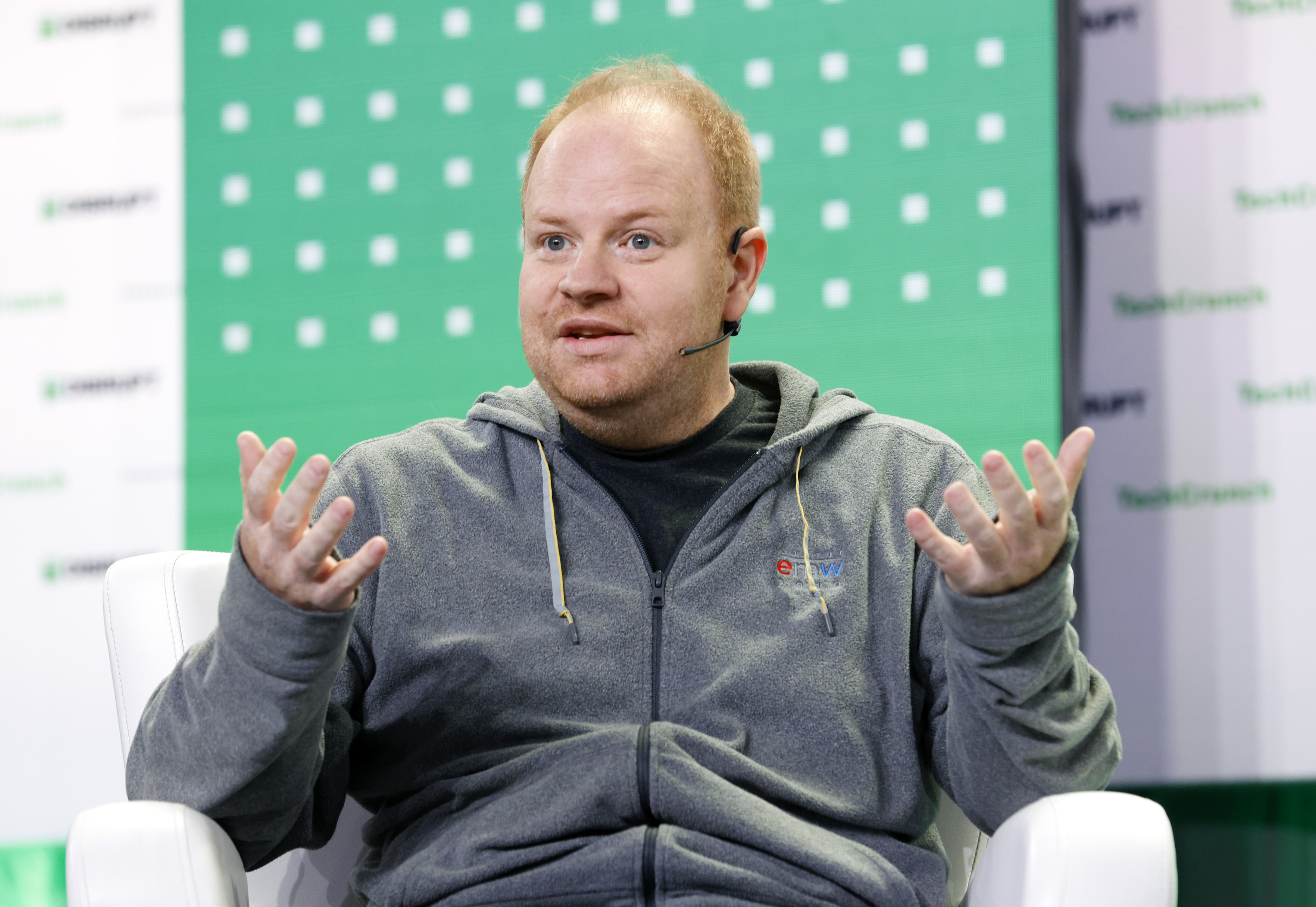
Parker Conrad runs payroll for 5,000 people every month. This isn't a metaphor for leadership. The CEO of Rippling - a company valued at $16.8 billion - literally opens the software, reviews the numbers, and clicks submit. Why? Because the last time he trusted other people to handle compliance, it cost him everything.
At 17, Conrad placed third nationally studying sea snail brains. At 34, he built the fastest-growing startup in America. At 36, he was forced to resign in disgrace. Now 46, he's worth $2.3 billion and openly admits his second act was "born out of a revenge fantasy." The trajectory is less inspiring founder story, more psychological case study in what drives someone to prove the world catastrophically wrong.
The Sea Snail Whisperer
Before Parker Conrad was debating compound startups on venture capital podcasts, he was spending two years dissecting the neurobiology of aplysia - the sea snail. Not as a college research assistant earning beer money. As a high schooler at The Collegiate School on Manhattan's Upper West Side, methodically investigating brain cells in a creature most people consider aquarium decoration.
The research won him third place and $20,000 in the Westinghouse Science Talent Search. But here's what's strange: when asked years later what fascinated him about sea snail neurons, Conrad deflected to talk about fundraising markets and hiring. The kid who spent 700 days examining gastropod synapses couldn't - or wouldn't - explain why.
That same year, Conrad was understudying Colin Craven in the Broadway production of The Secret Garden. Sea snails by day, musical theater by night. The teenage Conrad contained multitudes, none of which suggested "future HR software magnate."
The Zenefits Disaster
By 2014, Parker Conrad was the golden boy of Y Combinator. Zenefits - the HR platform he started with $20,000 in savings and a cancer diagnosis that made him obsessed with health insurance - was the fastest-growing startup in America. From incorporation to $4.5 billion valuation in under three years. Andreessen Horowitz wrote checks. Tech journalists wrote hagiographies.
The company sold health insurance through beautiful software. There was one problem: in several states, the people selling that insurance weren't licensed to do so. Whoops.
Conrad resigned on February 8, 2016. The narrative hardened immediately: ambitious founder prioritizes growth over compliance, gets what he deserves. He agreed to pay fines without admitting guilt. Then he disappeared.
Not for long.
The Stealth Comeback
Two months after resigning from Zenefits, Conrad and CTO Prasanna Sankar incorporated Rippling. They worked in Conrad's San Francisco home for two years. No office. No announcement. Just two guys who'd been publicly humiliated building software that would, in Conrad's words, make "the thing that destroyed me" - compliance, onboarding, systems integration - completely automatic.
Rippling launched publicly in 2018. By 2021, it was worth $6.5 billion. More than Zenefits at its peak. Conrad owned roughly 14%. The revenge fantasy was working.
The Compound Startup Heresy
Silicon Valley's most repeated advice: focus. Do one thing exceptionally well. Don't build multiple products until you've dominated one category. Parker Conrad thinks this is garbage.
He calls his approach the "compound startup" - building multiple products in parallel that share infrastructure. Rippling does HR, payroll, benefits, IT management, device management, and spend management. All in one system. All at once.
The conventional wisdom says this spreads resources too thin, confuses customers, and fails at everything. Conrad says the conventional wisdom is why most business software feels like it was designed by people who've never used business software.
His logic: if you're a company with 500 employees, you don't want a "best-in-class" payroll tool that doesn't talk to your "best-in-class" benefits administrator that doesn't integrate with your "best-in-class" device manager. You want one system that does all of it without requiring your IT person to become an integration engineer.
More heretically: he thinks building multiple products makes each individual product better, not worse. Shared data models. Amortized R&D costs. Sales efficiency. "The notion of focus, focus, focus is overrated," he's said on multiple podcasts, fully aware this makes venture capitalists itch.
The Compound Philosophy
Conrad's argument isn't just "build more stuff." It's that the boundaries between business software categories are artificial. Employee data doesn't exist in HR-land versus IT-land versus Finance-land. It exists in one place. Software should reflect that reality, not the org chart of the vendor selling it.
Rippling's infrastructure treats employee identity as the foundational layer. Everything else - which apps they access, which benefits they elect, which devices they use, how much they're paid - builds on top. One graph, many applications.
The Personality of Impatience
When asked to describe his governing personality trait, Conrad said "impatience" without hesitation. Not ambition. Not resilience. Impatience.
He wants to get into the nitty-gritty details and expects other employees to do the same. He runs his own company's payroll not as a cute branding exercise but because he believes if he doesn't understand the admin experience, he can't build good software. He describes himself as unchanged over the past decade - same drives, same frustrations, same intolerance for slow progress.
This isn't a person who learned patience through adversity. This is someone who weaponized impatience into a business model. Fast execution. Parallel product development. Revenue growing 78% year-over-year at scale. The entire compound startup thesis is impatience formalized: why build one thing slowly when you can build five things quickly?
Career Arc
The AI That Replaces You (Including You)
In March 2026, Conrad announced Rippling AI - an analyst that answers questions about your company's employee data in natural language. "How many engineers did we hire last quarter in the Denver office?" The AI answers. "What's our average time-to-fill for sales roles?" The AI answers.
Conrad called it "the most successful launch we've ever done." He also noted, with characteristic bluntness, that he uses it constantly. The CEO automating his own job using software his company built to automate everyone else's job. It's recursive efficiency or existential absurdity, depending on your tolerance for late capitalism.
The AI launch coincided with Rippling's revenue growth accelerating for three straight quarters. 78% year-over-year at over $1 billion ARR. The compound startup is compounding.
Things Parker Conrad Has Been
- Sea snail neurobiologist (age 15-17)
- Broadway understudy (The Secret Garden)
- Harvard Crimson Managing Editor
- Amgen product manager
- Fintech founder (SigFig/Wikinvest)
- Testicular cancer patient
- Y Combinator participant (2012)
- Fastest-growing startup CEO (Zenefits, 2014)
- Disgraced CEO (2016)
- Stealth mode founder (2016-2018)
- Compound startup evangelist
- Billionaire (#1623 on Forbes list)
- His own company's payroll administrator
The Personal Details
Conrad was born in 1980 in New York City. His mother, Ellen Rouse Conrad, founded an environmental nonprofit. His father, Winthrop B. Conrad Jr., was a senior partner at Davis Polk & Wardwell, one of Manhattan's white-shoe law firms. He grew up on the Upper West Side, attended The Collegiate School, went to camp.
At that camp, he met Alexandra MacRae. They were middle schoolers. They lost touch. Reconnected in college. Married in June 2011. They live in San Francisco's Mission District with their family. It's the kind of origin story that reads like fiction if you're cynical about how the world works: prep school kid marries childhood sweetheart, gets into Harvard, becomes billionaire.
Except for the part where he studied sea snails for two years. And the cancer. And the public disgrace. And the revenge fantasy. Those parts complicate the narrative.
What Makes This Interesting
Conrad hasn't changed his personality in ten years, by his own admission. Same impatience. Same detail obsession. Same contrarianism. What changed was the market's willingness to fund his impatience and the infrastructure he built to channel it.
Rippling works because Conrad is pathologically unable to accept that "best-in-class point solutions" are actually best. He can't tolerate integration tax. He won't build narrow. And he's raised $1.85 billion from people betting that his psychological makeup - impatient, detail-oriented, vindictive - is exactly what enterprise software needs.
The sea snails make sense in retrospect. You don't spend two years studying gastropod neurons if you're easily bored. You don't come back from public failure to build something bigger if you process rejection normally. You don't argue that focus is overrated on venture capital podcasts unless you're wired to prove people wrong.
Where This Goes
Rippling is now growing faster than it was a year ago despite being at scale. The AI product Conrad demoed in March is reportedly changing how customers use the platform. The company has 7,131 employees and is still hiring. Conrad owns roughly 14% of $16.8 billion, which compounds nicely.
The revenge fantasy appears complete. Zenefits peaked at $4.5 billion. Rippling is at $16.8 billion and accelerating. The thing Conrad built after losing everything is worth nearly four times the thing he lost. Silicon Valley loves a comeback story, but this one's unusual because the protagonist openly describes it as motivated by spite.
What happens when the revenge is achieved? Does the impatience find new targets? Does the compound startup philosophy vindicate itself at $50 billion, or collapse under its own complexity? Does Conrad ever explain why he spent two years studying sea snails?
Probably not that last one. He's too busy running payroll.