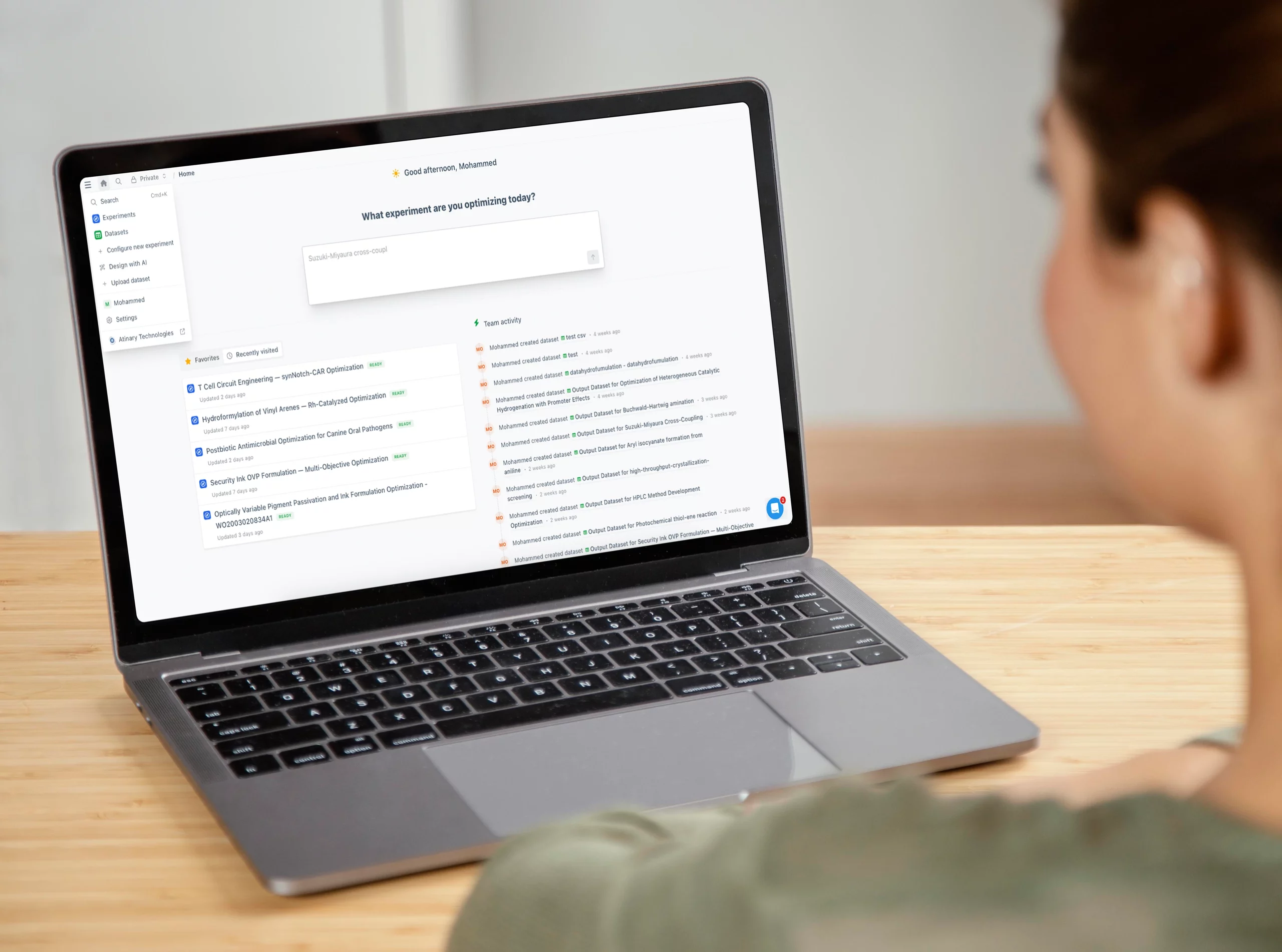
It is 3 a.m. The lab is awake.
A robotic arm pivots above a tray of micro-vials. A pipette descends. A spectrometer reads. A model in the cloud frowns - figuratively - and decides what to try next.
No one is in the room. No one needs to be. Somewhere in Lausanne, an Atinary engineer is asleep. Somewhere in Menlo Park, a chemist is watching the dashboard with one eye while she eats a sandwich. The lab keeps working. The lab has plans.
This is what Atinary's customers paid for: not a tool, but a teammate that does not sleep, second-guess, or ask for vacation. The closed loop hums on. By breakfast, there will be results.
What Atinary actually does
Atinary Technologies is a deeptech startup that builds SDLabs - a cloud-based, no-code platform for designing, running, and optimizing scientific experiments with machine learning. Plug in your robots. Hand it your objectives. Walk away. SDLabs picks the next experiment, the one after that, and the one after that, learning as it goes.
The category has a name: Self-Driving Labs®. Atinary owns the trademark. It also owns much of the foundational pitch - Co-Founder Hermann Tribukait helped coin the term back in 2016 when he led the Innovation Challenge on Clean Energy Materials under the Mission Innovation initiative. Loïc Roch, his Co-Founder and CTO, was in the room. Three years later, the company existed.
A laboratory that thinks for itself
Most R&D still looks like the 1950s in a lab coat: a scientist designs an experiment, runs it, reads it, adjusts, repeats. Slow. Expensive. And, statistically, mostly wrong on the first pass. SDLabs replaces the human in that loop with an optimizer - and then puts the human back in charge of the goals.
The closed-loop, in five steps
Behind the dashboard sit a small zoo of proprietary optimizers - Falcon, Gryffin, Chimera, and the Emmental-class algorithms - all designed to handle multi-objective, multi-fidelity problems. Translation: SDLabs can balance yield, cost, and carbon footprint at the same time, while juggling cheap simulations and expensive lab runs. It is Bayesian optimization with a real-world conscience.
What you can actually do with it
SDLabs Platform
A no-code, cloud-based AI platform for experiment planning, optimization and analytics. Onboards in about two hours. Integrates with existing lab software.
Self-Driving Labs®
Closed-loop ecosystems orchestrating Chemspeed platforms, ABB robotics and collaborative cobots. AI plans, hardware executes, data returns.
Atinary Lab
An AI-driven Self-Driving Data Factory producing high-quality data and molecules for partners in drug discovery, catalysis and materials science.
Optimizer Suite
Falcon, Gryffin, Chimera and Emmental-class algorithms for Bayesian, multi-objective and multi-fidelity optimization. The math that picks the next experiment.
Two scientists, one trademark
Hermann Tribukait, CEO, is a physicist by training and a policy-mover by temperament - he was one of the architects of Mission Innovation IC6, the global clean-energy gathering that seeded the company's intellectual core. He runs the business out of Menlo Park.
Loïc Roch, CTO, is the algorithms half. He builds the optimizers and oversees the platform. He works out of Lausanne, where the company was incorporated as Atinary Technologies Sàrl in 2019 before adding its US arm.
Between them: a remote-first team of about 31 chemists, machine-learning researchers, and software engineers working across continents.
Money, milestones, and a $5M seed
Who Atinary plays with
Self-driving labs need three things: a brain, a body, and a building. Atinary brings the brain. Its partners bring the rest.
Five small things that say a lot
They own the category name
Self-Driving Labs® is a registered trademark. Atinary did not just enter the market - it labeled the shelf.
Python, TypeScript, Langchain, AWS
The underlying tech is a modern AI startup's stack with deeptech ambitions bolted on top. MLflow, AlloyDB, Batch processing - the usual suspects.
Two hours, no code
Atinary says SDLabs can be deployed in under two hours with no coding required. Most enterprise software dreams of those numbers.
Born at a policy summit
The company's intellectual seed was a global clean-energy event, not a garage. Different origin myth, same outcome.
Two zip codes, one mission
Lausanne handles the science. Menlo Park handles the customers. The team handles the time zones.
Green by design
The optimizer can target carbon footprint as a co-equal objective with yield. That is climate tech wearing a chemist's lab coat.
See it in motion
Atinary maintains a YouTube channel with webinars, partnership demos and walkthroughs of SDLabs in operation.
Where to find them
It is 7 a.m. The lab is still awake.
The chemist comes back in. The robotic arm has stopped. The dashboard is green. Forty-three experiments have run overnight - more than she would have managed in a fortnight - and the optimizer has narrowed the next direction down to three candidates.
She picks the one she finds most interesting and reframes the objective. The optimizer recalibrates. The arm pivots. The pipette descends. Three a.m. tonight will look a lot like three a.m. last night, except the model will know more, and the result will arrive faster.
That is what Atinary built: not a faster way to do the old job, but a different shape of the job. The scientist defines the question. The lab handles the search. Somewhere in Lausanne, an engineer is also waking up. Somewhere in Menlo Park, a sandwich is being eaten. The loop hums on.