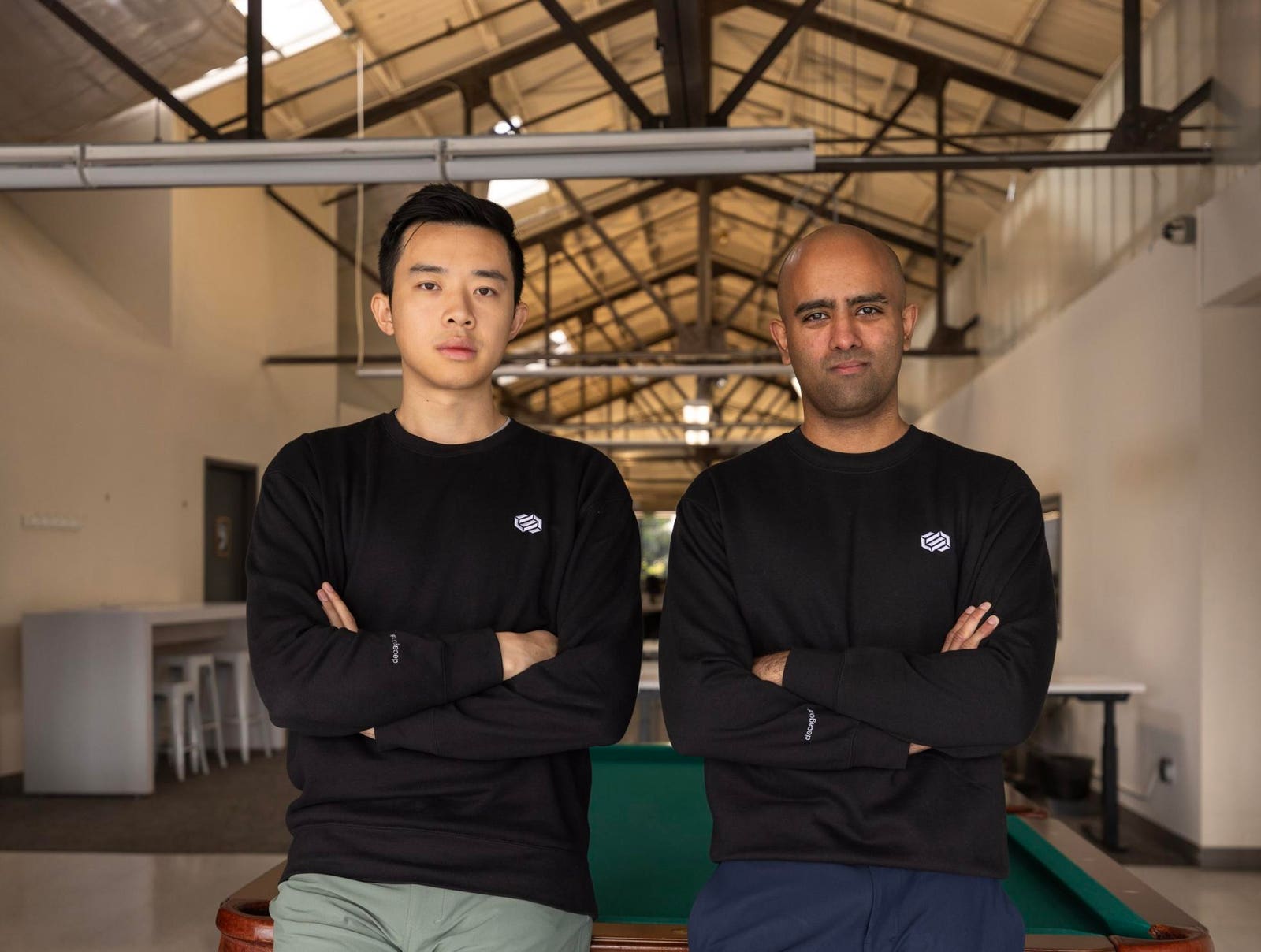
For a while, Decagon could fit inside two apartments. Ashwin Sreenivas and Jesse Zhang took calls from separate rooms, one in a living room and the other in a bedroom. The arrangement, Sreenivas later recalled, made their young company seem a little bigger than it was. It is an endearing bit of startup theater. It also captures the gap between the size of the team and the size of the problem they were trying to solve: how a large company speaks to its customers when those customers need something more useful than a canned reply.
By the time Decagon hired its first employee, the founders say they had reached $1 million in annual recurring revenue. The sequence sounds backward if one imagines a startup as a hiring chart. For Sreenivas, the early company was a conversation machine. He and Zhang spoke with more than 100 leaders in operations, sales and customer support. They carried ideas into those meetings, but they were willing to change them. What mattered was whether buyers described the same problem, had already tried to solve it and would commit money to a better answer.
The clearest response came from customer support. In one interview, Sreenivas remembered buyers saying they would sign annual contracts worth around $150,000 if the founders could get the product working. Other ideas drew polite interest and delayed budgets. Support drew a more urgent kind of sentence. A buyer's willingness to pay is not poetry, although to a founder after a long series of exploratory calls it may sound rather like it.
Early milestones as described by Sreenivas in founder interviews.
The years before the question
Sreenivas has described a childhood in India organized around study. He recalled waking at 5 a.m. and working through history, geography, physics, chemistry and mathematics until 8:30 at night, from fourth grade through twelfth. He mentioned Olympiads and the National Talent Search Exam. In a later conversation about the pace of Decagon, he looked back on that routine with a peculiar kind of relief: the present work involves people, and he finds it fun. The remark offers a glimpse of a founder whose idea of a demanding day was formed well before a venture investor ever entered the room.
At Stanford, he earned bachelor's and master's degrees in computer science. His public profile lists academic honors including the Frederick Terman Engineering Scholastic Award, Phi Beta Kappa and Tau Beta Pi. A stint at Palantir followed. Then, with friends from his undergraduate years, he started Helia around 2018 or early 2019. Helia used computer vision to turn video into structured information that businesses could use, including for enterprise security. Scale AI acquired it at the end of 2020.
The technical connection between Helia and Decagon is clear in Sreenivas's telling. In one case, better vision models could make sense of video. In the other, more capable language models could take on complicated customer interactions. The business lesson was more personal. He has said that first-time founders, including his earlier self, can overthink the three-year plan. The hard work feels substantial while the market has yet to vote. His prescription for a second company was shorter: “Go to your customers and ask them.”
A crowded market with an empty space
Customer support was not an obscure corner waiting for someone to notice it. Chatbots had been around for years. Sreenivas knew the familiar ritual of typing “agent, agent, agent” to get past one. But a chatbot that answers common questions and a system trusted with the policies, accounts and internal tools of a large enterprise are different propositions. The founders heard from buyers who had examined existing products and still could not use them for their most complex needs.
That distinction gave Decagon its opening. Sreenivas described large consumer-facing companies with millions of customers, intricate rules and systems built at different times. A useful agent had to do more than repeat information. It needed to understand context, take action and behave reliably enough that a company would let it represent the brand. The founders did not have to invent the buyer's complaints. They asked which alternatives had been rejected and why. Customers supplied the list of failures; the founders still had to design a solution.
The partnership between Sreenivas and Zhang helped. Both had founded and sold earlier companies; Zhang's Lowkey had been acquired by Niantic. In an interview, Sreenivas said they shared an interest in enterprise businesses and in learning directly from customers. He also described a practical form of trust: when the company moves quickly, one founder must be able to hand an important problem to the other and let it go. Their wives get along, he said, and the two families came to live in the same building. It is a domestic footnote to an industrially paced venture.
“We gave for speed.”Ashwin Sreenivas on accepting less coordination as Decagon grew
The first product was built for the demands of those large buyers. In 2024, Decagon's Series A announcement listed Eventbrite, Bilt, Webflow, Substack and Rippling among its customers. The company had to show that its agents could handle actual support jobs, not merely give an impressive demonstration. Sreenivas has described pushing aside questions about a distant moat in favor of shipping what a customer would use now. A grand theory of defensibility is comforting. An enterprise buyer waiting for an integration is less patient.
From the first million to a different job
Growth changed the daily scale. Decagon announced a $250 million Series D in January 2026 at a $4.5 billion company valuation, after more than 100 new global enterprise customers joined during the previous fiscal year. Those are company figures, not a measure of Sreenivas's personal wealth. They do, however, mark the distance from those apartment calls. In a LinkedIn post after the round, he wrote about taking the staff to Hawaii and seeing nearly 300 people together from San Francisco, New York and London. The two-room illusion had become a real organization.
His title changed with the company. Decagon's early announcement named him co-founder and CTO; the company now lists him as co-founder and president. The shift is visible in what he discusses publicly. Technical architecture still appears in his writing, including an April 2026 essay explaining why Decagon built its Duet tool on its own Agent Operating Procedures. But he also writes about deployment, brand voice, regional teams and the problem of making an AI interaction feel useful to a person who has never heard the phrase “agent operating procedure.”
The company has moved into voice, chat, email and SMS. That breadth creates a tension Sreenivas returns to: an agent must scale without sounding indifferent. In September 2026 he wrote about Decagon's expansion in Belgium, the Netherlands and Luxembourg, and about its work with Rituals. The brand's agent, called Ray, had expanded across 19 countries and 15 languages in two months. Sreenivas's point was that a correct answer alone is insufficient. Tone, reliability and adaptation to each market matter when the software is speaking for a company.
The person at the other end
Decagon describes its ambition as giving customers an experience that feels like a personal concierge. This is an enormous promise for a technology often judged by whether it can end a support call quickly. It is also an unusually human standard to impose on software. The customer may be trying to change a booking, understand a charge or solve a problem that has already consumed too much of the afternoon. The interaction is one of thousands for the company; for that customer, it is the only one happening.
Sreenivas's public comments suggest that he understands the distance between a product demo and that moment. He talks about what buyers refused to purchase, what integrations they needed, what they were prepared to pay and what happened after deployment. His education gave him a command of the models. His first company gave him a lesson about the seductions of strategy. His second has given him a much larger arena in which to test a plain question: will this work for the person who has to use it?
The apartment story stays useful because it is so small. Two founders moved between rooms and tried to appear bigger. Yet the work that mattered was done in conversation, in finding a problem that recurred across calls and a buyer willing to act. By 2026, Decagon was opening local teams abroad and managing agents across languages. The scale has changed almost beyond recognition. The question that started the company has not lost its force. Ask the customer again. Then listen closely enough to let the answer change the plan.