An engineer looking at a problem usually wants to take it apart. Ashish Masih has spent much of his career in a business where the pieces include a bank’s balance sheet, a prediction about repayment and a conversation with someone who would probably prefer to be doing something else. Getting those pieces to fit is the work. The spreadsheet, regrettably, cannot conduct the conversation.
Masih is president and chief executive of Encore Capital Group, the San Diego company whose businesses buy and collect unpaid consumer debt. He joined in 2009 and became CEO in June 2017. His route there ran through mechanical engineering, manufacturing systems, business school, consulting and credit cards. It is an unusually useful education for a job that involves understanding systems without forgetting that people live inside them.
The interesting question in his career is how those two habits coexist. Masih talks about disciplined capital allocation and consumer treatment in the same working vocabulary. The business gives him reason to do so: money spent buying a portfolio today depends on what happens in thousands of individual accounts over time. A purchase decision and a repayment conversation belong to the same chain of consequences.
A mechanical engineer enters the credit business
Before the earnings calls came a bachelor’s degree in mechanical engineering from the Indian Institute of Technology Delhi. Masih went on to Lehigh University for a master’s in manufacturing systems engineering, then earned an MBA at Wharton. His LinkedIn education dates place the Wharton years in 1994-1996. Finance arrived after two engineering degrees, giving his professional biography a change of direction before its better-known corporate chapters.
His subsequent employers included KPMG Consulting and McKinsey & Company. By the time he reached Capital One, he was working inside the machinery of consumer credit. His responsibilities there included collections and a business-unit position combining finance leadership with analytics. He had experience on the lender’s side of the transaction before moving to a company that takes responsibility for accounts lenders have sold.
That sequence makes his later responsibilities easier to understand. Consulting involves separating a large question into manageable decisions. Credit operations add the inconvenience of having to carry out the answer, repeatedly, with actual customers. At Encore, both experiences would be relevant. An attractive model has to survive staffing, technology, documentation and the daily work of collecting payments.
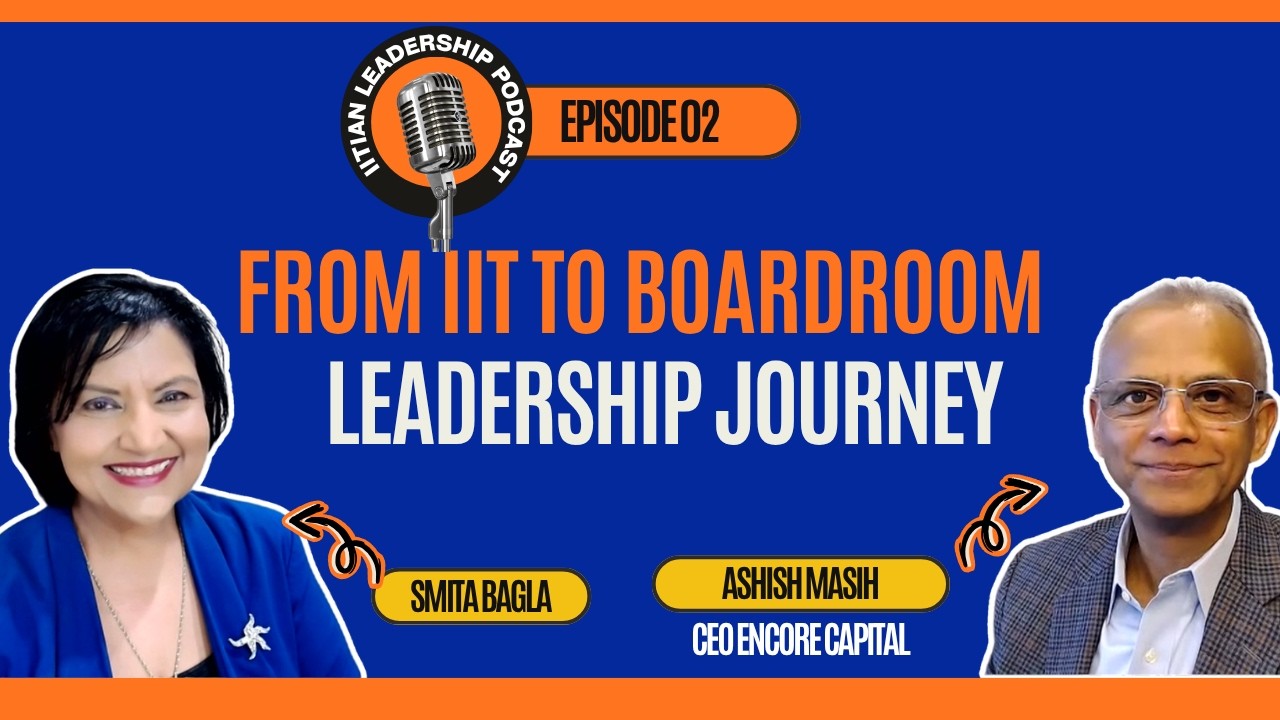
In a leadership conversation with IIT alumna Smita Bagla, the advice associated with Masih’s approach is straightforward: break a complex problem into parts and let evidence shape the decision. The conversation also treats a career as something less orderly than a succession of impressive titles. His own education and changes of employer provide a useful illustration. The route to his present job crossed disciplines as well as organizations.
Eight years learning the machinery
Masih did not arrive at Encore with the CEO title attached. After joining in 2009, he worked in corporate development and operations, later becoming president of Midland Credit Management, the group’s principal U.S. business. By his selection for the top job, his responsibilities covered internal call centers, decision science, analytics, legal collections, marketing and domestic operations.
He also oversaw Encore’s asset reconstruction business in India. The collection of responsibilities is revealing. It put him close to decisions about which accounts to buy, how to understand them and how to work them. A leader with that remit encounters the places where an elegant strategy acquires a queue, a deadline or a difficult implementation.
The succession was announced in May 2017. Ken Vecchione was leaving to become president of Western Alliance Bancorporation; Masih would take over following Encore’s June annual meeting and join its board. The announcement emphasized an established succession plan. His predecessor pointed to Masih’s knowledge of the business, while the chairman singled out operations, strategy, regulatory affairs and technology.
It was a promotion grounded in familiarity with the company’s working parts. That matters in debt purchasing, where the consequences of a decision can unfold well beyond the quarter in which it was made. The CEO has to understand both the portfolio being bought and the organization expected to collect it. Masih had spent eight years getting acquainted with that organization.
The person on the other end of the account
Masih’s public explanation of Encore begins with credit’s role in the economy. Banks extend loans; some accounts go unpaid; specialist businesses purchase receivables and work toward resolution. In that account of the system, Encore occupies a particular place after the original lending decision. Its ability to operate depends on the details of what happens next.
Under his leadership, Encore refreshed its mission, vision and values. Employees from different countries and levels of the business helped shape the values. Their language includes care, improvement, inclusion and collaboration. These are pleasant words, and pleasant words are inexpensive. For a collection business, the consequential question is what they change in a consumer interaction.
One attempt to answer it has been to ask consumers more systematically. Encore introduced customer feedback in its U.S. business and expanded digital tools including chat. Its Economic Freedom Study adds a broader view of how people think about their obligations. The 2022 edition, conducted by Morning Consult, surveyed 3,000 people across the United States and United Kingdom.
Among respondents with past-due debt, more time to pay emerged as a practical request: 82% in the U.S. and 84% in the U.K. said it would help. That finding gives an otherwise abstract discussion of consumer preferences a concrete shape. A payment schedule has to fit into time, and time is one of the things a household budget cannot manufacture on demand.
More time to pay
The responsibility also has a harder edge. In October 2020, during Masih’s tenure, Encore settled a CFPB lawsuit concerning its compliance with an earlier consent order. The settlement included a $15 million payment. Encore maintained that it had acted in accordance with relevant laws and said the underlying issues had already been corrected. The episode belongs alongside its statements about consumer treatment: the standards are subject to scrutiny beyond the company’s own assessment.
Growth arrives with an asterisk
The financial record under Masih includes both expansion and setbacks. In 2024, global portfolio purchases reached roughly $1.35 billion and collections reached $2.16 billion. Yet Encore recorded a net loss of about $139 million. Restructuring, revised recovery expectations and a goodwill impairment at its European Cabot business weighed on the result. Growing collections did not spare the company an uncomfortable earnings announcement.
Masih explained the year in terms of different conditions across markets. The U.S. business had substantial portfolio supply available, while Cabot faced competition and slower lending growth. Encore exited the Spanish secured non-performing loan market and the Italian non-performing loan market. Managing a multinational business included deciding where to stop committing resources.
The following year brought a return to profit. Encore’s 2025 net income was approximately $257 million, with global collections of $2.59 billion. Those figures make the preceding loss harder to wave away and the recovery more meaningful to examine. A profile built only around rising purchases would miss the work of revising assumptions and dealing with an operation that needed repair.
Encore Capital Group · GAAP net income / loss, rounded. Company performance during Masih’s tenure.
By the second quarter of 2026, Encore reported $737 million in global collections and $444 million in portfolio purchases. Masih credited purchasing, execution, digital capabilities and operational improvements. The figures describe a business operating at scale; his explanation brings it back to several connected tasks. Buy carefully. Fund the purchase. Improve the operation. Keep checking what the accounts actually produce.
A larger room, and a longer horizon
Masih’s responsibilities have also taken him outside Encore. He served on the Receivables Management Association board from 2013 to 2015, including its federal legislative and regulatory committee. In 2019 he was appointed to the U.S.-India CEO Forum, and in 2022 he was reappointed. The forum connects business leaders with discussions about commercial relations between the two countries.
He later joined the U.S.-India Business Council board and serves as a trustee of the Committee for Economic Development. These roles extend a career already spanning Indian engineering education and American finance into business policy. They are institutional connections with defined purposes, rather than evidence of a private network or personal friendship.
His involvement with Junior Achievement adds another time horizon. Masih joined its Worldwide Global Council in 2025. Encore has supported Junior Achievement programs, and his public comments emphasize giving young people practical knowledge about money, entrepreneurship and work. A business involved late in the life of a credit account is supporting education intended to begin much earlier.
“I’m inspired every day by the work they do.”
Ashish Masih, speaking about Encore colleagues in 2022
When he received a San Diego Business Journal CEO of the Year award in 2022, Masih described the legacy he wanted in terms of an organization: one that helps consumers, makes room for colleagues to collaborate and delivers business results. It is an ambition that leaves him several constituencies to satisfy. They do not all read the same scorecard.
That is what gives the engineering thread in his career its interest. A collection company can count purchases, payments and profits with precision. Understanding how they fit together requires decisions about time, incentives, conduct and people. Masih’s career has brought him progressively closer to responsibility for the whole arrangement. The next problem is unlikely to arrive neatly separated into parts.