A bank with four contact-center systems and 13 customer databases sounds less like an institution than a family argument conducted through software. More than 5,000 agents had to work across that arrangement. When Ashish Koul described the bank’s predicament in 2020, the proposed first step was wonderfully unglamorous: give its people one desktop.
That detail is a useful introduction to Koul, Acqueon’s founder and former CEO. His business concerned the machinery behind a familiar interruption: a company trying to reach you. A call, a message, an email. Somewhere behind it, systems had to agree about who you were, what had already happened and whether this was a sensible moment to get in touch.
Acqueon supplied a way to coordinate those decisions. Koul led it through independence, a growth investment and an acquisition by Five9. Yet the bank story captures the work more clearly than a procession of transactions. Before a business can have a coherent conversation with a customer, it helps if its own computers are on speaking terms.
The initial deployment brought disparate customer systems into one interface.
A career spent inside the machinery
Koul arrived at this problem through enterprise technology. Before Servion, he held leadership positions at NTT DATA and Genpact, working across communications, banking, financial services and technology businesses. Those are environments in which a new application must coexist with a great many old decisions. Buying software is comparatively straightforward. Getting an organization to use it coherently is where the plot thickens.
In April 2015, Servion named him senior vice president and general manager of its Product Engineering and Digital Services business. The remit covered global sales, marketing, operations and go-to-market strategy. Based in San Francisco, he reported to managing director and CEO K. Balakrishnan. He had studied at BITS Pilani, with a specialization in management and information systems.
At Genpact, he had been vice president and global practice leader for IT offerings serving the high-tech industry. The Servion appointment put him in charge of a business rather than a single technical function. It is an important distinction in understanding his subsequent career: Koul’s responsibility was to connect the product, its customers and the organization selling and delivering it.
The founder story has a prehistory
Acqueon was already operating before Koul became its CEO. In 2017, as president, he was discussing its participation in Cisco’s SolutionsPlus program, which simplified ordering and pricing for partners. The announcement described a relationship with Cisco extending back a decade. Long before the later acquisition, partnerships were part of the company’s commercial plumbing.
A 2018 product launch makes that practical character visible. Acqueon introduced Lynx, Insights, Command Center and Admin Console. Lynx connected customer-management software such as Salesforce, Microsoft Dynamics and ServiceNow to contact-center tools. Insights addressed operational data. The names were new; the underlying problem was familiar. People dealing with customers needed information that lived somewhere else.
In February 2019, Koul moved from president to CEO. By then, he had been with the business for nearly four years, helping expand its reach across 18 countries. His plans included product development and a larger partner network, with further growth in North America and Europe. The CEO announcement therefore marked a change of responsibility inside a business he already knew.
The founder designation belongs alongside that history. Acqueon’s independent-company chapter grew out of an existing operation: Everstone later described incubating it inside a technology-services business, and Koul recalled its beginnings as a spin-out. Calling him a founder makes sense within that chapter. The earlier presidency matters too. This was entrepreneurship with an installed base, existing relationships and a considerable amount of inherited machinery.
- 2015Joins Servion’s leadership
- 2019Becomes Acqueon CEO
- 2022Long Ridge invests
- 2024Five9 acquires Acqueon
The customer gets a vote
During Acqueon’s 2019 partnership with Vonage’s Nexmo platform, Koul argued that customers expected businesses to accommodate their preferences. His language was unusually direct for a field fond of lengthy product descriptions. It also supplies a test for the software. A company’s preferred schedule and a customer’s willingness to answer are separate things.
The proposed response combined information about the customer with decisions about timing and channel. Voice, messaging and email could serve different purposes. Predictive analytics could help select a campaign and decide when to act. In ordinary language, the ambition was to make a business remember enough about a person to stop behaving like a stranger at every encounter.
The unnamed bank provided a concrete example of that coordination. Its initial desktop deployment was followed by a move from premises-based contact-center systems to Amazon Connect. Acqueon could support that transition while connecting the existing customer applications. For Koul, the story illustrated the value of working across other vendors’ systems. An enterprise seldom has the luxury of beginning again with an empty shopping basket.
“Customers no longer tolerate interacting on businesses’ terms.”
Ashish Koul · 2019
Trust before the conversation
A system can choose a plausible time to call and still run into a very human obstacle: the recipient may not believe the caller. In 2020, Acqueon introduced an identity solution integrating technology from Journey. It enabled businesses to notify customers about forthcoming calls and gave customers a way to confirm the authenticity of messages or requests.
Koul called mutual verification a way to enable trusted communications. That phrase gives both parties a role. The business wants to know it has reached the intended person; the person wants to know the business is real. Better timing alone cannot settle that question. In this part of his work, customer engagement involved earning the right to begin the exchange.
There is a small absurdity at the center of the industry: immense technical effort can precede something as modest as a customer answering a telephone. Koul’s product decisions took that modest outcome seriously. Connecting information, coordinating channels and verifying identity all addressed conditions that have to be satisfied before the persuasive part of a conversation can even start.
Partners on both sides of the desk
In October 2022, Long Ridge Equity Partners made a majority growth investment in Acqueon. Everstone sold its majority position and retained a minority holding. At the time, Acqueon reported more than 200 enterprise customers and 110,000 agents using its platform. The announced uses of the investment included product innovation, partner expansion and further spending on people and client services.
The relationship added another participant to Koul’s work of coordination. Andrew Cedar represented Long Ridge in the investment announcement; Everstone’s Avnish Mehra described the company’s incubation and development. Koul’s stated priorities remained recognizable: innovation, customer service and partnerships. The investment changed ownership while financing work on the product and the organization around it.
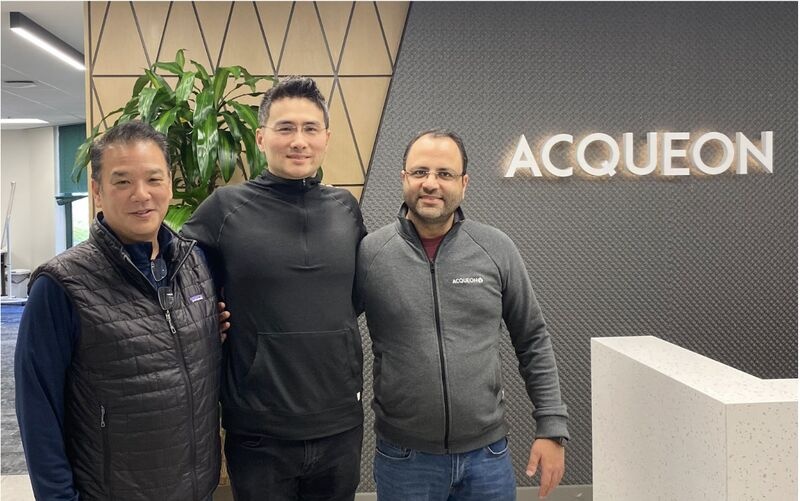
Another relationship became visible in 2024, when Acqueon and Cresta launched Acqueon Guidance powered by Cresta. The joint offering combined outbound campaigns with AI assistance for customer conversations. In a photograph from his Dallas visit, Cresta CEO Ping Wu stands with Koul and Acqueon product chief Matt Matsui beneath the company name. The reception area makes a pleasant change from an architecture diagram.
The partnership extended an existing interest in helping agents during an interaction. Koul emphasized timing, channel and message when explaining the collaboration. Those three choices connect the preparation for a conversation to what actually gets said. The technology’s commercial purpose remained explicit: help enterprises generate revenue, recover revenue and retain customers.
An acquisition with a two-year introduction
Five9 announced its agreement to acquire Acqueon on August 8, 2024. Koul said the businesses had already spent two years working together, including deep product integrations. The purchase therefore followed an operating relationship. Five9 wanted to extend its ability to coordinate customer interactions across activities including marketing, commerce, sales and service.
When Koul reflected on the agreement, he began with customers, then moved through partners, investors and employees. His description of the company’s purpose was particularly revealing: “bridge systems of engagement and systems of record.” The first handles the interaction; the second holds the accumulated information. His business occupied the space between them, helping information become an action someone could actually take.
Long Ridge announced the completed sale on September 9, 2024. That closed its investment and placed Acqueon inside Five9. For Koul, it was a new corporate setting for work he had pursued through several forms of ownership. The enduring problem was still the same: how to connect a company’s knowledge of its customer with a useful next conversation.
The next desk is an advisory one
Koul’s later work includes an advisory role at Long Ridge, whose Executive Council also lists him as a MessageGears board member. In March 2026, Invictus Growth Partners announced him among five new operating advisors joining its Guild. The program brings experienced operators into work with portfolio companies, carrying lessons from running businesses into the decisions other management teams face.
It is a fitting continuation of a career built around connections: between applications, between companies and between the people expected to make both work. The 13 databases in that bank remain a useful image to keep in mind. A customer has one relationship with a business. Making the business behave as though it knows that can occupy an entire career.