Company / Recruiting Software
Ashby.
The recruiting platform powering hiring at OpenAI, Shopify, Notion, Snowflake and roughly 2,700 other companies you've heard of.
Frame 01 - The unassuming SaaS company that quietly ate the ATS market.
The recruiting platform powering hiring at OpenAI, Shopify, Notion, Snowflake and roughly 2,700 other companies you've heard of.
Frame 01 - The unassuming SaaS company that quietly ate the ATS market.
Somewhere in a quiet corner of an office that does not advertise its address, a recruiter clicks through inbound applications for a research engineer role. The pile is large. The pile is, frankly, absurd. And yet the recruiter is calm, because the screen in front of them is not the bloated, color-coded purgatory most ATS users know. It is Ashby. It is fast. It surfaces the matches. It schedules the loops. It does the part that nobody actually likes doing, so the recruiter can do the part that matters - which is talking to a human being.
This is what Ashby has been quietly engineering for seven years. Not a louder ATS. Not a flashier one. A faster, denser, more useful one. The kind of software that wins because the people using it find it, use it, and refuse to give it up.
The legacy ATS was designed for HR teams in 2005, when a job application was a Word document and analytics meant a quarterly export to Excel. Modern hiring teams - the ones racing to staff a foundation model team, or to scale a fintech from twenty to two hundred - inherited that software and stapled five tools to it. A sourcing tool. A scheduling tool. A CRM. A BI tool. Maybe an interview platform. Each charged separately. Each spoke a different dialect of "candidate."
The result, predictably, was data that lived nowhere and decisions made on vibes. Recruiters spent their days copy-pasting between tabs. Hiring managers complained the dashboards lied. The candidates, who should have been the point, often heard nothing for weeks.
Benjamin Encz noticed this from the inside. As Director of Engineering at PlanGrid, he spent a startling fraction of his time on hiring, and a startling fraction of that fraction fighting the tooling. The frustration was specific enough to be productive. He met Abhik Pramanik at PlanGrid - an engineer with a resume that included Industrial Light & Magic and the Mayo Clinic - and the two of them, in the time-honored tradition of frustrated builders, decided to build the thing they wished existed.
Fig. A - Five tabs of pain, consolidated into one tab of slightly less pain. Progress.
Most YC-backed companies treat the eighteen months after seed funding like a sprint. Hire fast. Spend fast. Make noise. Encz and Pramanik did the opposite. They raised $3.5M and kept the team at three people for over a year. They reached $2M in annual recurring revenue with the same three. The story is a kind of folk legend in startup circles now, because it sounds restrained to the point of being eccentric, and because it worked.
The bet was not that hiring software was a great market. Everyone knew hiring software was a great market - Greenhouse, Lever, and Workday had made that obvious. The bet was that everyone had built the wrong shape of product. That if you bundled the stack instead of unbundling it, and if you treated analytics as a first-class citizen rather than a sad add-on, customers would notice.
They noticed.
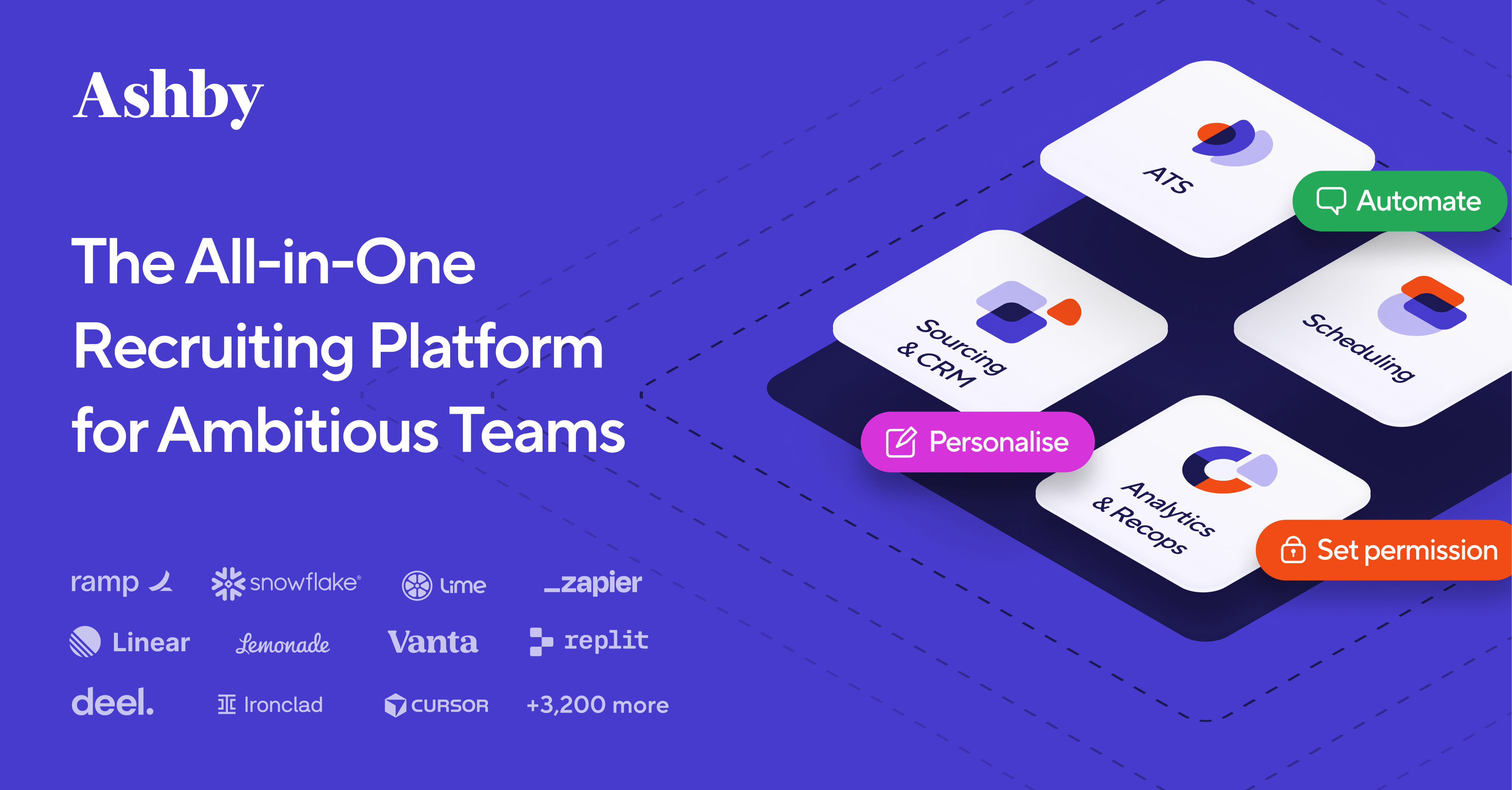
Ashby is technically an ATS, but the more accurate description is a recruiting operating system. The core handles applicant tracking - every interaction with every candidate, end to end. Around it sits the outbound sourcing tool, the interview scheduling automation, the CRM for nurturing talent over years rather than weeks, and a business intelligence layer built specifically for recruiting metrics. One login. One data model. One bill.
Over the past two years the AI layer has become the loudest part of the pitch, and unusually for a 2026 software company, the loudness is somewhat justified. AI inside Ashby reviews inbound applications and surfaces the best matches. It writes candidate summaries. It drafts outreach. Usage of these features grew 50% in a single year - and these are opt-in features, which is the rare AI growth chart you can actually trust.
Source: Series D announcement, July 2025. The chart that made the round close in 13 months.
You can describe a product for hours, or you can list its users. Ashby's user list is the rare one that makes the second option more efficient. The companies hiring through Ashby are the companies whose hiring you watch - frontier AI labs, vertical SaaS rockets, infrastructure heavyweights. They are not easy customers. They have opinions. They have engineering teams that grade software. They picked Ashby anyway.
Fig. B - A logo wall that a salesperson would politely fight you for.
Ashby's stated mission is to improve the productivity of working professionals with intelligent, powerful software. It is a deliberately unglamorous sentence. There is no manifesto about the future of work, no claim that the company is rewiring the human condition. There is a tool. The tool helps you do your job better. You use it. That is the entire arrangement.
This restraint is part of the product. Recruiters, hiring managers, and operations teams are tired of being marketed to. They want software that loads quickly, that doesn't lie in its dashboards, and that doesn't require a fourteen-week implementation. Ashby treats this as the actual job - not as the floor, but as the bar.
Hiring is the operation by which every company becomes the next version of itself. Get it wrong and you spend a decade undoing the damage. Get it right and you compound. The companies that compound fastest in 2026 - the AI labs, the developer-tools breakouts, the infrastructure platforms - are the ones using Ashby to do the picking. That is not a coincidence. It is a thesis being validated in real time.
The AI features will get sharper. The analytics will get richer. More of the busywork will quietly evaporate. Recruiters will spend less time as data-entry clerks and more time as the actual humans candidates remember. That is the boring, real, useful future Ashby is building toward.
Back at OpenAI, on that Tuesday, the recruiter closes the laptop. The shortlist is sent. Three interviews are on the calendar for Thursday. The candidates already have confirmation emails. The dashboard updates itself. Nobody had to fight a single tool. That is the difference. That is the whole company.