Asad Khan had a peculiar reason to feel encouraged: customers were opening support tickets. They wanted changes. They had questions. They were making a nuisance of themselves in the way people do when they expect something to work. To Khan, that expectation mattered. An indifferent customer could simply disappear. These people were still in the conversation.
His test for early demand began with curiosity. Would someone try the product, return to it, then ask for something better? The questions could be more revealing than a compliment. A compliment required no further commitment. A request for a fix came with an implied future: I would like to keep using this.
“The product can never be perfect,” he said. For the co-founder and CEO of TestMu AI, formerly LambdaTest, that observation carries a particular professional irony. His business helps other people check their software. His own education as a product founder involved listening carefully when users explained what still needed checking.
Before the cloud, the client
Khan’s working life has stayed close to software quality while the business around it has changed. He earned a degree in information technology at JSS Academy of Technical Education in Noida. At GlobalLogic, he worked as a lead engineer with financial-software customers. Banking software provided a practical setting for quality assurance: people expected transactions and systems to behave as promised.
He later co-founded 360logica, a testing-services business where he led business development. The role involved marketing, management, strategic planning and relationships with clients. A services company gets an unusually close view of other companies’ difficulties. Customers arrive with a product, a deadline and a collection of things that might go wrong. Someone has to turn that collection into a workable assignment.
360logica grew into a multi-million-dollar business. Saksoft acquired an initial 51 percent stake in the company in 2015, following an agreement signed at the end of December 2014. The management team continued running the operation. The transaction joined a testing specialist to a larger information-management business; for Khan, it also preceded another attempt at the same industry’s problems.
That continuity matters. His next venture would address work he already knew from the client side. The commercial question was whether a recurring difficulty could support a product that many teams used, rather than a separate engagement for each customer.
A Rolodex meets the browser
When Khan began working on LambdaTest in early 2017, he had a problem statement and an address book. Testing teams used different tools for different jobs, without an integrated platform to manage the whole undertaking. The ambition was broad. The initial product would be narrower: manual and automated cross-browser testing in the cloud.
To check the idea, he called contacts accumulated through his career. His instrument of discovery was a Rolodex, accompanied in his telling by a small confession: “yeah, I still have that thing”. The mechanism was old-fashioned; the task remains current. Ask people who do the work whether the proposed solution would actually help them.
Those conversations supplied ideas, and the team took roughly two to three months to settle the first feature set. There is something pleasingly unglamorous about that beginning. A company concerned with browsers and cloud infrastructure started with phone calls. Before there was a platform to put in front of customers, there were customers whose answers could change the platform.
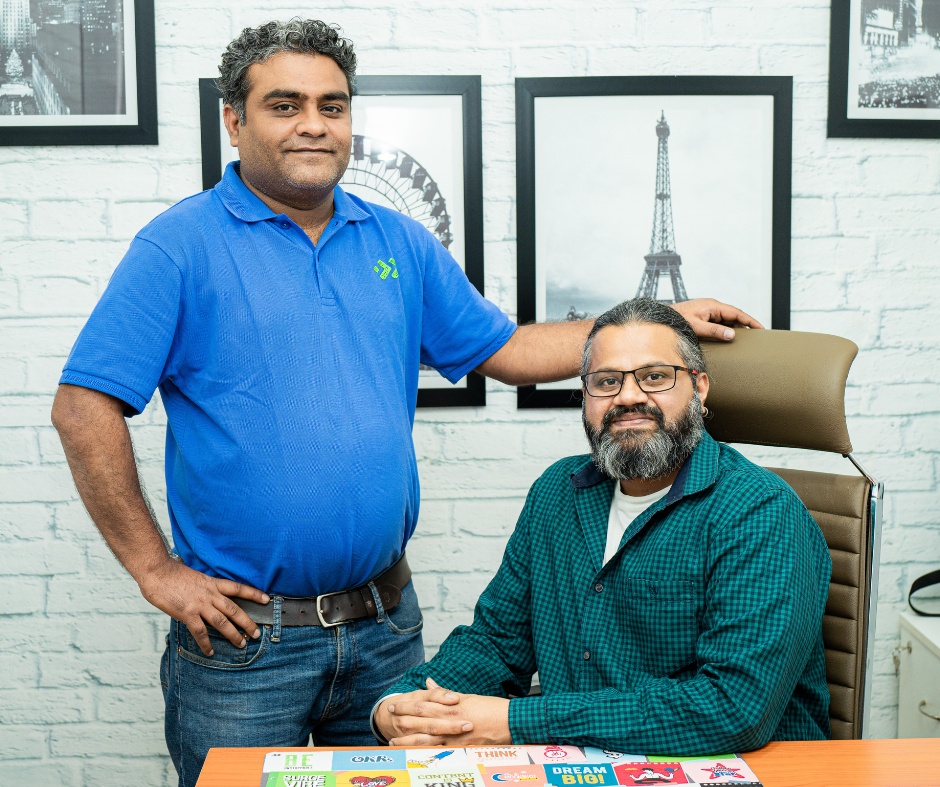
Khan and fellow founder Jay Singh were entering a market that already had competitors. They needed a useful opening, and an opening people could understand.
Saksoft takes a majority stake in 360logica.
Khan and Jay Singh found LambdaTest.
KaneAI launches; a $38m round follows.
The company becomes TestMu AI.
The work around the work
By 2022, the company’s ambitions extended into test execution and orchestration. HyperExecute addressed the machinery around running tests: coordinating the work rather than merely supplying somewhere for it to happen. For a testing business, that is a consequential expansion. A team can have plenty of tests and still spend too much time arranging their execution.
With backing from investors including Blume, the company combined adoption by individual practitioners with selling to larger organizations. A developer trying a tool and an enterprise buying infrastructure enter through different doors. Serving both calls for more than one sales conversation.
Hiring and rewarding employees formed another part of that expansion. That detail belongs beside the product history. A platform broadening its responsibilities also broadens what its staff must know. Engineering, customer understanding and commercial execution have to develop together; adding features does not automatically produce an organization capable of supporting them.
Seen this way, the move beyond browser testing was also a management problem. The product could promise to coordinate more work only if the company learned to coordinate more of its own.
A founder learns to make room
Khan has been candid about how much he needed to learn. Moving from services into a product company required him to revise his approach. He began taking a direct role in understanding customer use cases, bringing his knowledge of the testing business to decisions about what to build.
He also described outbound sales efforts that failed three times before a fourth attempt worked. Experience selling services had encouraged assumptions that did not transfer neatly to selling a product. Hiring, preparation and targeting needed attention. An earlier success had given him experience, along with a few habits worth questioning.
Over time, he handed more responsibility to colleagues so he could think further ahead. Freedom came with accountability and continuing scrutiny: “I’ll never stop asking questions.” It is an unusually serviceable description of a CEO’s balancing act. A team needs room to decide; a founder needs enough distance to consider where those decisions lead.
He credited customers and colleagues with changing his approach. In that account, the company’s growth involved a second kind of development: the founder becoming capable of leading a business different from the one he already knew.
“I’ll never stop asking questions.”
Asad Khan
Now the test can start with a sentence
KaneAI, launched in 2024, brought the company further into AI-assisted testing. Its proposition was to let teams create and evolve tests through natural language, with editing available in both language and code. Khan argued that this could reduce the expertise needed to begin automating tests and allow more people to participate in creating them.
The appeal follows from a familiar maintenance problem. Tests need attention as applications change. A tool intended to save time can acquire its own workload. The promise of language-based authoring is that people can spend more of their effort describing the behavior they want checked.
December 2024 brought a $38 million funding round led by Avataar Venture Partners, with Qualcomm Ventures participating. The company said it would put the capital toward KaneAI, its test cloud and HyperExecute. Financing gave that product direction more resources. It also raised the practical stakes of delivering something useful to teams already managing release schedules.
Qualcomm Ventures included LambdaTest among its infrastructure investments in its review of 2024. The investment placed Khan’s testing business within a wider effort to support the systems surrounding AI. Software generation attracts attention; the infrastructure required to assess the results has a business case of its own.
The name was already in the room
On January 12, 2026, LambdaTest became TestMu AI. The new identity came from TestMu, its community conference. Khan’s company borrowed from a gathering it had already built, giving a familiar name a wider job.
In his message about the change, Khan put customers and the quality-engineering community at the center of the company’s development. He listed conferences, bootcamps, webinars, open-source contributions and certifications among the ways that relationship had developed. He also dated a deeper engineering commitment to agentic AI to 2022.
The company presented the rebrand as a continuation: the existing team, infrastructure, accounts and integrations carried forward. Its expanded ambition was for agents to plan, author, execute and analyze tests while retaining human involvement. For existing customers, continuity was a concrete part of the announcement. A testing team with scripts already running has reason to care what happens on the morning after a name change.
The conference remains part of that community work. The 2026 edition ran virtually in August, with recordings available afterward. The name now appears on both a product company and a place where practitioners discuss the work that company wants to improve.
The agent still has to explain itself
Khan’s AI ambitions come with an insistence on understandable results. He has argued that tools should help teams see why a test failed. He has also stressed the continuing expertise of human testers, and the need to keep developing that expertise as automation takes on more tasks.
Those concerns give the promise of autonomous testing a useful complication. Creating a test is one job. Knowing whether it checks the right behavior is another. An engineering team must still decide what a result means for the product it is preparing to release.
In August 2026, Khan announced that TestMu AI had signed the Open Weights and American AI Leadership letter. The statement supported open models, developer choice and the open ecosystem on which testing depends. It connected the company’s AI direction to the frameworks and shared tools its customers already use.
By October 2026, that direction had reached the terminal. Kane CLI 0.9 added native-app testing on real Android and iOS devices in the company’s cloud, without requiring a local mobile simulator setup. It was another attempt to close the distance between creating software and checking it on the machines people actually use.
His current public writing also returns to brittle tests and quality at the speed of AI-assisted development. Across the changing products and vocabulary, the question remains recognizable: what prevents a team from knowing whether its software works?
Years earlier, customers supplied Khan with a useful answer by refusing to be quiet about their problems. His company now wants agents to take on more of that investigative work. The standard is still a demanding one. The result has to be useful enough that someone comes back tomorrow - perhaps with another complaint.
Follow the questions
- TestMu AI
- Khan on LinkedIn
- Khan on X
- Watch: Khan on the new name
- The early LambdaTest story
- The product-market-fit conversation
- Listen: Indian Silicon Valley
- The 2024 funding news
- Khan on testing and AI
- Khan’s writing
- Open weights statement
- October: testing on real devices
- Early platform history and founders’ photograph