There is a peculiar problem in marketing software that runs the physical world: when it works, nobody notices. The train arrives. The power stays on. The factory keeps its rhythm. The intelligence is somewhere inside the system, making a thousand small judgments while the public gets on with Tuesday. Arya Barirani has spent nearly three decades giving language to technology like this - complicated, consequential and largely invisible. Now, as chief marketing officer of Hitachi Digital and Hitachi America, his assignment is to make an enormous company’s capabilities feel less like a catalog and more like a coherent idea.
The idea has moved from “digital engineering,” the category Barirani helped shape at GlobalLogic, toward “physical AI,” a phrase for intelligence applied to machines, infrastructure and operations. It is not the friendliest terrain for a slogan. Energy grids do not care about the mood at a launch party. Rail systems are unmoved by adjectives. Industrial equipment rewards performance, safety and uptime. Barirani’s craft is to stand between the engineers and the buyer and ask the unfashionably useful question: what changes for the customer?
A degree built like a bridge
At the University of Iowa, Barirani studied computer science and marketing. The pairing reads almost too neatly now. One field explains how a system behaves; the other explains why a person might care. His professional life has occupied that bridge ever since. He moved through the enterprise software world at Mercury Interactive, Hewlett Packard, Veritas and Symantec, learning categories with names that could empty a dinner table: storage management, IT automation, security, networking and DevOps.
These were useful apprenticeships in invisible value. Enterprise technology is purchased by committees, judged over years and noticed most vividly when it fails. A marketer cannot rely on novelty alone. The message has to survive a technical review, a budget meeting and the suspicious glance of someone whose weekend will be ruined if the deployment goes sideways. Colleagues later described Barirani as customer-centric, hands-on and unusually able to simplify complex technology. One recommendation praised his “outside-in perspective.” Another called him an excellent listener. Those are modest phrases with large operational consequences.
There is also a warmer detail in the public trail. When Barirani announced his move to Hitachi Digital, a former colleague remembered him as a mentor two decades earlier - and remembered Persian food lunches near Wolfe Road and El Camino Real. Corporate biographies tend to sand a career down to titles. Lunch restores the person. Teaching, it turns out, sometimes comes with rice and a drive back to the office.
The category before the category
When Barirani joined GlobalLogic in January 2016, the company described itself as an experience design and digital product development business. The work was real; the market’s mental shelf for it was still being built. His opening argument was that every company faced pressure to become a software company, while many lacked the talent and resources to do it quickly. GlobalLogic, he said, offered engineering and experience design for that transformation.
The phrase that stuck was “digital engineering.” Category design can sound like a parlor game for consultants, but the practical job is tougher. A useful category gives buyers a way to name a need they already feel. It has to be broad enough to include a growing market and precise enough to guide a purchase. Over Barirani’s eight years as CMO, GlobalLogic developed that position and grew beyond $1 billion in annual revenue. Hitachi acquired the company in 2021.
It would be tidy to pretend that a phrase caused the growth. Businesses do not move by copywriting alone. Thousands of engineers did the building; sales teams won the work; clients returned. The marketer’s contribution was alignment. “Digital engineering” made the company easier to understand at the moment the market needed exactly that help. Barirani connected the makers to the buyers without asking either side to become the other.
A larger machine, a shorter sentence
Hitachi gave Barirani a much larger machine to explain. He became CMO of Hitachi Digital in early 2024, then added Hitachi America that September. His remit now covers brand management, communications and marketing across the digital portfolio and the Americas. The territory includes energy, mobility, industrial automation and digital transformation - multiple businesses, long histories and customers who care more about solved problems than organizational charts.
The central narrative is the combination of information technology, operational technology and physical products. In plain English: code, real-world operations and the machines doing the work. Hitachi’s current label for a suite built around this combination is HMAX. The ambition is to apply AI where digital decisions meet physical consequences.
This is a difficult marketing brief because “AI” arrives carrying enough baggage for a long holiday. Barirani’s version works best when it becomes concrete. A system can detect a maintenance need. An operation can use data from physical assets. A piece of infrastructure can respond with more precision. The story is not about making a machine sound human. It is about helping a machine do its actual job with better information.
AI gets a hard hat
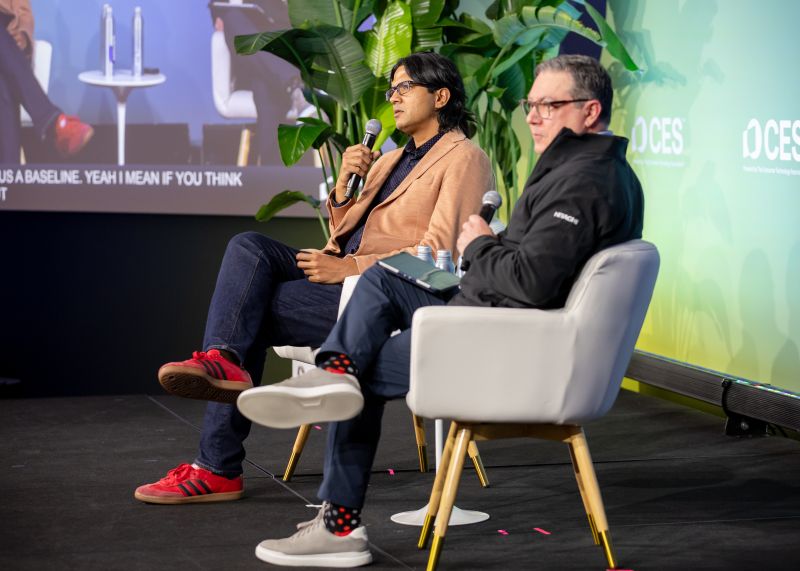
At CES 2026, Barirani sat down with NVIDIA vice president Deepu Talla for a session titled “Pioneering AI Technologies for the Physical World.” Roughly 500 people attended. The two spoke about energy, manufacturing and mobility, industries where an AI system must coexist with physics, regulation, old equipment and the stubborn fact that a factory floor has no refresh button.
Barirani later wrote that he had “a blast” presenting with NVIDIA. The photograph supports the mood: Talla’s red trainers, Barirani’s patterned socks, both men holding microphones in a room dressed in green. Yet the underlying message was sober. Mission-critical systems require safety, efficiency and precision. Physical AI earns trust through outcomes, not fluency.
For Barirani, the session was also a public demonstration of a familiar method. Start with the market change. Explain the customer problem. Connect the company’s existing strengths to the new possibility. Hitachi has spent generations around physical infrastructure; it also owns digital engineering and data capabilities. The physical AI frame places those facts in the same sentence.
The listener’s advantage
Barirani’s career suggests that the best technology marketers are bilingual but not showy about it. They can talk to an engineer without decorating uncertainty, then talk to a buyer without dragging the architecture diagram into lunch. His range across product companies and services businesses matters. Products invite feature comparison. Services require confidence in people and process. Infrastructure demands patience. A portfolio like Hitachi’s requires all three languages at once.
His advisory work adds another room to that conversation. In 2025, Barirani joined the Governance Council of UC Irvine’s Center for Digital Transformation after supporting the center for more than six years. He described the role as a chance to guide priorities and act as an ambassador between professional and personal communities. The center’s mission - helping executives, faculty, students and society prepare for technology-driven change - neatly echoes his day job. Translation is more useful when it travels both directions.
There is no grand eccentricity required here. The quirks are professional ones: an appetite for difficult categories, an insistence on buyer language, a technical education that refuses to stay in the server room. In a field that often rewards the newest noun, Barirani has built a career around verbs: define, connect, listen, explain.
The ordinary miracle
The next chapter of Barirani’s work will be judged in ordinary moments. A commuter will not praise a marketing architecture when a train arrives. A plant manager will not admire category design when maintenance happens before a breakdown. A household will not toast an enterprise narrative when the lights remain on. This anonymity is the bargain of infrastructure: success disappears into daily life.
For a marketer, that may be the most interesting constraint of all. The story must be vivid without making itself the hero. It must explain advanced systems without turning complexity into theater. Barirani’s path from Silicon Valley software to Hitachi’s physical world offers a workable rule: learn the machinery, listen to the buyer, and choose the few words sturdy enough to carry both.