Ben Gibson arrived at California State University, Long Beach with the tidy intention of becoming a lawyer. College had other plans. He found the Daily Forty-Niner, discovered that he loved writing, changed his major from political science to journalism, and became an editor. At the same time, he held down what he calls his other job: the swim team. Training could occupy six hours a day. One pursuit taught him to find the sentence. The other taught him to keep going after the sentence refused to appear.
More than thirty years later, those early disciplines still make sense of his crowded résumé. Gibson has sold stories about switches, wireless networks, data protection, applications, cloud infrastructure, and now cybersecurity. He has held the chief marketing role at Aruba Networks, Veritas, F5 Networks, Nutanix, and Securonix. The products changed. The central problem did not: take something technically intricate, locate its human consequence, and give a large organization a reason to move together.
His career story is especially revealing because Gibson has told it without sanding off every rough edge. He writes about poor fits, an overextended commute, a layoff, hard turnarounds, and the colleagues whose phone calls altered his direction. Executives are often introduced as if they arrived fully assembled in a tasteful conference room. Gibson's account has chlorine in it. It has airline miles. It has a surprising number of friends who keep reappearing at the next company.
The shy swimmer finds his copy desk
Competitive swimming helped Gibson reach Long Beach State. The newspaper helped him understand what he might do there. He has described himself entering college as quiet and shy, then becoming somewhat less so among teammates and editors. His coach, Tim Shaw, supplied an education in intensity and devotion to craft. The newsroom supplied another: words could be a profession rather than decoration.
After college came public relations. In 1993 he joined Miller Communications, where technology accounts brought him close to the peculiar poetry of Silicon Valley: SCSI host adapters, terminal emulation, dental lasers, and the relaunch of PF Flyers. His aerospace-engineer father could finally see how a journalism degree might find a home in technology. At Miller, Gibson also met Jeanette, his future wife.
The agency years became his bridge into 3Com, first in communications and then in product marketing. An executive in a newly acquired switching business took a chance on the PR person who wanted a wider brief. It would become a recurring Gibson pattern. A new assignment arrived through a relationship, and the relationship survived long after the org chart was replaced.
Five companies, five years, useful scars
Cisco hired Gibson in the late 1990s as an IOS product marketing manager. He worked inside the desktop switching business while it became a major contributor to the company. The scale was intoxicating, but scale also produced matrices. Gibson wanted more of marketing than one slice, so around 2000 he stepped out.
The next stretch did not resemble the polished middle of an executive biography. In roughly five years he moved through Foundry Networks, Atrica, Procket, Proxim, and Meru Networks, with a short Cisco return mixed in. Foundry was brief enough to teach him that title and compensation cannot rescue a poor fit. Atrica ended in the only layoff of his career. Proxim was attempting a turnaround amid layoffs and angry investors. Gibson later used the phrase “scar tissue” for what those years supplied.
They also widened his range. At Proxim he owned corporate marketing and, for a time, investor relations. At Meru he led a team competing in enterprise Wi-Fi and saw a product-marketing effort win Best of Show at Networld+Interop. Even the unstable jobs produced durable colleagues. Lori Hultin, Lynn Lucas, Annie Headley, and others recur across his own telling, not as a networking list but as people called upon for counsel, candor, and another hard assignment.
In 2005, Gibson returned to Cisco for the longer second act. Data centers were becoming a contest among powerful business units and alliances. His work touched Cisco's server push, data-center switching, the VCE coalition with VMware and EMC, and the project that became FlexPod with NetApp. It demanded diplomacy inside the company and across partners that might soon become competitors. The journalist had become an organizational translator.
The first CMO chair, at the “biggest small company”
Aruba Networks offered the right-sized test. It had crossed roughly $250 million in annual revenue, possessed a strong wireless business, and was willing to challenge Cisco. Its founders called it the “biggest small company.” Gibson had spent half of his first twenty career years at Cisco and the other half moving among ten companies and agencies. He believed he was ready to own the full marketing stack.
Aruba made the idea concrete. Gibson gave regional marketing leaders room to operate like chief marketers of their own theaters, setting the mix with sales leadership instead of merely executing a central calendar. The company connected Wi-Fi to the rise of bring-your-own-device through its Gen Mobile campaign. Its Airheads community treated customer education and peer connection as engines of loyalty. During Gibson's tenure, Aruba tripled annual revenue and expanded from wireless networking into mobile security and location services before Hewlett-Packard acquired it in 2015.
Then came a succession of larger assignments. At Veritas he led the marketing organization and rebranding after the business separated from Symantec. At F5, the team built “We Make Apps Go: Faster, Smarter, Safer.” When the campaign was revealed at a sales kickoff, it earned a standing ovation. Marketing meetings seldom end that way, which is why Gibson still remembers it.
The F5 role also came with a less cinematic number: more than forty Alaska Airlines trips between San Jose and Seattle by Gibson's recollection. The work helped shape F5's move toward cloud-native offerings, but the time away from home exceeded what he had expected. Nutanix founder and CEO Dheeraj Pandey, whom Gibson had advised, offered the next turn. Gibson joined Nutanix as CMO in late 2017 and stayed until 2022.
Agency work, 3Com, and the move from PR to product marketing.
Two Cisco chapters surrounding five formative years across startups and turnarounds.
CMO roles at Aruba, Veritas, F5, and Nutanix.
Global marketing leadership at Securonix.
A lane away from the org chart
When Gibson left Nutanix, he wrote, advised emerging companies and marketing leaders, and returned more deeply to the pool. He became head coach of the Leland High School swim team in San Jose. He served as president and a board member for a USA Water Polo club and remained a U.S. Masters competitor at regional and national meets.
The parallel is almost too neat, but that does not make it false. Coaching demands observation before instruction. A swimmer may need autonomy, a technical correction, encouragement, or a harder set. Gibson has written that leadership requires the same calibration. One of his longtime advisers taught him that giving people freedom can be overdone; some team members want a more present coach but may not ask for one.
Swimming also makes the scoreboard impolite and useful. Time is time. In marketing, attribution is murkier. Revenue belongs to the combined work of product, sales, partnerships, customer success, and demand creation. Gibson's answer has been to give marketers a broad view of the race. Product story, regional execution, community, customer education, and pipeline are not separate performances. They are relay legs.
Back from the time machine
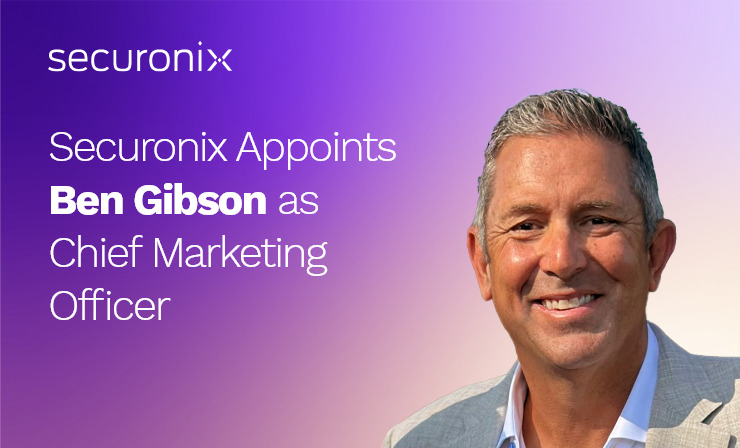
In April 2025 Gibson returned to a full-time CMO seat at Securonix, a cloud security analytics company. The terrain was familiar in one sense. Cybersecurity companies still had complex products, urgent buyers, crowded language, and sales organizations asking marketing to turn attention into pipeline. In another sense, he felt as if he had stepped out of a time machine. Generative AI had moved from an experiment to an everyday creative instrument.
Gibson's response was not to treat the machine as an oracle. He treated it like an agency that needed onboarding. He supplied market context, competitors, customer needs, company values, examples of campaigns he admired, and examples that had missed. He generated alternative creative directions and edited them. For a veteran storyteller, the revelation was speed: more cuts could be explored before people chose what belonged in the final one.
That process helped shape Securonix's “Breach Ready. Board Ready. AI Powered.” campaign. The three clauses pull a highly technical security operations platform into business language. Detection addresses the breach. Evidence and outcomes address the board. Automation addresses a security team burdened by repetitive investigation and alerts. Gibson's movie habit came along for the ride; he has compared modernizing a security operations center with the purposeful reinvention of Mad Max: Fury Road.
That sentence could serve as a compact theory of his career. The first draft was the would-be lawyer. The edit made him a journalist. The first long technology chapter gave him Cisco's scale; the edit sent him into smaller companies where he gained range and bruises. The first executive ascent asked for ever larger assignments; the edit returned him to coaching, advising, writing, and competition. Then another edit put him inside cybersecurity at a moment when machines began making drafts of their own.
Gibson joined Securonix saying his top goal was to create “meaningful, lasting experiences” for customers and prospects through innovation, education, and advocacy. The language is revealing. It is not merely about reaching an audience. It is about leaving people with something useful and giving them a part in the story.
His father once offered a measure of character: look at the company a person keeps. Gibson borrowed it to close his own career reflection. That is why the names matter, why the old colleagues reappear, and why his most satisfying metaphor is a network made from people. Enterprise technology will continue inventing denser acronyms. Campaigns will acquire faster tools. The pool will keep its plain arithmetic. Gibson's wager is that clarity, repetition, and trust will remain surprisingly difficult to automate.