The interesting thing about a solar farm is how little of its intelligence you can see. From the road, there are panels, rows, perhaps a fence. Underneath sits a more consequential argument: how much machinery should it take to keep all that glass pointed in a profitable direction?
- Array builds the structures and controls that move solar panels.
- Its signature approach pairs linked rows with passive wind protection.
- Foundations, software and cable management are expanding the business.
Array Technologies has spent decades answering that question. Its trackers rotate photovoltaic modules through the day. The sun supplies the energy; steel supports, gearboxes, motors and software help decide how much a plant collects. The buyer is usually a developer, utility, independent power producer or construction contractor. The product is industrial equipment. The ambition is cheaper electricity over a project's life.
The machine beneath the electricity
The origin is agreeably unglamorous. Ron Corio developed a tracker in 1989, then purchased Wattsun and formally established Array in 1992. The company dates its founding to that first machine. In 2006, its DuraTrack equipment went into a 6 MW project in Alamosa, Colorado. By 2012, shipments had passed a gigawatt. In 2026, Array reported more than 100 GW of tracker products delivered worldwide.
That is capacity served by its equipment, rather than electricity Array itself sells. Its place in the industry is beneath the modules and inside the construction budget. A contractor needs tolerances that crews can manage. An owner needs dependable operation. Both need the structure to fit the land.
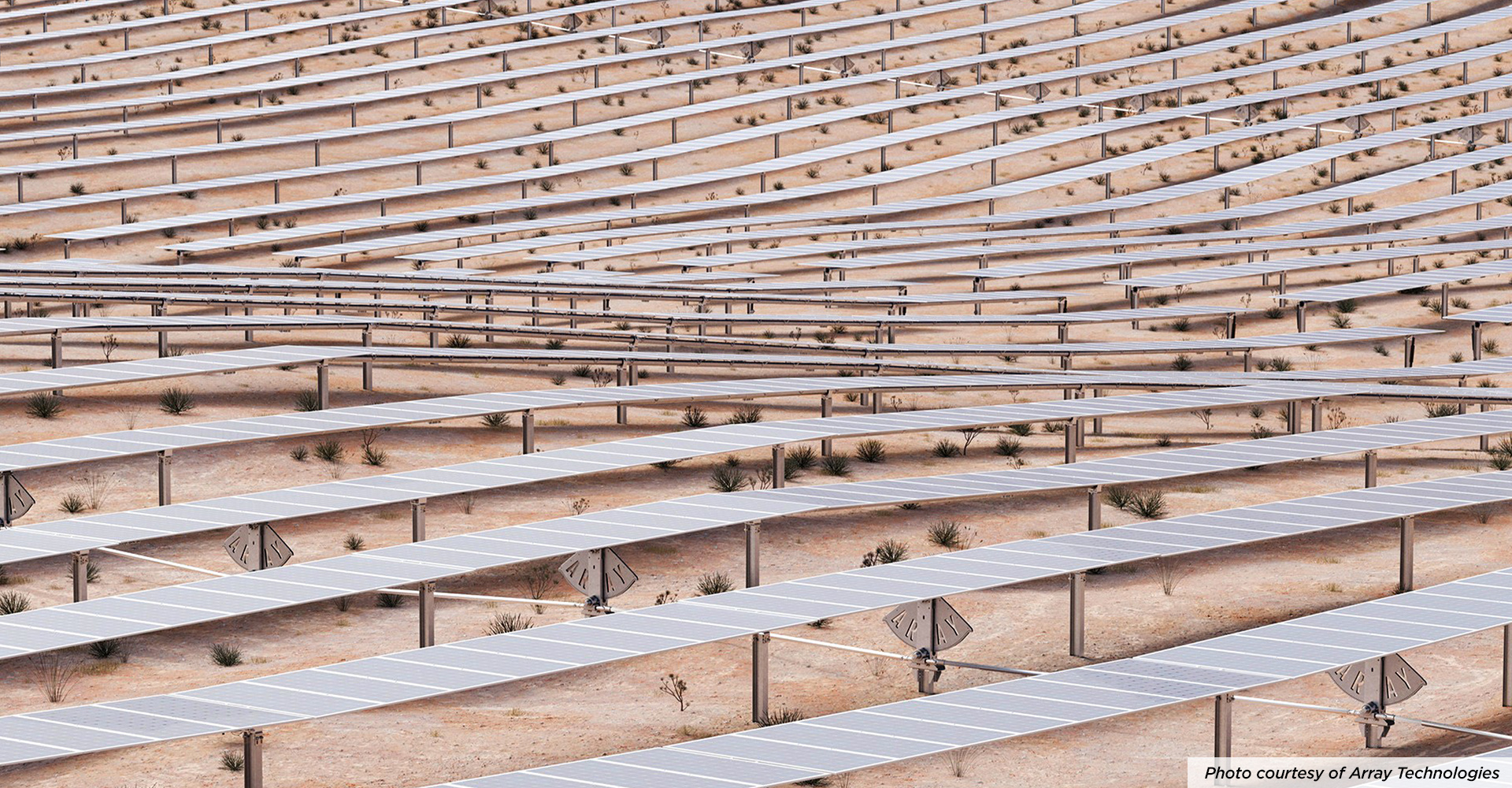
DuraTrack's linked architecture lets a motor move multiple rows. Single-bolt module clamps simplify installation. OmniTrack addresses another expensive habit of construction: flattening the place before building on it. By accommodating undulations within a row, it can reduce grading. The savings depend on the site, but the logic is tangible. Every cubic yard left alone avoids some work.
Let the wind do some work
Wind makes the design problem stranger. A panel is an energy collector and a surface that catches air. Moving it into a protective position can preserve the structure while sacrificing production. Doing so requires a decision, and decisions can depend on sensors, communications and power.
DuraTrack's passive mechanical wind mitigation reduces reliance on that chain. Wind response is built into the mechanism. This is the detail that gives Array its character: an attempt to solve part of an operating problem through the physical design itself. In a remote field, every avoided dependency has an appeal.
How much machinery should it take to keep all that glass pointed in a profitable direction?
Hail asks for a different maneuver. Array's DuraTrack Hail XP can position modules at 77 degrees in either direction. SmarTrack Hail Alert Response uses third-party weather information to initiate defensive positioning. The distinction matters: passive wind protection does not mean every weather response operates without software or electricity.
Concept illustration. Actual operation depends on system design and conditions.
SmarTrack also adjusts for less dramatic conditions. Its backtracking accounts for slopes and shading between rows. Its diffuse-light feature recognizes overcast conditions and moves panels flatter. Snow response uses depth sensors. Following the sun turns out to involve knowing when another angle makes more sense.
The price of changing direction
There is a temptation to make simplicity sound like a universal cure. Array's accounts supply a useful correction. In May 2021, rising steel and freight costs forced it to withdraw its ability to affirm full-year guidance while reviewing contracts. The machinery could perform as intended while the economics moved underneath it.
A supply agreement with Nucor, announced that month, secured components and static pricing for a portion of 2021 materials. Blackstone subsequently committed up to $500 million in preferred equity capital, with $350 million at the initial closing. Capital and procurement mattered alongside engineering.
Another adjustment arrived in 2025. Array recorded a $29.5 million inventory valuation charge while phasing out STI H250 inventory incompatible with SmarTrack. It also recorded a $102.6 million noncash goodwill impairment associated with the STI acquisition. These were different accounting events, but together they complicate any easy story of expansion. Software compatibility can make yesterday's hardware less useful.
Revenue grew 40% in 2025 to roughly $1.284 billion; net loss to common shareholders was $112 million. Growth and profit were moving on different tracks. By June 2026, executed contracts and awarded orders reached $2.5 billion. That orderbook signals demand, while still requiring delivery and conversion into revenue.
Selling more of the solar field
Array is widening what arrives on the truck. Its 2025 APA Solar acquisition added engineered foundations and fixed-tilt structures. The announced enterprise value was approximately $179 million, with consideration, tax benefits and potential earnout provisions making the transaction more complicated than a single price tag.
In August 2026, it completed the acquisition of Affordable Wire Management. The announced terms combined a $153 million base price with up to $50 million of additional consideration. Cable protection joins trackers and foundations in a portfolio increasingly concerned with the connections between components.
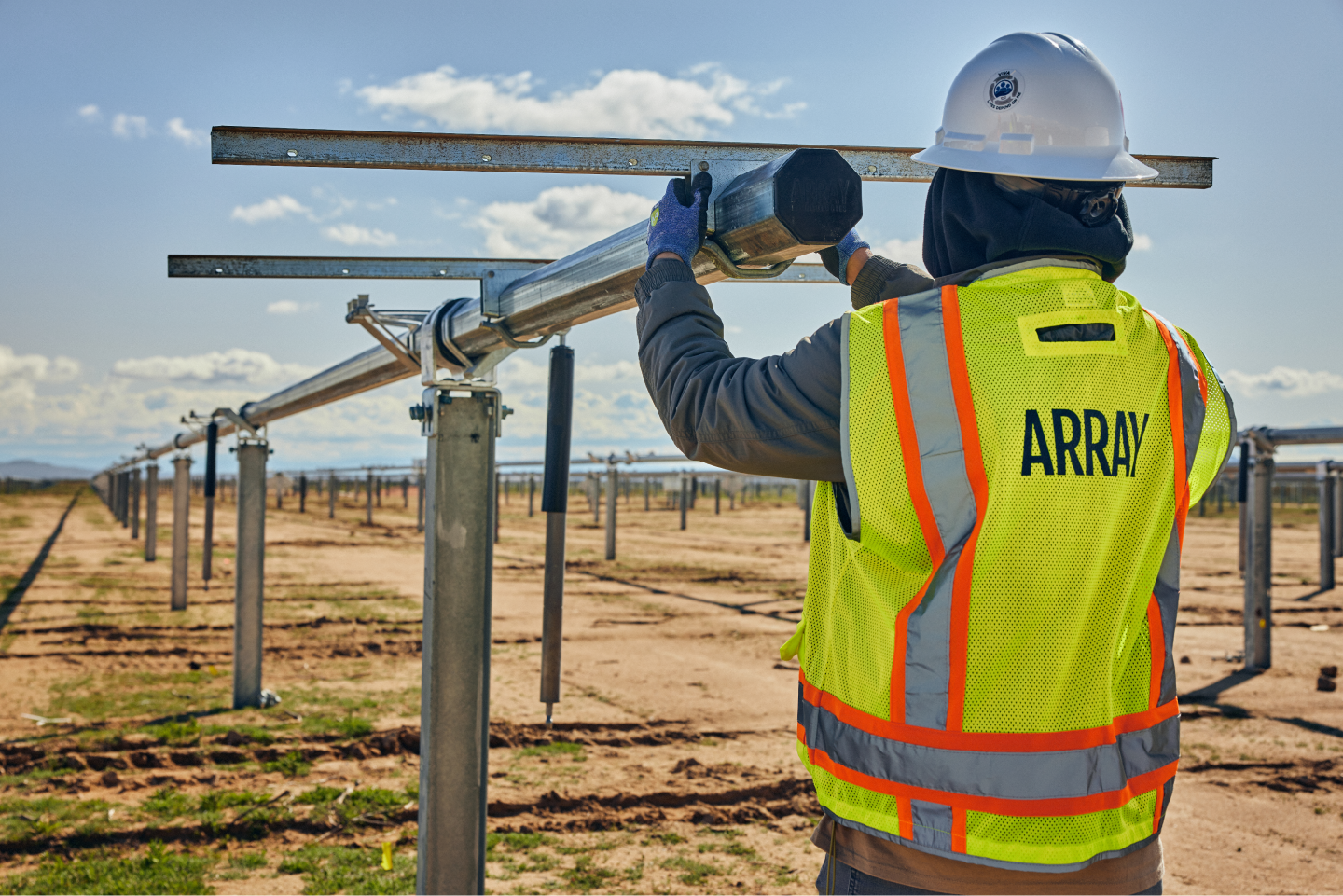
The manufacturing footprint is changing too. September 2026 brought the opening of a 216,000-square-foot Albuquerque facility, representing more than $50 million of development investment. Designed to support approximately 300 jobs, it brings some historically outsourced component production in-house. “manufacturing has been at the heart of our company from the beginning,” CEO Kevin Hostetler said at the opening.
Buy the operating result
Alternatives include Nextracker, PV Hardware and GameChange Solar. Array's case rests on lifetime economics, installation and reliability. Buyers can pair equipment with engineering support, commissioning and ARRAY Academy training. The practical lesson is to compare the installed, supported system, including its soil, controls and weather assumptions.
That calculation can favor another design when site constraints, financing or expected energy gains fail to justify the package. A steep hail angle is no blanket guarantee against damage. Equipment cannot resolve a stalled grid connection. Even a well-designed tracker needs a viable project.
Array does permit itself one joke: a sheep persona named Ray writes about solar grazing and land use. Beneath the industrial seriousness is an unusually apt mascot. Ray notices the ground. Increasingly, so does the company.