Two laptops and no customers. Nicholas Speyer’s recollection of starting SYSO with Chris Gosline has the virtue of being easy to picture. Before the funding announcements and the gigawatts, there were two people with computers and a business to persuade into existence. Electricity was already moving through the grid. Finding a place for their company in that movement was another matter.
They founded SYSO in 2019 around the operation of renewable energy and storage assets. It was a business concerned with what happens after a project has equipment to run: registration, scheduling, market participation, and the continuing task of making the numbers work. A solar installation is an excellent subject for a photograph. Its settlement process has a less promising future on the mantelpiece.
Gosline became the company’s first CEO. He arrived with a career that had moved through energy software, demand response, and solar. The practical thread matters. Again and again, his work involved connecting a useful technology to the systems and people needed to put it to use.
“We started SYSO together with two laptops and no customers.”
NICHOLAS SPEYER / CO-FOUNDER
Maps, software, and the rules of the game
His education paired geographic information systems at the University of Vermont with a later master’s in energy policy at the University of New Hampshire. There is an appealing combination here: tools for understanding where things are, followed by an education in the rules governing what can happen. Electricity has plenty of both.
His early career included software engineering at AREVA T&D, working on real-time energy management systems, before a decade at EnerNOC. Demand response made the relationship between electricity demand and grid operation part of his working life. By the time he moved into solar, he had experience with the machinery behind energy decisions as well as the decisions themselves.
That route gives SYSO a useful context. The company’s later emphasis on operating assets sits within a longer career in energy systems. Renewable generation and storage brought their own demands, but the need to connect equipment, information, and commercial arrangements was familiar territory.
A place in solar, even without the roof
At BlueWave Solar, where he served as Senior Vice President, the customer’s route into clean energy became especially tangible. Community solar allowed households to participate without installing panels on their own buildings. For someone in an apartment, or under a roof unsuitable for solar, that distinction changed the available options.
In January 2016, BlueWave and Vivint Solar announced an alliance to offer community solar memberships in Massachusetts. Projects in Oxford and Fairhaven were expected to serve nearly 250 customers. Gosline’s description of the proposition was brisk: “It’s simple, it’s accessible.” Accessibility was a product feature with a real address attached.
Another partnership, with Solstice, connected residents to BlueWave’s solar farms in Plympton and Mendon. Announced that August, the arrangement offered participants electricity savings without the expense of joining. It put organizations working on access alongside a developer with projects to offer. Gosline publicly supported the collaboration and its expansion.
The partnerships addressed different circumstances rather than assuming every customer could follow the same route. A shared solar project could serve someone without a suitable roof. Financing could help a homeowner purchase an installation. Neither arrangement made the other redundant. Together they show why a career in solar could involve as much product design and coordination as attention to the panels.
There was also the problem of paying for rooftop solar. BlueWave’s collaboration with Avidia Bank produced a home solar loan, announced in January 2016. BlueWave’s John DeVillars credited Gosline and Craig Wetmore as the product’s architects. The offering joined financing, installers, and an online application process in one route for homeowners.
These arrangements help explain the continuity in his career. The solar panel might be the visible technology, but participation depended on other inventions: a membership, a loan, a partnership, a process someone could complete. Those were substantial pieces of the undertaking. A household could admire renewable energy indefinitely while waiting for a workable way to buy into it.
The work after the ribbon cutting
SYSO took on another set of connections. Its customers were developers and independent power producers with renewable and storage projects to manage. The company’s services extended from registration and commissioning to operations, optimization, reporting, and settlement. The work continued long after construction crews had packed up.
Read that list as a sequence and the company’s purpose becomes clearer. An asset must enter the relevant system, operate within it, participate in its markets, and account for what happened. Each step creates work for somebody. Gosline and Speyer built a company offering to take that work on.
- Register & commissionPrepare the asset for participation.
- Operate & optimizeManage the equipment and its market activity.
- Report & settleAccount for performance and transactions.
Consider the customer’s position. Owning a project means accepting a continuing series of obligations. Registration is one job; managing the operating asset is another. Reporting and settlement add further steps. Buying help with those activities gives the owner a defined service to evaluate. The relationship has to hold up through ordinary working days as well as the moment the agreement is signed.
The appeal of this focus is its specificity. A vision for a cleaner grid can accommodate almost any number of ambitions. A customer still needs to know who is handling the operating tasks. SYSO made those tasks the service it sold, with technology and people behind the offer.
Capital with a working knowledge of the grid
In October 2022, SYSO announced a $10 million Series A led by Lacuna Sustainable Investments. The company had nearly one gigawatt under management and planned to expand its markets and its engineering, operations, and sales teams. The financing described a company moving beyond its small beginnings into an organization with more work to staff.
Gosline’s explanation of Lacuna’s involvement was commercially precise. The investor already invested in projects belonging to SYSO’s customers. Its knowledge of the business and its place in that network mattered alongside the money. For a company selling services into an established industry, an investor’s understanding could have practical uses.
His comment also provides a small lesson in how he presented the business. He identified a connection between an investor’s existing activity and SYSO’s prospective work. The explanation stayed close to customers and projects. That makes the announcement more revealing than a round number alone: it shows which part of the relationship he chose to explain.
In August 2024, a $14.5 million Series B followed, led by Kimmeridge with Lacuna participating. SYSO reported more than 2.5 gigawatts of assets under management across seven named US power markets. Gosline described the investment as backing for the company’s direction and plans to increase its operating scale.
The operating portfolio gives those funding announcements a second measure. Capital could support expansion, while assets under management described the scope of the work already entrusted to the company. Keeping the two measures separate makes the progress easier to understand. The company was raising money to develop its business while also taking responsibility for an expanding collection of energy assets.
Later that year, an earlier chapter of his career reappeared as a customer relationship. BlueWave selected SYSO for battery storage market operations in New England. The agreement covered scheduling, capacity management, arbitrage optimization, and round-the-clock network operations support.
It is a satisfying turn in the story without requiring a grand theory about it. Gosline had helped build products at BlueWave; now the company he co-founded was providing services to BlueWave’s battery portfolio. His career had crossed from making solar easier to access to helping energy assets navigate their operating obligations.
Another kind of helm
Outside work, Gosline’s interests ranged across water, mountains, and the air. He boated and fished, flew recreationally, and kept chickens. The last item gives the list a welcome change of altitude. An energy executive could spend plenty of time talking about distributed resources; a flock supplies its own daily demands.
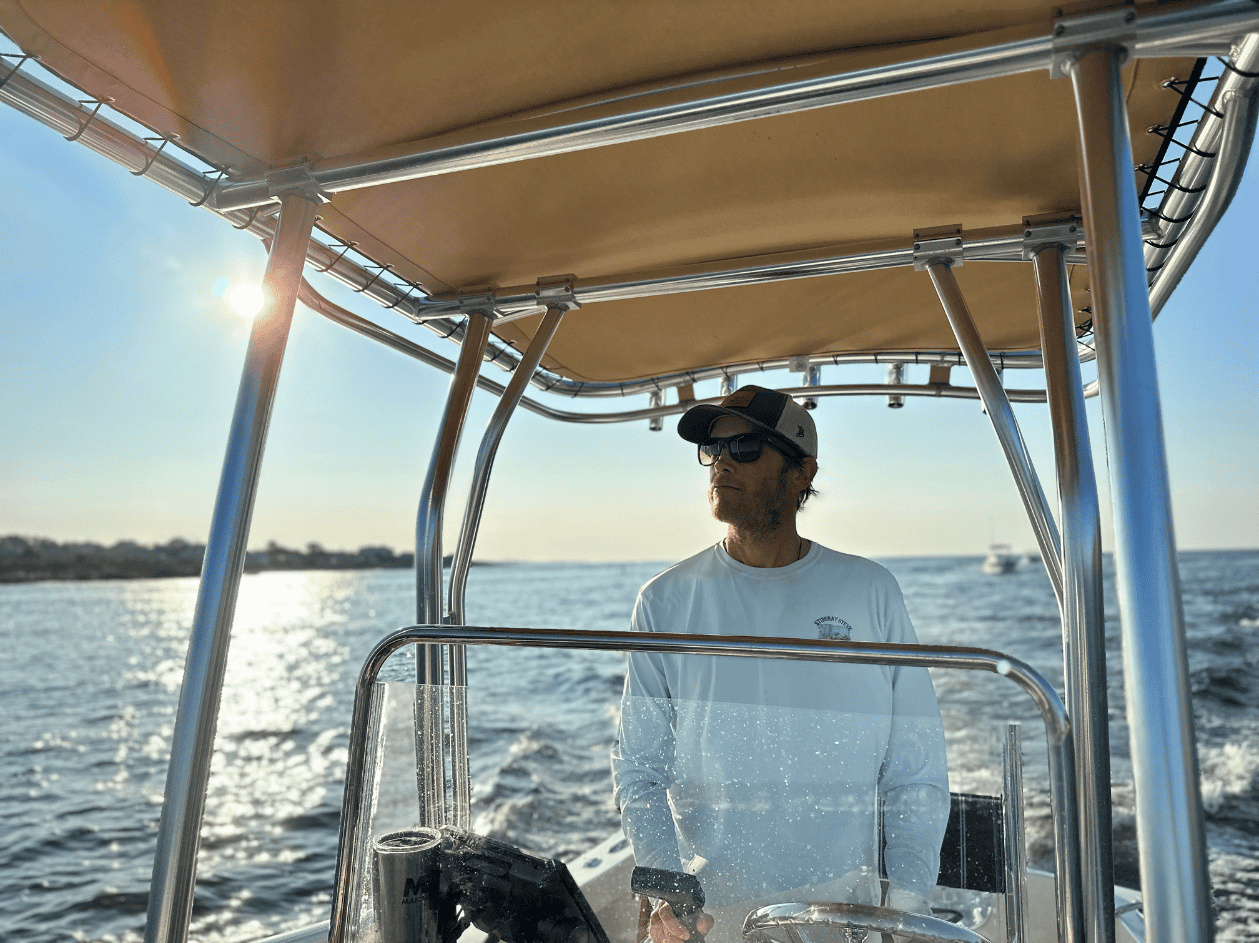
Earlier interests included electronics and building forts outdoors. Those details belong beside the professional history because they give it a human scale. The person handling an energy business also liked making things and going places. His family’s adventures on the water and in the mountains were part of a life in which being a husband and father came first.
The team that carries the work
Speyer’s account of their partnership is unusually useful because it allows for friction. The two trusted each other, brought different skills, and could disagree repeatedly without exhausting their affection. That is a more convincing working relationship than one in which every conversation apparently ends in unanimous applause.
He remembered Gosline approaching difficulties with practicality and good humor. Challenges became problems to work through. He also recalled Gosline taking pride in assembling a team and supporting people’s careers. Taken together, these memories describe the daily experience of building alongside him, something a financing announcement cannot readily convey.
A team gives an operating business its continuity. Customers need people who understand the commitments, know the work, and can keep making decisions together. In that setting, trust has an everyday use. The qualities Speyer remembered belong inside the business story because they describe how its founders worked, and what Gosline encouraged in the people around him.
SYSO honors Gosline in memoriam as its co-founder and first CEO. Speyer now leads the company. By March 2026, it reported more than 4.5 gigawatts under management across over 300 sites, with operations extending into Canada. Those are later company milestones, reached by the people carrying the work forward.
The beginning remains a useful place to return: two laptops, no customers. It keeps the company’s scale from obscuring the partnership behind it. Gosline’s career offers plenty of projects and transactions to count. The colleagues he trusted, and who trusted him, help explain how the counting began.