Sunlight has an excellent publicist. The steel clamp gets considerably less attention. Yet Kevin Hostetler’s career makes a useful case for looking underneath the panel, where the clean energy business becomes a collection of manufactured parts, delivery schedules, and decisions about who does what. Before he became chief executive of Array Technologies, he ran a company whose products controlled the flow of liquids and gases. There is a certain continuity between persuading a valve to move correctly and persuading a field of solar panels to follow the sun.
At Rotork, which he joined as chief executive in 2018, one example of change was remarkably small in scale: how an actuator was assembled. Hostetler described a shift from several employees contributing to assembly toward an operator assembling an individual unit. The purpose was to give that operator greater ownership of the process. A transformation programme sounds grand. At the workbench, it could mean being able to point to a finished product and know whose work it was.
That is an unusually concrete starting point for a solar executive’s story. It also provides a useful way of reading the decisions that followed. The product matters. So do the people assembling it, the organisation selling it, and the customer waiting for it. Hostetler has spent his working life moving among those concerns.
A finance degree, then the factory floor
His academic qualifications are in business: a bachelor’s degree in finance from King’s College and an MBA from New York University’s Stern School of Business. His career took him into industrial operations. He spent seven years at Ingersoll Rand in leadership and business development, followed by senior positions at IDEX, including responsibility for fluid and metering technologies and its Asian business.
The industries in that portfolio included energy, water, chemicals, food, and agriculture. Later came private equity advisory work and the chief executive’s job at FDH Infrastructure Services, also known as FDH Velocitel. There, acquisitions supported a business working on telecommunications and ageing infrastructure, including bridges, dams, and transmission towers. The route to solar passed through businesses whose usefulness tends to become apparent when something stops working.
At Rotork, Hostetler led a programme aimed at better margins, more effective use of capital, and stronger commercial operations. He has described leadership in distinctly practical terms: “Agility comes to mind. Also, resourcefulness.” Those are modest words for demanding habits. They require a manager to move between a plan and the place where someone must actually carry it out. A strategy can be beautifully typeset and still leave an operator waiting for a part.
- Ingersoll Rand
- IDEX
- FDH
- 2018 Rotork
- 2022 Array
The acquisition waiting on his desk
Array announced his appointment on April 5, 2022. He would become chief executive and join the board on April 18, succeeding Jim Fusaro. Chairman Brad Forth identified integrating STI Norland as part of the incoming leader’s assignment. Hostetler arrived with experience in engineered products and actuation, and he described the company as an intersection of that experience and his interest in the environment.
STI Norland had already been acquired in January. Hostetler therefore inherited the job of making the combination work. In his reflection on 2022, he wrote about bringing the two organisations together, reviewing the mission and values, and building a company with a broader range of products. Buying a business provides an announcement date. Integrating it gives the calendar rather more to do.
His first highlight in that reflection was meeting employees around the world. He specifically recognised machine operators and quality technicians in New Mexico, Brazil, and Spain, alongside engineering, fulfilment, and service teams. He also recalled celebrating the passage of the Inflation Reduction Act on the White House lawn. The juxtaposition is revealing: the industrial work and the public policy had become parts of the same job.
The clamp goes to Washington
On June 12, 2024, Hostetler took that connection to the Congressional Joint Economic Committee. The hearing concerned American manufacturing investment. He explained the tracker’s basic task: rotate solar panels to follow the sun. In his account, that could increase energy production by up to 25 percent. The qualifier matters. It describes a potential benefit, rather than a promise that every field will produce the same result.
He brought examples from outside Array’s own factory. A bolt supplier was expanding in Arizona; steel and tube businesses were investing in Texas and Kentucky. He also discussed Array’s relationship with Central New Mexico Community College, including a donated solar site used for power generation and practical training. His manufacturing argument extended from purchased materials to the people who would learn to work with them.
Ahead of the hearing, Hostetler posted a short video from Capitol Hill. He introduced the occasion with the observation that being called to testify was hardly an everyday event, then turned to the Albuquerque campus and local jobs. The setting was Washington. The subject was a factory back home.
Domestic sourcing subsequently became a specific customer offering. In August 2025, Array announced trackers for ENGIE’s 200 MWac Emerald Green Solar project in Indiana that would meet 100 percent of the domestic content Assigned Cost Percentage under the Treasury guidance cited in the announcement. The precise definition is important. The claim concerned the tracker components within a particular accounting framework, rather than every item at an entire solar plant.
“We’re proud to be an American company”
Kevin Hostetler · Congressional testimony, June 2024
Two jobs, one balance sheet
For part of this period, Hostetler also carried a second title. He served as interim chief financial officer from July 1, 2024, until H. Keith Jennings took over on January 6, 2025. Alongside the customer conversations and manufacturing plans sat responsibility for the finance function. His finance education had acquired a very immediate application.
Array’s 2026 proxy statement presented the mixed picture a profile needs to keep in view. Revenue had recovered by 40 percent in 2025, and the year ended with a $2.2 billion orderbook. The same document acknowledged that longer term shareholder returns had fallen short of expectations. An orderbook records business still to be delivered; it does not settle the question of what shareholders have earned.
By September 2026, the company was opening its new Albuquerque factory while the solar market remained unsettled. Hostetler discussed policy changes and investor uncertainty in an interview at the opening. The contrast between an investment that takes years to put into service and a market that can change its mind during lunch is part of the assignment. Machinery has a longer attention span than a share price.
Array’s company results. An orderbook is not recognised revenue.
More of the solar field
Hostetler’s next moves widened the range of equipment Array could offer. APA Solar, acquired in August 2025, brought foundations and racking into the business. At an investor technology showcase a year later, the company set out its ambition to connect more of the infrastructure around the tracker. The proposition was technical compatibility: components designed to work together, with a larger role for Array in each project.
The Ohio operation made that ambition tangible. In March 2026, APA opened a 30,000 square foot headquarters in Ridgeville Corners. Its expanded campus was to house a foundations centre focused on difficult soils and frost heave, with research, testing, training, and a five acre solar site planned. Hostetler described closer working relationships among engineering, manufacturing, and commercial teams as a way to shorten the journey from development to something useful for customers.
On August 31, 2026, Array completed another acquisition: Affordable Wire Management. AWM’s products organise, secure, and protect electrical wiring. Its co-founders, Scott Rand and Dan Smith, brought another set of engineering and customer relationships into the group. Hostetler’s stated aim was to simplify design and installation while broadening the offering across solar, storage, and data centre markets.
There is an appealing lack of glamour to foundations and cable supports. They are precisely the things a project needs to get right. Acquiring them also creates work: products must function together, teams must coordinate, and the customer has to experience the promised convenience. Hostetler now has another version of the integration assignment that greeted him in 2022.
Acquired 2025
Follow the sun
Acquired 2026
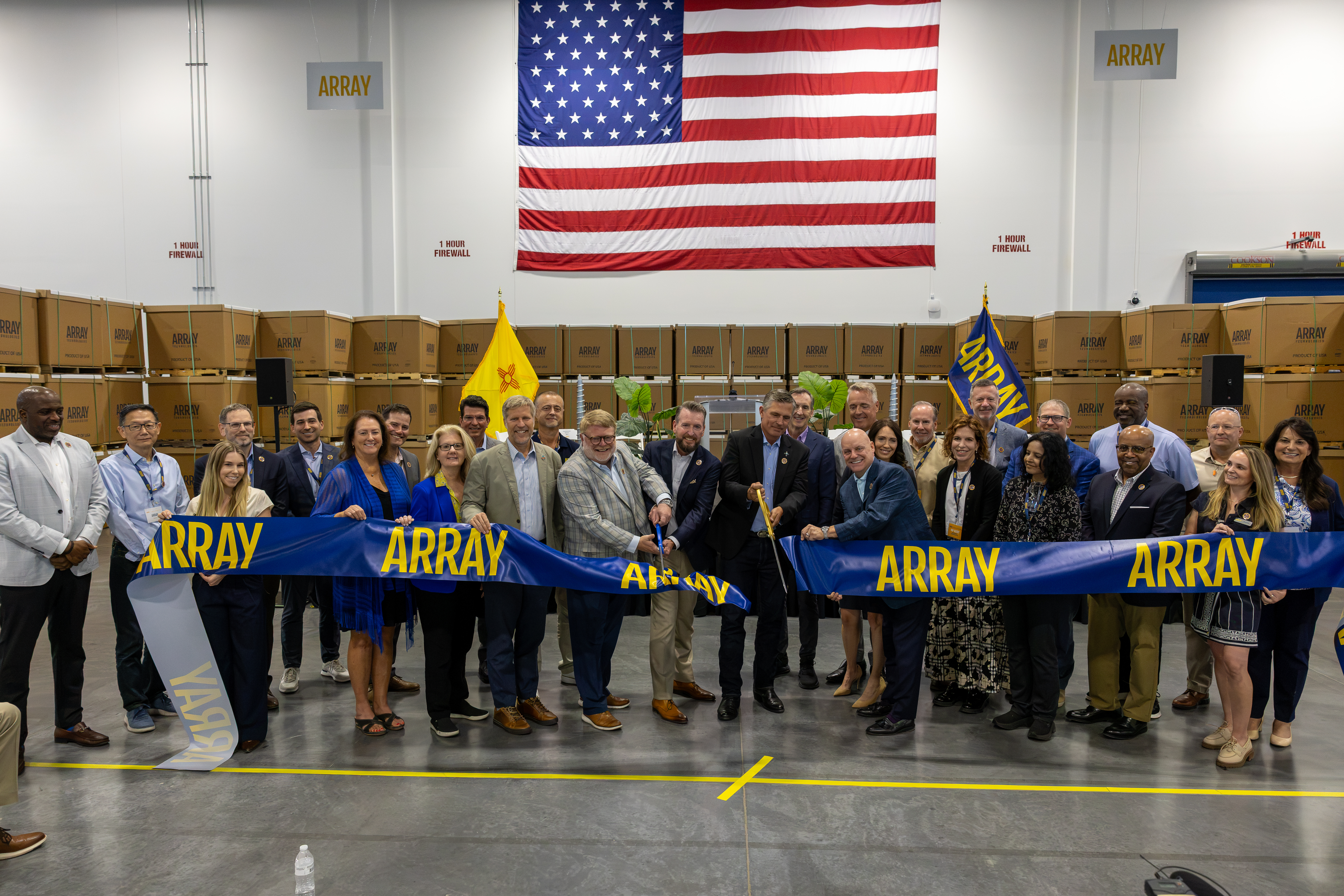
A ribbon, then the work
The Albuquerque opening on September 9, 2026, offered a physical measure of the effort. The new facility represented an investment of more than $50 million and covered 216,000 square feet, roughly three times the previous site. Array said it would support about 300 jobs and allow it to manufacture components previously bought from outside suppliers. Guests toured the production operation after the ceremony.
Earlier that summer, Array had announced that cumulative tracker deliveries had passed 100 gigawatts across more than 30 countries. That is a company milestone accumulated over decades, including years before Hostetler arrived. His task is to make the next stage work: a broader portfolio, new manufacturing capacity, and customers dealing with changing project economics.
His responsibilities also reach beyond Array. He serves on the American Clean Power Association’s board, including its 2026 roster, and on the board of Enstall, which supplies rooftop solar mounting systems. The connections span different parts of a business often compressed into a photograph of blue panels.
The photograph is easier to understand once the smaller pieces come into view. Beneath the panel are foundations. Alongside it are wires. Somewhere behind both is an operator finishing a component, an engineer considering the site, and a customer expecting delivery. Hostetler’s career keeps returning to the relationship among them. The sun will follow its schedule. The rest takes management.