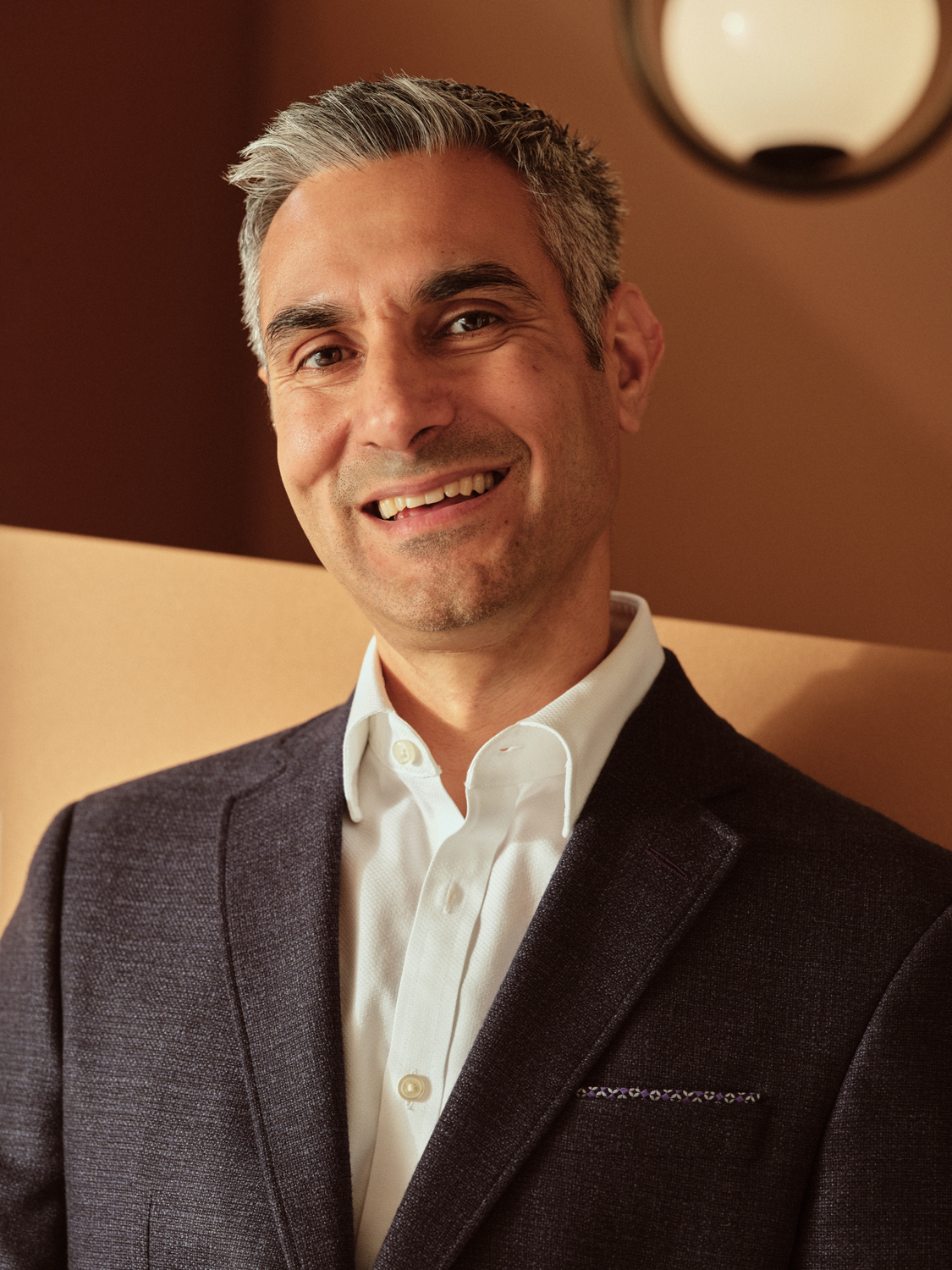
There is a moment in enterprise investing that most people never live to see: the decade-long bet paying off. Arif Janmohamed has lived it twice in two years. In September 2025, he stood on the Nasdaq floor as Netskope rang its IPO bell - a company he had first backed at Series B in 2013, a board seat he had held for twelve years. Six months earlier, ServiceNow announced it would buy Moveworks, the AI company on whose board he sat from the very first day, for $2.85 billion. Two outcomes, two decades of work. Most investors would frame it as luck. Janmohamed calls it underwriting.
The story starts in Canada, in a family that knew how to build things. His grandfather ran businesses across multiple continents. His father was an engineer who earned an MBA and became an entrepreneur. The pattern was already set before Arif picked up his first textbook at the University of Waterloo - one of the world's most respected computer engineering programs, in a country that produces an outsized number of the people who quietly run Silicon Valley's infrastructure. He graduated in 2000 and walked straight into the dot-com bubble, joining WebTV just as Microsoft was acquiring it. He watched what happened when the air came out. He kept watching.
After stints at Andes Networks and Sun Microsystems, he went to Wharton for his MBA, where he did something that told you everything about how his mind worked: he started a student-run venture fund. Not a club. A fund. WVP Ventures was an attempt to practice the thing before the class on the thing existed. In 2006, he joined Cisco's corporate development team and worked on a deal that would have seemed like fiction from the outside - the $3.2 billion acquisition of WebEx. He helped close it. Then he looked at the table he was sitting at, thought about the other side of it, and in January 2008 walked into Lightspeed Venture Partners as a new partner.
He has stayed ever since. More than 16 years at the same firm is unusual enough in venture capital that it demands explanation. The explanation, in his own words, is the best companies take a decade or more to mature. He is not being philosophical. He is describing his operating model. When Lightspeed led Netskope's Series B in 2013, cloud security was not yet a board-level conversation at most enterprises. By 2025, Netskope had 3,000 employees and a Nasdaq listing, with Lightspeed holding 16.9% as the largest single shareholder. Janmohamed held his board seat for the full journey.
His investment philosophy is precise where most VCs are vague. He focuses on Series A and B, typically writing checks between $3 million and $20 million. He wants enterprise software, cloud infrastructure, AI, data, and security - the less visible parts of how large organizations actually function. He distinguishes between market risk and execution risk with a clarity that comes from having worked inside large companies before he wrote his first check. "Market risk is the most dangerous risk to underwrite as a VC," he told the 20VC podcast. It is not a soundbite. It is a filter.
The portfolio reflects the filter. Navan - the corporate travel and expense platform formerly called TripActions - got Janmohamed's backing at Series A and B, when the bet was not just on the product but on whether the market for next-generation T&E software would materialize. ThoughtSpot, the AI-driven analytics platform, was a seed-stage investment in 2012. Redpanda, building a Kafka-compatible streaming data platform, received a $100 million Series C check in June 2023. Each bet carries the same fingerprint: foundational infrastructure, a technical founder with a genuine insight, and a market still early enough that most investors are asking whether it is real.
In 2019, TechCrunch asked him to explain how he thinks about cybersecurity investing. His answer doubles as his entire investment philosophy: "Every enterprise company is talking a big AI game, and it's our job to really figure out who's got something that's truly differentiated and who's really latching on to the buzzword du jour." That was 2019. The buzzword has only gotten louder. The filter has not changed.
Away from the portfolio, he is less curated than his professional record would suggest. He grew up in Canada but learned to play ice hockey in his late twenties - a detail that manages to be both improbable and perfectly Canadian. He speaks French, but with what he describes as a mixed Swiss-Canadian-Anglophone accent from his year at EPFL in Lausanne. His favorite novel is Shantaram. His favorite albums include Massive Attack's Protection and Pearl Jam's Ten. On Twitter, where he has been posting since June 2008, he mixes observations on AI and enterprise software with accounts of his sons outwitting him: one placed a life-size witch in the bathroom on Halloween; another checkmated him in an argument about whether Red Rising "takes place in space." He describes his definition of success as happiness at home, the freedom to spend time the way you want, and the latitude to work for and learn from people who are exceptional.
As of early 2026, he is stepping back from day-to-day responsibilities at Lightspeed to launch a new early-stage investment firm. The move is consistent with everything in his record: he is returning to the beginning of the company-building arc, to the moment before the market is obvious, to the work that only makes sense if you believe the best companies take a decade or more to mature. He has proven he can wait. The question is which founders are worth waiting for next.