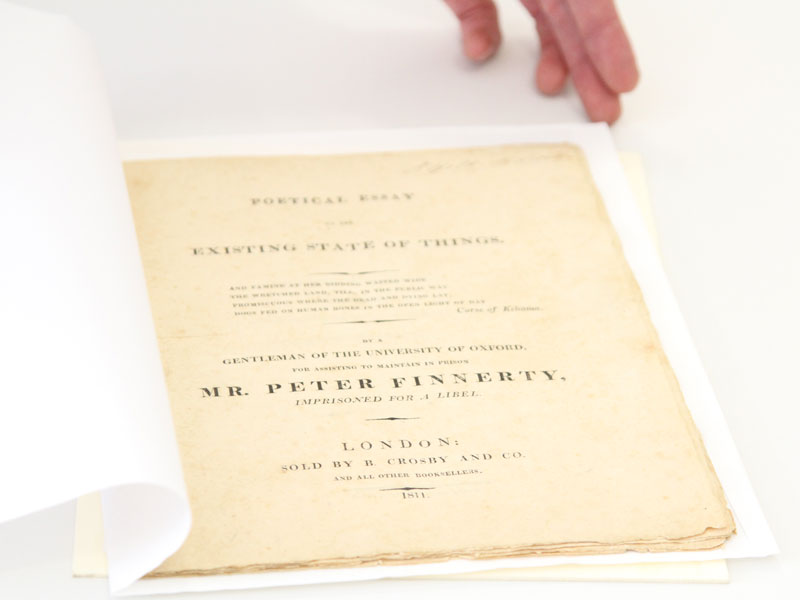
Twenty pages is a modest quantity of paper for an investor accustomed to company accounts. In November 2015, however, a twenty-page pamphlet supplied an unusually revealing entry in Antonio Bonchristiano’s public record. He and Brian Fenwick-Smith helped support the Bodleian’s acquisition and digitization of a rare Shelley poem. The former online bookseller had become a supporter of a very particular book.
The twelve-millionth book
The pamphlet, Poetical Essay on the Existing State of Things, became the Oxford library’s twelve-millionth printed book. It was the only known surviving copy. Its arrival was celebrated at the Weston Library on 10 November, with Vanessa Redgrave and the poet Simon Armitage among those taking part. An acquisition could scarcely ask for a more literary welcoming committee.
There is a pleasing complication here. Bonchristiano’s business career includes helping people buy books through a screen. This project helped people read an exceptionally scarce one through a screen, freely. The commercial and scholarly purposes were different; the question of access connected them. A physical object stayed rare while its contents became easier to reach.
That offers a useful way into a career often introduced through titles. Bonchristiano is now co-chairman of GP Investments, a firm he joined in 1993. He also co-founded Submarino and Akad Seguros. Moving between those enterprises takes us from a shopping basket to a boardroom to an insurance policy. Oxford adds a bookshelf, and makes the room considerably more interesting.
A bookseller with a head start
Born in Santos in 1967, Bonchristiano studied Politics, Philosophy and Economics at Oxford. His early working life took him through Salomon Brothers in London and New York, and a partnership at Johnston Associates, a London financial consultancy. These were international beginnings for a career that would become closely associated with Brazilian businesses.
At GP, investment work also led into operations. He served as chief financial officer of SuperMar Supermercados from 1995 to 1997. The job belongs in the story because retail exists at two scales at once: the financial model and the individual transaction. A customer buys something; a company must arrange everything that makes the purchase possible. The spreadsheet has consequences in the shop.
In 1999, Bonchristiano, Marcelo Ballona and Flávio Jansen founded Submarino. Books, CDs and toys were among its opening categories. Those objects carry the texture of the period rather well. A CD needed a delivery address; a song had not yet become something that most shoppers expected to summon from the air.
The founders had acquired Booknet, an existing online bookstore. Its inheritance included about 50,000 registered customers, bibliographic information and publisher contracts. Recalling the deal in 2025, Bonchristiano identified those assets as an advantage at the start. The new business arrived with relationships and records already in place.
It is a more instructive beginning than the familiar blank-page origin story. Someone had already done the patient work of assembling a catalog and reaching customers. The next venture could build upon it. Submarino’s name also travelled conveniently: the word works in both Portuguese and Spanish, fitting a launch that reached Brazil and Spain. Even the branding had a practical job.
When the money stopped
Submarino’s first years straddled the dot-com crash. Bonchristiano ran it as CEO from 1999 to 2001, a short interval containing a substantial change in the weather. A promising internet business had to keep operating when the enthusiasm surrounding internet businesses became much harder to finance.
Years later, in a September 2022 interview, he described GP’s early technology activity with the benefit of uncomfortable experience: roughly 25 investments in twelve months, and insufficient structure to handle the pace. His recollection contained an admission about capacity, rather than merely a complaint about markets. Having money to invest and being equipped to support every investment are separate problems.
“Precisamos ter paciência.”
Antonio Bonchristiano, September 2022
“We need to be patient.” Translation from Portuguese.
His later call for patience is easier to understand against that earlier rush. A change in financing conditions can force a business to reconsider how quickly it expands, what it can afford and what its owners expect. There is very little glamour in revising those calculations. There is also no useful substitute for doing them.
Submarino went public in 2005, after Bonchristiano’s tenure as CEO. It subsequently merged with Americanas.com to form B2W. Those events should retain their dates. A founder’s period in the executive chair is one chapter in a company’s life; subsequent managers and colleagues write others. Compressing the sequence into a single person’s triumph would make it tidier and less accurate.
The distinction gives his career more substance. He had worked inside a retailer, helped create another, and then continued in investment leadership. He could encounter a company as an executive responsible for its operations or as an owner helping decide who should run it. Each position comes with a different view of the same desk.
Taking the owner’s chair
Beginning in 2003, Bonchristiano and Fersen Lambranho took over GP’s leadership from its founding generation. The transition put responsibility for the institution itself alongside responsibility for its investments. Choosing businesses was part of the work; maintaining a firm capable of making and supporting those choices was another.
Over the years, Bonchristiano’s board appointments ranged across property, logistics, retail and technology. They included Gafisa, ALL, Ambev and Rimini Street. Amusement parks turn up too: Hopi Hari and Playcenter appear in his corporate biography. It is an unusually literal reminder that a diversified boardroom career can include both sober capital allocation and roller coasters.
- 1993Joins GP Investments
- 1999Co-founds and runs Submarino
- 2003Takes GP’s helm with Lambranho
- 2022Named among Akad’s founders
- TodayGP co-chairman; Akad board member
His current GP title is co-chairman, alongside Lambranho. Rodrigo Boscolo is chief executive. That division places Bonchristiano at board level after years in executive leadership. At G2D Investments, he is also a director, participating in another part of the investment group’s work.
A further appointment took him to IZEA Worldwide’s board in 2024. The company works in influencer marketing, adding an internet-era business quite different from Submarino’s original catalog. Selling physical goods online and helping brands work with creators involve different economics, but both belong to the evolving business of finding customers through digital channels.
Look at the sequence rather than the collection of titles and a pattern becomes visible. His responsibilities have repeatedly shifted as organizations developed. The person who helped start a company need not keep running its daily operations indefinitely. Letting the roles change can be part of taking the institution seriously.
An insurance policy on change
Akad brought that accumulated investment experience into insurance. Its founding group joined Bonchristiano, Lambranho and Danilo Gamboa with technology entrepreneurs Marcelo Sales and Monique Oliveira. The combination put financial experience and software experience around the same table. Insurance offered plenty of work for both.
Akad emerged under its new name in 2022 following GP and Cyberlabs’ acquisition of Argo’s Brazilian insurance operation. Bonchristiano’s part is that of co-founder and board member. Gamboa is the chief executive. Keeping those responsibilities distinct helps explain how the company works: backing a venture, governing it and directing its daily activity involve different people and different obligations.
A 2024 financing round led by Valor Capital raised R$110 million. At that stage, more than 80% of the policies Akad issued were described as fully automated. That is a useful operational detail. Technology in insurance has to reach beyond the language used to introduce a company and into the actual process of issuing its products.
Full-year company figures. Premiums are insurance business written, not profit or Bonchristiano’s personal wealth.
The company’s 2025 report provides a later checkpoint: R$1.17 billion in premiums issued, a network of 19,495 brokers and R$34.9 million in net income. Those numbers describe an insurance operation with customers, intermediaries and financial responsibilities. They belong to the business and the people working in it.
There is an echo of the Booknet beginning here, though the products are different. Distribution matters. Relationships matter. Information has to be organized well enough for a transaction to happen. An online bookstore needs its catalog and delivery arrangements; an insurer needs a functioning route from a customer’s requirement to an issued policy. Software enters a business already full of human arrangements.
Back to the library
The cultural appointments widen the picture. Bonchristiano’s public biography includes service with Fundação Estudar, Fundação Bienal de São Paulo and the John Carter Brown Library. He is also on the Bodleian’s advisory board. Alongside the businesses is a continuing involvement with institutions that educate, exhibit and preserve.
The Bodleian’s 2022-23 donor report names Antonio and Patricia Bonchristiano. That later acknowledgment places the Shelley project within a longer association with the library. It would be easy to treat the poem as an entertaining footnote to an investor’s life. The continuing relationship gives it more weight.
No private scene is needed to make that detail personal. There is no need to invent a favorite reading chair or a conversation over a rare edition. The documented act is sufficient: support helped acquire a scarce text and make a digital version available. People beyond the room could benefit from the object inside it.
Submarino’s customers wanted a book to arrive. The Bodleian’s readers could encounter a book that almost nobody could own. Between those two situations lies much of what makes this career worth following: an interest in businesses and institutions whose usefulness depends on what other people can do with them.
Back at Oxford, the pamphlet remains a wonderfully small object around which to arrange such a large working life. A career measured in deals, companies and board appointments has space for twenty pages. For readers, the pleasing result was simple. The book could stay in the library. The poem could travel.