Anoop Gupta has spent much of his working life helping information travel faster. Video across a slow internet connection. Ideas through Microsoft. A promising candidate into the field of vision of a recruiter. In 2026, as he handed over the chief executive’s job at SeekOut, he returned to a subject with a less obliging timetable: heirloom tomatoes.
He had been thinking about the change for several years. Sean Thompson would become CEO on May 4; Gupta would become executive chairman. There was a company to support, and there were also relationships, family and community to make time for. The calendar, that most heavily cultivated patch of executive territory, could finally have a little open ground.
“They still take a season to grow,” Gupta said of tomatoes. Coming from a founder in the AI recruiting business, the observation has a pleasing lack of ambition. A tomato has never agreed to a quarterly acceleration plan. Gupta appeared ready to respect its position.
The garden also supplies an unusually good way into his career. His story contains prestigious institutions and substantial financing rounds, but its more interesting feature is his willingness to leave a familiar arrangement. A professorship became a startup. An acquisition became a long corporate education. That education became another startup, which itself had to change direction.
A gold medal, then an unfamiliar name
Born in Delhi on December 15, 1958, Gupta grew up in a middle-class family that valued ethics, learning and a positive outlook. His father’s work took the family abroad, including to Africa. He remembered friends, sports and travel, and described the experience as helping him feel like a citizen of the world.
He graduated from IIT Delhi in electrical engineering in 1980 with the President’s Gold Medal. That year he moved to the United States for graduate study at Carnegie Mellon, completing his computer science PhD in 1986. The choice required some explanation at home: relatives knew Harvard’s name much better than Carnegie Mellon’s. Academic reputation, it seems, still needed a competent publicist.
At Stanford, where he joined the faculty in 1987, his work ranged across computer architecture, operating systems and programming languages. With John Hennessy, he co-led the Stanford DASH multiprocessor project. Later, with David Culler and Jaswinder Pal Singh, he co-authored Parallel Computer Architecture: A Hardware-Software Approach, published in 1998.
The professional recognition accumulated too: an NSF Presidential Young Investigator Award in 1990 and Stanford’s Robert N. Noyce Faculty Scholar chair in 1993 and 1994. Yet the research that helped move him into business began with an approachable question. Could a classroom reach people through the internet?
- 1980Delhi → Carnegie Mellon
- 1987Stanford faculty
- 1997VXtreme → Microsoft
- 2017SeekOut
- 2026Executive chairman
Before streaming became a verb for an evening
Gupta led Stanford’s Virtual Classroom project, exploring the compression and networking problems involved in sending video online. In 1995, that work led to VXtreme, a streaming-media company he co-founded. Navin Chaddha, a collaborator from those years, would remain part of his professional circle decades later.
The technical conditions matter. This was the internet of constrained bandwidth, when delivering usable video meant dealing with the connection people actually had. VXtreme developed adaptive compression that responded to available bandwidth. Among its customers were CNN Interactive, CNNfn and General Electric. The company was working on a practical difficulty beneath a much larger possibility.
Microsoft announced its acquisition of VXtreme on August 5, 1997. Its plan was to integrate the technology into NetShow and Site Server, alongside a broader push into streaming media. Gupta’s move from campus to company therefore came with a route to distribution: research could become something used far beyond a university.
That prospect appealed to him. He valued Stanford’s colleagues and research environment, but Microsoft offered another scale of audience and the resources to turn ideas into products. It also brought a move to the Seattle area. In his telling, the decision involved the character of family life as well as the reach of software.
An education beside Bill Gates
Gupta spent 18 years at Microsoft. He led multimedia and collaboration research, served as Bill Gates’ technology assistant from 2001 to 2003, and then ran the Unified Communications Group from 2003 to 2007. Later responsibilities included technology policy, education and research into telepresence and natural user interfaces.
The assistant’s title can sound more administrative than the job Gupta described. He sat in on Gates’ product, architecture and technology reviews, helped teams prepare, and worked on strategic gaps. It was an education in how technical decisions meet business decisions, with unusually direct access to the conversation.
He remembered Gates’ ability to grasp a technical concept quickly and locate a central issue others had missed. He also saw someone prepared to change course when the information justified it. For a researcher moving into management, that combination gave him a close view of judgment exercised across many different products.
His later record includes more than 100 published research papers and over 85 issued US patents. Those numbers describe a sustained technical career, rather than a founder briefly borrowing the vocabulary of engineering. They also make his next choice more interesting: after years inside a large company, he wanted room to try smaller, less certain things.
Career totals reported by Microsoft Research.
The startup beside the vegetable patch
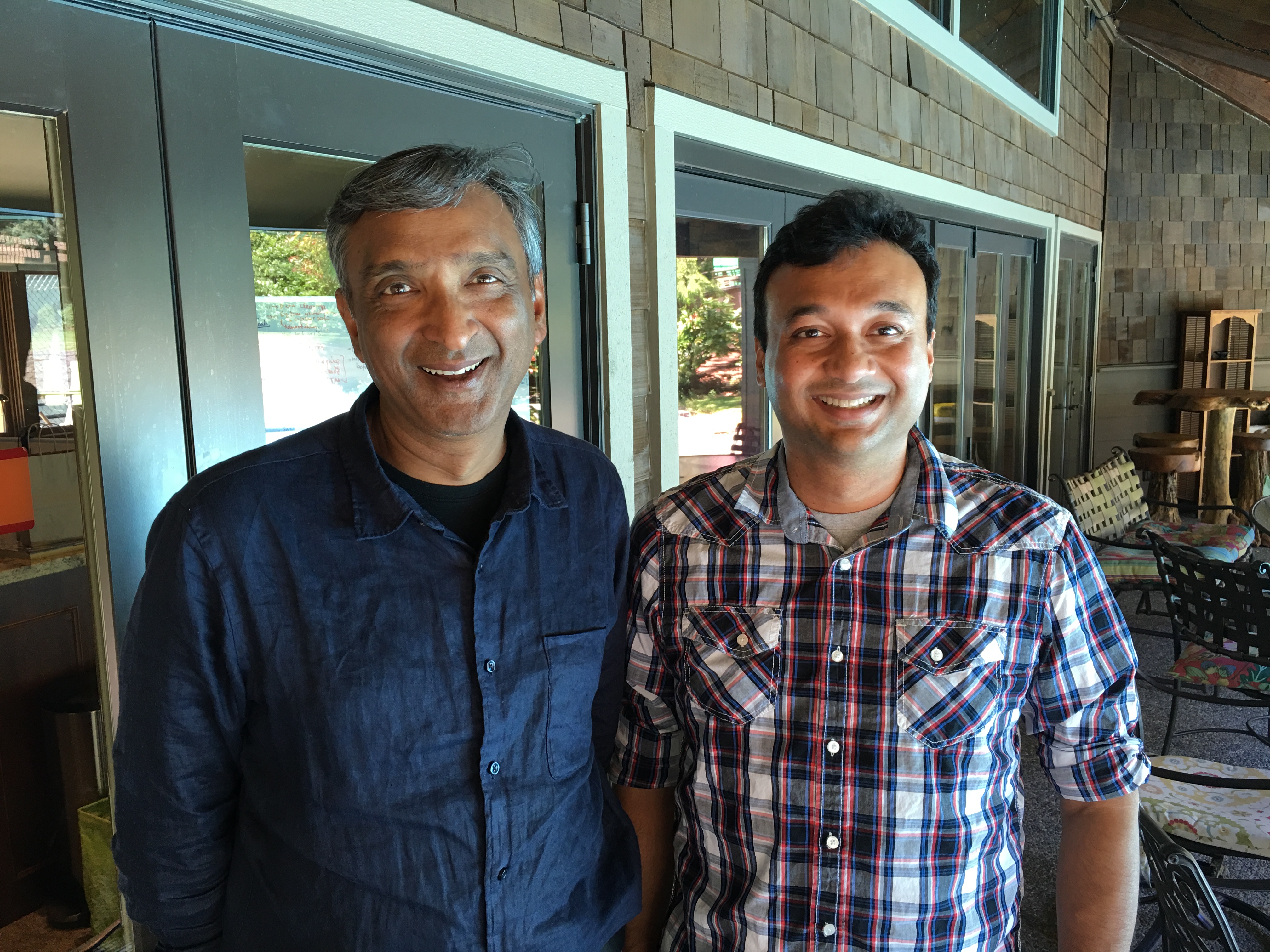
Gupta and Aravind Bala had worked together on Microsoft’s Office Mix presentation service. Both left Microsoft in November 2015. By the following summer, they were working with a small team at Gupta’s Bellevue home, near a cabana. His commute crossed the yard. Breaks could be spent in the garden.
Their early service, Telo, later known as Nextio, explored a different bargain for messaging. If a marketer or recruiter paid to reach someone, why should the recipient receive none of the value? The founders were trying to make attention worth giving. They had encountered the problem themselves while seeking feedback on possible businesses.
The messaging proposition did not catch on. A career-insights feature attracted more interest: recruiters wanted to understand career paths, job requirements and the people behind them. The company’s direction shifted toward recruiting, becoming SeekOut in 2017. Listening to the response meant letting go of the original pitch.
By May 2019, SeekOut had more than 75 enterprise customers and announced a $6 million round led by Madrona, with Mayfield participating. Its premise was specific. An engineer might leave stronger evidence of ability in code, patents or research than in a polished professional profile. Finding that evidence could change who received a call.
The person beyond the profile
That idea connected to a frustration Gupta had experienced as a leader. Organizations collected considerable data, yet often knew remarkably little about their own employees’ experience, interests and ambitions. Information sat in separate systems and spreadsheets. A company could be searching outside for an ability already present somewhere inside.
SeekOut’s ambitions expanded accordingly, covering internal talent as well as external recruiting. Gupta and the team discussed employee development, mobility and retention alongside hiring. The underlying question stayed close to his experience managing researchers and engineering teams: how do you understand what people can do, and give them a chance to do it?
The company’s growth brought a different set of lessons. In January 2022, SeekOut announced a $115 million Series C at a $1.2 billion valuation. That spring Gupta received GeekWire’s CEO of the Year award. In discussing the business, he increasingly emphasized culture, describing kindness, curiosity, empathy and collaboration as consequential choices in hiring and retaining colleagues.
The period after expansion also included retrenchment. SeekOut cut staff in October 2023 and again in May 2024 as recruiting demand weakened. The financing headlines and the reductions belong in the same account. Building a company includes decisions about contraction, and a founder’s résumé does not make the market cooperative.
“They still take a season to grow.”
Anoop Gupta, on tomatoes · April 2026
A new chief executive, a little open space
With SeekOut Spot, Gupta’s team moved toward a service combining AI agents and human recruiters. His explanation focused on the result a hiring manager wanted: suitable people to interview. Search software could become part of a delivered recruiting service. SeekOut Recruit continued to put the platform directly into recruiters’ hands.
It was a shift consistent with his earlier work: technical machinery had to reach an everyday task. In conversations about AI, he described the importance of understanding messy talent data, combining records and translating job requirements into useful searches. The newer agents extended that work into more of the recruiting process.
Thompson’s appointment, announced in April 2026, put a former NAVEX chief executive with SAP and Microsoft experience in charge of the next phase. Bala remained CTO. Gupta stayed involved as executive chairman. The arrangement allowed continuity without requiring the co-founder to keep occupying the same daily job.
For Gupta, the people around these transitions have always mattered. Hennessy encouraged his first move into a startup and offered a return to Stanford if it failed. Bala shared the uncertainties of the second venture. Looking back on their partnership, Gupta acknowledged frequent disagreements rooted in caring about the customers and the company they were building.
His departure message made room for gratitude and for a question about what deserved his time. After so many changes of institution, technology and business model, the change now concerned pace. SeekOut would have another chief executive. Gupta would have an ongoing role, a less crowded calendar, and a garden with its own entirely reasonable deadlines.
More from Gupta’s world
- SeekOut · Company profile
- Anoop Gupta on LinkedIn · Twitter / X
- Watch: Gupta and Soma Somasegar on AI recruiting
- Research, publications and career at Microsoft
- Read: hiring, culture and untapped talent
- Read: a 2003 conversation with Gupta
- Read: the 2026 leadership handoff
- SeekOut blog: 2026 EY regional finalist announcement