At a certain size, every institution becomes a geography. Jefferson Health's primary care operation has roughly 150 sites, spread across Pennsylvania and southern New Jersey, serving approximately one million people. Somewhere inside that map, a patient wants the simplest thing in medicine: to be known. Anna Flattau's job is to make the map answer.
Her title is System Chief of Primary Care. She is also the Alumni Professor and Chair of Family and Community Medicine at Sidney Kimmel Medical College. Those roles place one foot in the daily machinery of a health system and the other in a medical school preparing people to run the machinery later. The arrangement suits a career built around translation: from evidence to operations, from a pilot to a practice, from a neighborhood's need to an institution's budget.
The temptation is to describe this as a story about scale. Flattau's more interesting subject is what scale is for. She has worked in organizations counted by beds, clinics, partner agencies and billions of dollars. Yet her public language returns to relationships. "Trust is built on relationships," she wrote while describing virtual primary care. Five words, no management fog.
A physician learns to think in systems
Flattau's education looks like three lenses stacked carefully together. At the London School of Hygiene & Tropical Medicine, she earned a master's degree in health promotion. Harvard Medical School supplied the medical degree. Albert Einstein College of Medicine added a master's in clinical research methodology. Family medicine residency at Columbia University Medical Center brought the disciplines into a room with a patient.
The sequence helps explain the work that followed. A clinician asks what one person needs. A researcher asks whether an intervention works. A health-promotion specialist asks what surrounds the person before and after the appointment. Flattau kept all three questions, then acquired a fourth: how can an institution make the answer routine?
At Montefiore Medical Center in the Bronx, she became the founding director of a wound-healing program. The work crossed the usual borders between clinic and home. In 2008, Montefiore's home-health agency organized a dedicated nursing team rather than rotating patients among generalist teams. Flattau and two colleagues later wrote about the model for Harvard Business Review. The point was not novelty. It was continuity, specialized knowledge and a design that followed people across settings.
One surviving account from a Bronx community organization reveals her method on a smaller stage. Flattau helped develop a workshop, then personally trained peer educators to teach it. Ninety-nine residents participated. The organization remembered not only the improved knowledge afterward, but also the way the peers talked about a prominent physician who recognized their ability to teach their own community. Authority, in this version of medicine, was something to share.
“Family physicians are broadly trained to be responsive to the needs of the communities we serve.”Anna Flattau, 2026
One idea, widening circles
Build a cross-setting program at Montefiore, then document how its dedicated team works.
Help coordinate a New York care redesign with more than 200 organizational partners.
Join Jefferson and connect academic leadership with system operations.
Earn national recognition, then take on an elected role representing academic family medicine.
Two hundred partners and a very large spreadsheet
From 2015 to 2017, Flattau served as the founding Chief Clinical Officer of OneCity Health, a delivery-system reform network led by NYC Health + Hospitals. Its announced scale was formidable: a $1.2 billion initiative involving more than 200 partner organizations. The assignment was to build an integrated, value-based system across institutions that did not begin with a single operating rhythm.
This was coalition work, the least cinematic kind of leadership and among the hardest. A coalition has no shortage of good intentions. It has shortages of common definitions, compatible workflows and patience. Flattau designed and implemented initiatives in clinical care, population health and care management. The work expanded her unit of attention from a program to an ecosystem.
She returned to Montefiore in 2017 as vice chair for clinical services and director of strategic development in Family and Social Medicine. When the Bronx faced the first severe pandemic surge in 2020, the department reorganized quickly: its family-medicine hospitalist capacity tripled within two weeks while community centers shifted much of their work to telemedicine and preserved most of the prior year's visit volume. Flattau later co-authored the account. It reads like a field report on disciplined improvisation.
A different initiative showed what responsiveness could mean outside a clinical schedule. The Family Resilience Fund paired cash assistance with social-work support for more than 1,000 children whose caregivers died during the pandemic. The mechanism was practical because grief does not arrive alone; it brings rent, food, paperwork and all the other rude errands of survival.
The merger after the announcement
Flattau joined Jefferson in 2021. On paper, her present portfolio sounds like several organizations sharing a business card: traditional and virtual primary care, integrated behavioral health, medical weight management, complex-care models, geriatrics, palliative medicine and community-based care. She has also led her team through integration across multiple mergers. A merger may be announced in a ballroom; primary care absorbs it one referral, record and appointment at a time.
Her paired academic and system posts offer a way through that complexity. The department can study new models, teach them and train future clinicians. The system can put them into operation across regions. Each side keeps the other honest. Scholarship without implementation becomes a handsome PDF. Operations without inquiry can harden into habit.
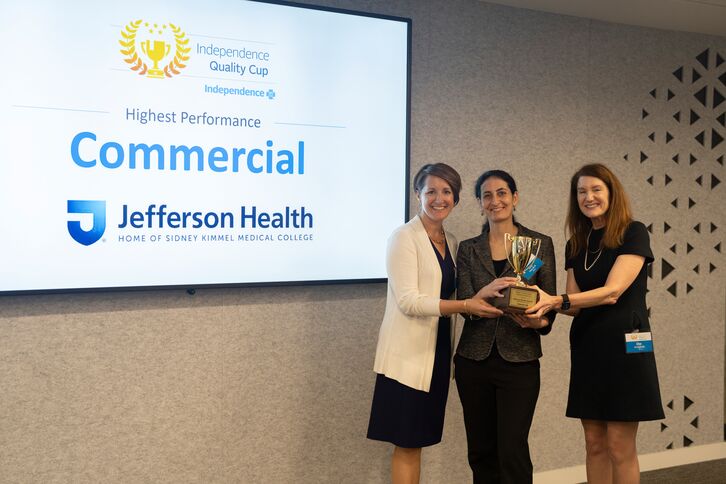
Recognition arrived twice in 2025. The Primary Care Collaborative presented Flattau and Jefferson with its Advanced Primary Care Practice Award, citing patient- and family-centered, team-based, high-value care. Later that year, Jefferson received an Independence Blue Cross Quality Cup for commercial primary care performance. Flattau accepted it with Jefferson colleague Jennifer Stephens and Independence executive Ellen Riccobene. Primary care finally had a literal trophy, a pleasingly extravagant object for a field whose victories are usually quiet.
Flattau responded to the national award by directing attention toward the leadership team across Jefferson's regions. It was consistent with the way she describes system change: as a collective craft. No individual can personally coordinate 150 practice sites. Leadership at that scale is the design of conditions in which many people can make sound decisions together.
“Delivery systems must support comprehensive, relationship-based primary care so that we can fulfill our critical role in the healthcare ecosystem.”Anna Flattau, 2026
Virtual, but not distant
Technology is often sold as a way to remove friction. Flattau talks about virtual care in more exact terms. It should meet patients' definitions of access, bring people who have stayed outside the system into ongoing care and support a durable relationship. Jefferson says thousands of patients from varied neighborhoods and age groups have enrolled in its virtual primary-care program.
That distinction matters. A video visit can be a transaction with better lighting, or it can become the front door to continuity. Flattau's public comments favor the second model. In a 2026 podcast conversation, she connected virtual access with broader questions about delivery and coverage. In her own writing, she praised technology for building bridges to people who might not otherwise engage. The bridge is not the destination; the relationship is.
Her national platform is widening. In March 2026, the Association of Departments of Family Medicine elected her president-elect. The organization represents more than 144 academic departments and health systems in the United States and Canada. Her three-year sequence moves from president-elect to president and then board chair. It gives her a forum for the argument already visible in her career: family medicine should be central to the design of healthcare, not merely asked to cope with the design afterward.
Flattau has said that increased investment in primary care is necessary for stronger individual and community outcomes. She has also joined national conversations about where that investment should go. Her preferred vocabulary is revealing: comprehensive, accessible, relationship-based. These are ordinary words carrying an ambitious instruction. Build something large. Keep it coherent. Let a person enter by screen or clinic door and still find a human being who knows why they came.
The map will continue to grow. Organizations will merge, technology will change and the spreadsheets will acquire new tabs. Flattau's career suggests that the test stays stubbornly small: when the system expands, can the relationship expand with it? One million people are not a market segment. They are one million separate reasons to get the architecture right.