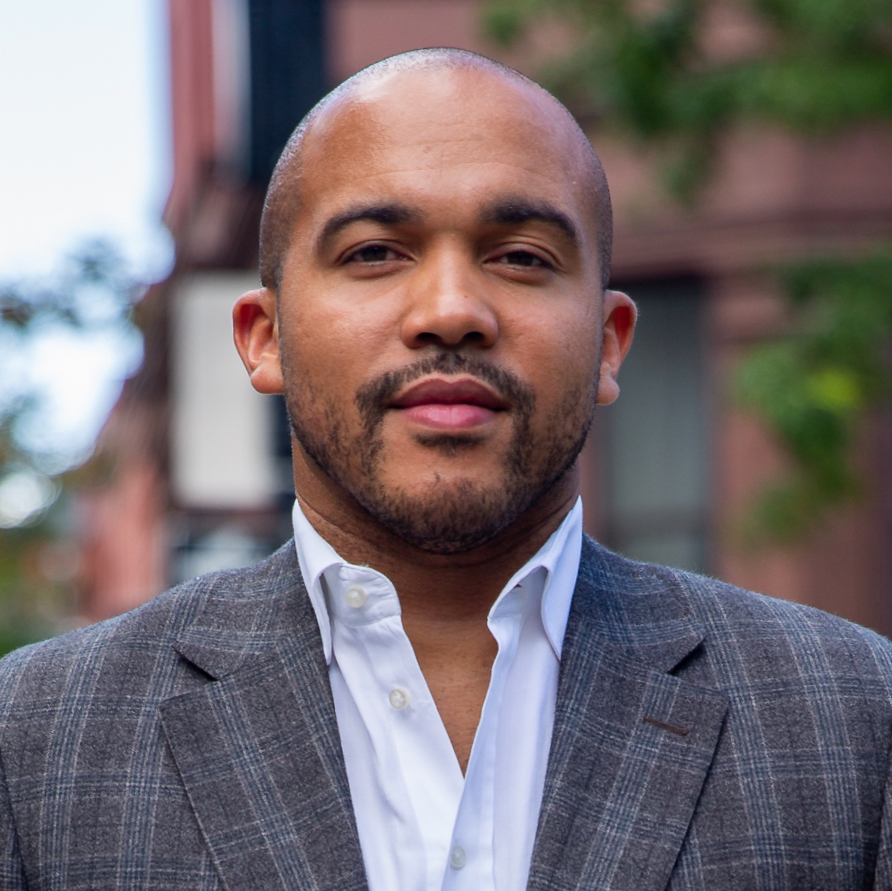
The Profile
A clinic that opened the month the city closed
April 2020. New York was emptying out. Sirens were the soundtrack. And in Harlem, a brand-new doctor's office turned on its lights with exactly three patient rooms. Most people would have called it the worst possible moment to open a medical practice. Akili Hinson called it Juno Medical and got to work.
While routine care was being shelved everywhere else, Juno kept doing the unglamorous, essential things: wellness exams, women's health screenings, the steady cadence of primary care that families need whether or not there is a pandemic on. The decision said something about the place and the person. This was not a man chasing a trend. It was someone who had decided, deliberately, that the neighborhoods large health systems skip were exactly the ones worth showing up for.
Hinson's resume reads like a tour of the institutions that usually pull young physicians away from neighborhood medicine. He earned a BA in economics from Georgetown, an MD from Weill Cornell Medical College, and an MBA from Columbia Business School. He did surgical residency at NewYork-Presbyterian. He worked as a healthcare investment banking associate at Goldman Sachs, then as a consultant at McKinsey & Company inside its Healthcare Systems & Services practice. Each rung pointed toward a comfortable, well-compensated, abstract relationship with medicine - the kind where you optimize health systems from a slide deck rather than greet a patient by name.
He went the other way. The McKinsey work gave him a clear view of where American healthcare leaks value and trust, especially for families who are underinsured, underserved, or simply unseen. Rather than write another recommendation, he built the fix. Juno Medical is the answer to a question he kept asking from inside the machine: what would modern, dignified, family-centered care actually look like if you designed it for everyone, not just the well-resourced?
Everyone deserves quality health care, regardless of where they live or their income, race, or sexual orientation.
- Akili Hinson
The model is deceptively simple and quietly radical. Juno blends adult primary care, pediatrics, women's health, and same-day visits under one roof, wrapped in technology that makes scheduling, results, and follow-up feel less like a bureaucratic obstacle course. The pricing aims to be transparent. The staff aims to look like the people walking through the door. And the locations are chosen on purpose: Hinson points Juno toward medically underserved areas and provider-shortage neighborhoods, places where a modern clinic is not a luxury but a rarity.
That instinct is most visible in Tulsa. Juno planted a clinic in the Greenwood District, the historic neighborhood once known as Black Wall Street. Choosing that ground is a statement about who deserves first-rate care and where. From Harlem the practice grew to Brooklyn, then to East Atlanta, then to Greenwood, with Inglewood in Los Angeles named as a target. Four cities, three states, one stubborn idea: your zip code should not decide the quality of your doctor.
Investors noticed. In December 2022, Juno closed a $12 million Series A led by NEXT VENTURES and Serena Williams' Serena Ventures, with a roster that included Vast Ventures, Empire State Development's New York Ventures, TXV Partners, Genius Guild, Gaingels, Atento Capital, and Humbition. Total funding climbed to roughly $17.45 million. The money was earmarked for the technology platform, new markets, and recruiting clinicians into the cities Juno was entering. When a tennis champion's fund and a state development arm back the same neighborhood clinic, the bet is no longer fringe.
Juno's vision is to reimagine the future of healthcare by finally making exceptional, family-centered care accessible and affordable for the 99%.
- Akili Hinson, on the Series A
The recognition followed the work. Crain's New York Business put him on its Notables in Health Care list in 2021. In 2024, the Obama Foundation named him a USA Leader for its 2024-2025 cohort, a program reserved for people building something durable in their communities. He has also served as a medical advisor to Dr. B. None of it changed the daily arithmetic of running clinics, but all of it confirmed the direction.
What makes Hinson interesting is the friction in his story. He is a surgeon by training who built a company around primary care, the least flashy and most needed corner of medicine. He is a banker-turned-consultant who left the world of abstractions to handle the concrete: a clinic's rent, a clinician's schedule, a family's appointment. He speaks the language of value-based care and digital transformation, then spends it on the patients those phrases usually overlook. He is not romantic about the system. He is precise about fixing it.
Family runs through the enterprise too. Dr. Shante Hinson, a rheumatologist and physician leader, joined as a founding physician, turning down other prestigious paths to help build Juno's clinical backbone. Hinson leads alongside a team that has included Aarti Agarwal, MD, Alex Bargar, and Desmond Morris. The phrase Hinson keeps returning to - care for families that are "fully stratified, vibrant, and thriving" - is less a slogan than a spec sheet for the kind of company he wants Juno to be.
Look closely at how Juno is assembled and the consultant's fingerprints are everywhere, just pointed in an unusual direction. Hinson talks fluently about value-based care, the idea that a practice should be paid for keeping people well rather than for the volume of visits it churns through. That framework usually lives in boardrooms and policy papers. At Juno it gets translated into something a family can feel: same-day appointments, a single roof for pediatrics and adult care and women's health, results you can actually find, and pricing meant to be read without a decoder ring. The technology is not the product. The technology is what gets out of the way so the care can happen.
There is also a clear-eyed read on geography embedded in the company. American healthcare tends to cluster where the money already is, which leaves a long list of neighborhoods technically inside major metros yet functionally short on modern primary care. Hinson built Juno to move toward those gaps rather than around them. It is a harder commercial path - the easy money sits in affluent corridors - but it is the entire point. A clinic in Greenwood or East Atlanta is not a charity outpost; it is a bet that excellent, well-run, financially sustainable care belongs in those places as much as anywhere, and that families there will choose it when it finally shows up.
The pandemic origin keeps proving useful as a stress test. A practice that can open and hold its footing in April 2020 has already answered the question every healthcare startup eventually faces: can it deliver when the system around it is failing? Juno did its wellness exams and screenings while larger institutions triaged everything else into next year. That early proof - operational, not theoretical - is part of why the Series A came together, and why the Obama Foundation's selection committee saw something worth backing for the long run.
Read his trajectory and the throughline is unmistakable. Every credential he collected could have bought distance from the exam room. He spent them buying his way back in - and bringing a better version of the room to the neighborhoods that had been waiting longest for one.