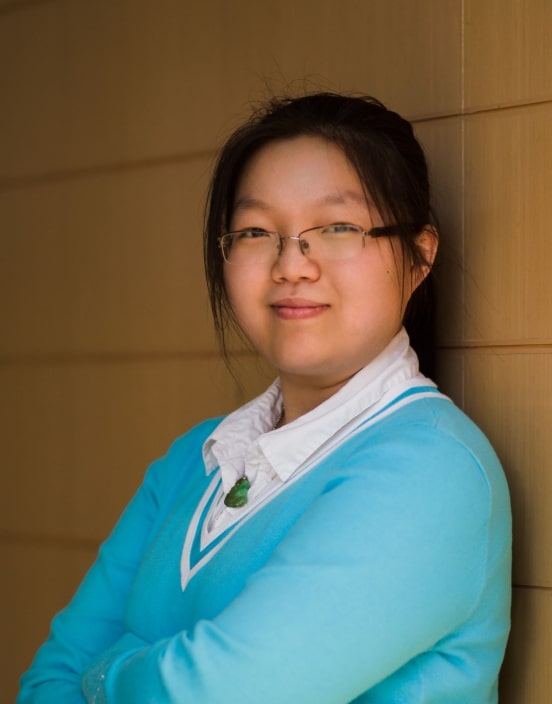
Ann Lin. The lab coat came off; the rigor didn't.
The Profile
Ann Lin
She decided the hardest problem in drug discovery wasn't the chemistry. It was finding the right lab to do it.
She decided the hardest problem in drug discovery wasn't the chemistry. It was finding the right lab to do it.
In March 2022, Ann Lin was complaining about a chore that every biotech founder knows and no one solves: finding the outside labs - contract research organizations, or CROs - that actually do the science a startup can't do in-house. The investor Elliot Hershberg listened, then told her to stop complaining and start a company. She circulated a Google Sheet to gather feedback from people drowning in the same problem. Within a week, the sheet had surfaced fifteen million dollars in potential projects looking for a home.
That sheet became Cromatic. Incorporated in May 2022, it now runs as an AI-native platform that helps life-science companies discover, vet, contract, and manage the labs they outsource to. The pitch is unglamorous and exactly the point: a market worth billions runs on stale referral lists, consultant fees, and hours lost to Google. Lin built software to replace the guesswork.
She is, by training, a geneticist - a Stanford PhD who could be at a bench right now. Instead she chose the plumbing. "Biotech companies often struggle to find suitable CROs and manage million-dollar contracted projects without proper software support," she says. It is a founder's sentence: the problem stated so plainly it sounds like it should already be solved.
The CRO landscape is notoriously hard to navigate, with firms wasting hours on searches or consultant fees.— Ann Lin, on why Cromatic exists
The teenage logic was disarmingly direct. As a Stony Brook undergraduate - a double major in biochemistry and economics, a pairing that reads, in hindsight, like a map of her career - Lin learned that a young scientist named Jason Sheltzer had made the Forbes 30 Under 30 list in 2015. "I'm going to join this person's lab," she recalled deciding. "He's young and he's motivated and he seemed like he would be a great mentor. And he really is an amazing mentor!"
The internship at Cold Spring Harbor Laboratory turned into something bigger. Working in Sheltzer's group, Lin helped produce one of the more uncomfortable findings in cancer pharmacology: a drug that worked - but not for the reason everyone believed. The supposed target wasn't doing the killing. The drug fought cancer as a kind of happy accident, hitting something else entirely. The result forced a harder question onto the whole field: how do you prove a therapy works the way you think it does?
In December 2019, Forbes named Lin to its 30 Under 30 in Science. She was 23, a Stanford PhD candidate, and already an author on research that had embarrassed a drug target. The teenager who picked a mentor off a list had become the kind of scientist who ends up on one.
Between the bench and the boardroom there was a detour through Norway, where she went as a Fulbright Scholar and built something that sounds like science fiction and is merely Tuesday in modern biology: an organ-on-a-chip device wired into a mass spectrometer, so a drug's effect on living tissue could be measured in real time. Economics, genetics, instrumentation, markets - the resume keeps refusing to stay in one lane.
Catch what others assume. The cancer-drug work was about verifying a mechanism nobody had questioned. Cromatic is about verifying vendors nobody had time to vet. Same instinct, different lab.
Feed it a multi-page RFP. It extracts the objectives, infers the skills required, standardizes vendor profiles by size, location and revenue, and hands back a shortlist - science fluency optional.
Plenty of founders chase the next molecule. Lin went after the part everyone hates and no one fixes: the search, the sourcing, the contracts, the project management. The middle of the sentence, not the headline.
It is a contrarian read on her own field. She co-founded a drug-discovery company, Meliora, and could have stayed in pure science. Instead she concluded the binding constraint on biotech speed was operational, not scientific - that a small company with a brilliant idea still loses months finding someone to run an assay. Cromatic's wager is that fixing logistics compounds across an entire industry.
The 2023 seed round paired specialist agri-bio funds AgFunder and LifeX with brand-name generalists - Accel, Kleiner Perkins, Lux Capital, FJ Labs. The company has also partnered with accelerators including Nucleate, SOSV, and ValleyDAO, plugging it into the early-stage biotech pipeline at the exact moment those founders first need outside labs.
Lin runs the company with CTO Anne Chen, a former software engineer at Meta - a deliberate pairing of deep life-science fluency with consumer-grade product engineering. The aim: make biotech software that feels like the apps people actually like using.
Make a notoriously opaque market navigable - and turn Cromatic into the default operating system for how biotech buys science.— The mission, distilled
Profile compiled from public sources: AgFunderNews, Cold Spring Harbor Laboratory, Meliora Therapeutics, Stony Brook University, Crunchbase, and Cromatic.