He helped invent a cancer drug. Then he decided the industry's real bottleneck wasn't molecules. It was knowing what everyone else had already figured out.
Most people who finish a chemistry PhD at Stanford go on to make molecules. Dennis Hu spent years doing exactly that. Then he did something stranger: he started writing about everyone else's molecules instead.
That writing became Drug Hunter - a subscription platform that takes the science buried inside patents, conference abstracts, and dense journals, and turns it into something a working scientist can actually read on a Tuesday. Today it serves more than 200 research and development institutions, including most of the world's top pharma and biotech companies.
The premise is almost insultingly simple. The science behind new medicines is some of the most expensive, hard-won knowledge on the planet. And for years, it was scattered across so many fragmented and obscure sources that the people who needed it most could barely find it. Hu treated that as a problem worth solving full-time.
He is not a journalist who learned chemistry. He is a chemist who learned that explaining the work clearly might matter as much as doing it. There is, as he likes to point out, no such thing as a PhD in drug discovery - and almost nobody has "drug hunting" written in their job description. He built the platform he wishes he'd had at the bench.
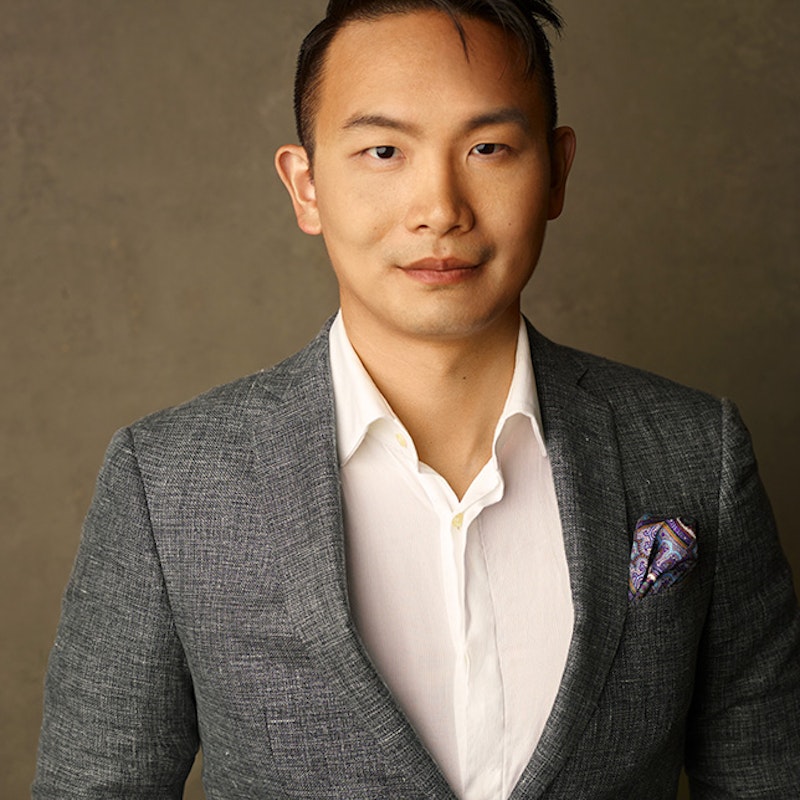
The amazing science behind new medicines was buried in increasingly fragmented and obscure sources.
Before Drug Hunter was a company, Hu was a project team leader at a small biotech then known as FLX Bio, later RAPT Therapeutics. There he worked on the kind of problem the whole industry obsesses over: getting a single molecule to do exactly the right thing inside the human body.
He contributed to the invention of tivumecirnon, an oncology candidate that advanced into Phase II as a cancer immunotherapy. Naming a real drug candidate is a rare thing. Most chemists go an entire career without one reaching a clinic.
Then he moved to Genentech, one of the most storied names in biotech, and led small-molecule work across a diverse range of target classes. He has the patents and publications to prove the bench years were not a warm-up act.
A Phase II oncology candidate for cancer immunotherapy. Hu helped invent it during his years leading a small-molecule team at FLX Bio / RAPT.
Small-molecule team leader, publishing and patenting chemical matter across a diverse set of target classes inside one of biotech's most respected shops.
Drug Hunter started in 2018, on the side. It was the kind of project a curious person does because the alternative - watching great science vanish into PDFs nobody reads - bothered them too much to ignore. Hu thought it was a tragedy that the insight inside new medicines was diluting across an ever-growing pile of journals, patents, and conferences.
For a while it stayed a hobby. Then came the announcement that every founder eventually makes: he was finally full-time on building Drug Hunter. The side project had outgrown the side.
In 2023 the company launched its commercial subscription plan. The growth that followed reads like a chemistry reaction that finally found its catalyst: roughly 200 institutional customers, more than 50,000 LinkedIn followers, nearly 20,000 newsletter subscribers, and an annual appearance in over six million searches.
The publishing pace went from monthly to daily - a twentyfold acceleration - powered by a team of more than ten full-time PhDs. By 2025 the company had crossed twenty full-time US employees and gathered, for the first time, in person in Oregon. The rest of the time, they work fully remote.
The detail Hu seems proudest of is the least glamorous one: the business runs on subscriptions. One hundred percent of revenue comes from people choosing to pay for it. The company is cash-flow positive, which means no fundraising treadmill and no obligation to anyone but its readers.
That independence is the whole strategy. It lets him hire, in his words, the most outstanding, independent, and innovative people - and keep the product honest, because the only customer to please is the scientist reading it.
There's no such thing as a PhD in drug discovery, and few have 'drug hunting' in a job description.
Some people collect stamps. Hu collected named fellowships - and the institutions that come with them.
From a single molecule in a clinic to a platform read across an entire industry.
His handle is @DennisWhom - a chemist who is also fond of a good grammar joke.
Drug Hunter is fully remote. The first time the whole team met in person was 2025, in Oregon.
He named a real drug candidate before he ever named a company.
Goldwater, then Churchill. He had a habit of winning the fellowship before winning the degree.
The talk series where Hu and guest experts break down real drug discovery programs.
His seminar on the people who champion drug projects without a job title that names what they do.
His own accounting of the milestones, the numbers, and why the company stayed independent.