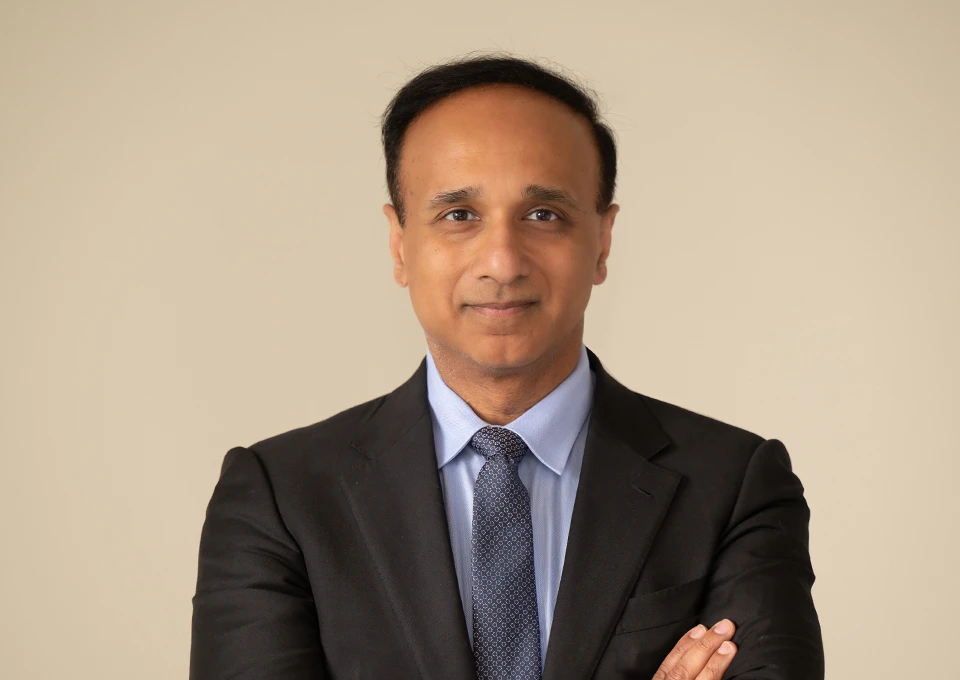
He keeps making medicines that weren't supposed to be possible
Walk into Parabilis Medicines in Cambridge and you meet a CEO who would rather talk about a protein interface than a balance sheet. Beta-catenin meets a partner called TCF inside the cell, and for decades that handshake drove tumors while sitting beyond the reach of every pill and every antibody. Mathai Mammen's team built a molecule to jam it anyway. They call it FOG-001. He calls it the whole point.
Parabilis is the company formerly known as FogPharma. Mammen joined in 2023, and by late 2024 he had renamed it - picking a word stitched from Greek and Latin that means, at once, "beyond what's possible" and "obtainable." It is a strange thing to name a company after a paradox. It is also exactly the bet. "We're a very different-looking company than we were 16 months ago," he told Endpoints when the fog lifted.
The vehicle is a class of engineered molecules the company calls Helicons - peptides that don't lock into a single rigid shape and draw on thousands of amino acid building blocks. That flexibility is the trick. It lets them cross the cell membrane and grip the flat, featureless surfaces where proteins talk to proteins, the places small molecules slide off and antibodies can't reach. Roughly 90 percent of the proteins inside a cell have been considered undruggable. Mammen treats that number as a map, not a warning.
What distinguishes good drug hunters from the rest is being able to connect the dots in a unique way.
- Mathai Mammen, to PharmaVoiceA chemist who became a physician who became a founder
The training reads like someone who refused to choose a lane. A BSc in chemistry and biochemistry from Dalhousie. A Ph.D. in chemistry from Harvard, working under George Whitesides, one of the most cited chemists alive. An M.D. through the Harvard-MIT HST program. Most people pick the bench or the clinic. Mammen took both, then went and started a company on top of them.
That company was Theravance, founded in 1997 straight out of graduate school. Look at the co-founders: Whitesides, his own doctoral advisor, and Roy Vagelos, the former CEO and chairman of Merck. A grad student does not normally assemble that table. Over the next 17 years his team nominated 31 development candidates and produced five approved products - Breo, Anoro, Trelegy, Yupelri, Vibativ - the kind of respiratory medicines that end up in millions of inhalers. In 2014 he and the leadership team split Theravance into two public companies, Innoviva and Theravance Biopharma.
The portfolio behind the name
Approximate scale of impact across four chapters
The big-pharma years
In 2016 he left to join Merck as a senior vice president, taking the reins across immunology, oncology, immuno-oncology, and cardiovascular, metabolic and renal disease. He arrived in time to help push Keytruda - now one of the best-selling medicines on earth - further along.
Then Johnson & Johnson came calling. On January 1, 2018, he became global head of R&D at Janssen, J&J's pharmaceuticals arm, eventually rising to Executive Vice President and a seat on the Executive Committee. The numbers from that stretch are the kind that get repeated in board decks: more than 40 acquisitions and licensing deals, over 350 strategic partnerships, nine global medicine approvals, and a reported 90 percent success rate moving programs from Phase 2 into Phase 3. He also pushed data science and AI into the discovery engine company-wide, early, before it was the default.
"You should develop your medicine in a unique and effective way that also will be very difficult for others to follow." His entire career is that sentence, repeated.
Why leave all that to run a startup?
Because, in his telling, the industry has a sameness problem. Too many companies stack onto the same validated targets, shipping medicines that look like the last medicine. He calls it the "me-too problem." His answer is to go where it's hard on purpose - to treat difficulty as the moat. "If we're able to uniquely drug the interface between beta catenin and TCF," he said, "that's a huge deal, and the business advantage is in that durable differentiation."
It is a philosophy with an edge to it, a quiet argument against an entire industry's comfort zone: "True innovation requires a fundamental industry-wide shift away from incrementalism and toward high-difficulty, high-reward science." Easy to say from a slide. Harder to say while spending real money chasing a target textbooks labeled hopeless.
If you build a culture and a team that knows how to execute and tackle new problems from scratch, you'll have a good company.
- Mathai MammenWhere the medicines came from
The throughline across Theravance, Merck, J&J and now Parabilis is a single sensibility: connect biology that others see as separate, and build the molecule no one else can copy. By the company's own count he has had a hand in roughly 19 approved medicines and more than two dozen others that reached clinical proof-of-concept. He has also written more than 150 peer-reviewed papers and patents - he is, genuinely, still a scientist, not just a manager of them.
The shape of the bet
Parabilis pairs the Helicon chemistry with an AI- and physics-based discovery platform, the two revolutions Mammen likes to talk about - biology and data science - colliding at once. The thesis is simple to state and brutal to execute: if the inside of the cell is mostly unreachable, then whoever learns to reach it owns territory no competitor can fast-follow into. FOG-001, described as the first beta-catenin:TCF interaction inhibitor, is the first flag planted on that map.
He keeps a hand in plenty of other rooms, too - board seats at Sandoz, Xaira, Kelonia and GBH, advisory roles with General Atlantic and Foresite Capital, and a past directorship at 10x Genomics. But the center of gravity is Cambridge, and the question he seems to be asking every day is the same one he has asked since the Theravance days: what can we make that nobody else can?
For three decades the answer has been: quite a lot. The undruggable proteins inside every one of our cells are about to find out whether the streak holds.