Before there was a listed drone company, there was a hovercraft made from thermocol. Rahul Singh brought the idea to Ankit Mehta at IIT Bombay: build something that could skim over Powai Lake. It was a wonderfully student-sized proposition, involving a large body of water and a generous interpretation of what counted as suitable building material.
They made prototypes. One worked. Ashish Bhat, another student with electronics expertise, joined their experiments. Mehta had arrived at the institute from Jodhpur in 2000; by graduation in 2005, he had worked on more than 20 hardware projects. The lake experiment supplied something a degree alone could scarcely guarantee: evidence that these particular people enjoyed making difficult things together.
That pleasure matters in his story. Long before he had investors to persuade or shareholders to address, Mehta had collaborators whose abilities he had watched at close range. His confidence in a future company grew out of practical work. A hovercraft was an unlikely business plan. As a way of discovering colleagues, it had rather more to recommend it.
A team assembled under pressure
Mehta completed a dual degree in mechanical engineering, specialising in computer aided design and automation. At IIT Bombay, technical competitions gave his friendships deadlines and consequences. He remembers the determination to win ABU Robocon as a force that brought the future founding group together. In 2005, the team won the national competition under Professor Amarnath’s guidance.
The group went on to represent India at the competition in Beijing. Their later company would deal in autonomous flight, but its working relationships had been tested much closer to the floor: robots, mechanisms, electronics, and the particular frustration of a machine refusing to do what its builders intended.
Mehta’s recollections give the institute’s Innovation Cell and Professor Amarnath considerable credit. They provided room to experiment and access to funding for ideas. The opportunity was unusually forgiving. An experiment could teach something even when it failed to become a product. Commercial life would eventually impose a less accommodating marking scheme.
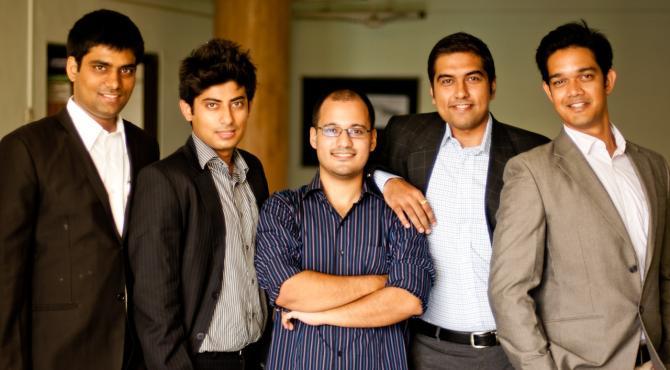
He also acquired a lasting connection outside the campus group. Vipul Joshi, his childhood friend from Jodhpur, joined the enterprise in 2008. The business gathered people through shared work and old friendship, leaving Mehta with relationships that reached back well before the company had a market.
The useful art of needing less
ideaForge was incorporated in February 2007. Its early work included a handheld device for generating power to charge electronics away from the grid. The name left the founders room to pursue different inventions; a company called ideaForge could change its mind without ordering new stationery.
To help finance the beginning, Mehta took a consulting job for six months and saved money. Later, the founders worked with a friend’s robotics education business and took on funded technical projects. Their route into entrepreneurship included a good deal of work that would never feature on a stock exchange screen.
He describes deliberately limiting his personal requirements. It is a plain account of a practical advantage: smaller personal expenses gave an uncertain business more time.
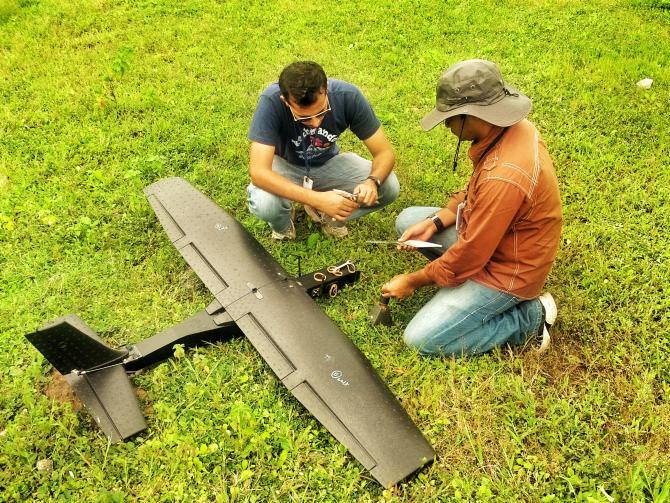
The early company worked on data logging and UAV electronics for IIT Bombay projects. Those jobs connected the founders’ technical interests to organisations with actual requirements. They also supplied a way to keep working while a market for their own products took shape. The glamorous object was an aircraft; the enabling work included electronics, contracts, and enough income to attempt the next thing.
“I had kept my needs very, very low.”
Ankit Mehta, reflecting on the early years
The aircraft gets a customer
In 2008, the team’s hovering platform shared first place with MIT at a micro aerial vehicle competition in Agra, organised by the Indian Army and the U.S. Department of Defense. Recognition brought enquiries from defence laboratories. The founders’ ability to integrate electronics and airframes had acquired an audience beyond the campus.
The Mumbai attacks of November 2008 sharpened their interest in aerial surveillance. By 2009, ideaForge had introduced an autonomous quadrotor. The question was becoming more specific: could a small aircraft give people on the ground a useful view of places they could not easily see?
An early prototype also appeared in the 2009 film 3 Idiots. A cinema audience could appreciate the airborne invention without considering procurement, training, maintenance, or the price of keeping a hardware company alive. Its builders had to think about all four. Bollywood supplied a memorable cameo; the business required customers who would return after the credits.
Mehta dates the first UAV sale to a state special task force in early 2010. The sequence is worth keeping straight: student experiments, technical assignments, competitive recognition, a product, and then a sale. Each step answered a different question. Being able to build something did not automatically establish who would buy it or how it would be used.
Sixteen years to the bell
The operating environment demanded several disciplines at once. Mehta has described drones as a meeting point for aerodynamics, structures, wireless communication, computer vision, cameras, and power electronics. An aircraft had to bring those systems together reliably in the conditions where a customer actually worked.
By late 2020, ideaForge had received a $20 million Indian Army order for SWITCH UAVs. The platform was designed for surveillance in high-altitude and difficult conditions. Its usefulness depended on the less photogenic side of engineering: integration, testing, and repeated improvements.
Investment arrived along the way, after years of limited resources. Qualcomm Ventures records joining the business in 2017 alongside Celesta Capital, Infosys, and other investors. The relationship extended into introductions to Qualcomm teams working on communications and computing. For a company combining aircraft and software, the relevance of a backer could reach well beyond a cheque.
On 7 July 2023, ideaForge listed on India’s stock exchanges. Sixteen years separated incorporation from that day. The interval makes a corrective to the compressed version of a startup story, in which the invention appears, investors arrive, and a bell rings before anybody has had to replace a component. Mehta’s route allowed ample time for the components.
- 2007Company incorporated
- 2009Autonomous quadrotor
- 2017Qualcomm investment
- 2023Public listing
Who gets to make the decision?
The company’s prospectus describes Mehta’s responsibilities as business growth, strategy, global expansion, and investor relations. Those duties take him some distance from a student project bench. They also explain why a profile of him needs more than an inventory of aircraft.
His early account of teamwork puts weight on complementary responsibilities. Different founders should have room to lead the decisions within their own areas. It is an appealingly practical treatment of the founder ego: give competence a territory and make responsibility clear.
In 2025, Mehta reflected on another change. He had moved from relying purely on data towards combining data with intuition earned through experience. He also wished he had sought more mentoring earlier. Hard work had occupied so much of his attention that he had underestimated the support and knowledge available around him.
The observation adds some texture to his reputation for persistence. Staying with a problem can be useful; learning from someone who has already met it can be useful too. Mehta’s later advice makes space for both. The engineer who once trusted the team’s ability to build now describes the value of a wider circle of judgement.
An aircraft should leave something useful behind
The institute recognised Mehta, Singh, and Bhat with Young Alumni Achiever Awards in 2020. That shared recognition suits a career whose important chapters keep returning to the same collaborators. Mehta’s public fellowship profile also records participation in the Unreasonable Impact World Forum in 2019 and work with FICCI’s drone committee.
His ambitions increasingly concern what happens after a drone flies. In a February 2025 discussion of civilian uses, he talked about moving from demonstrations to adoption at scale. Mapping a site can yield information about the volume of earth to be moved. The flight is one operation in a longer chain of work, ending with an answer someone can use.
That outlook helps explain the company’s combination of aircraft, software, training, and services. A buyer may admire a flying machine; a working organisation needs it to fit into a task. Mehta’s aspiration is for drones to become part of everyday infrastructure. In that future, the aircraft can lose some of its novelty while becoming more useful.
It is a considerable distance from the pleasure of making something hover over a lake. The pleasure remains legible, though. The recurring question is what else a physical machine might make possible once it leaves the bench.
Aerial dataProcess
A usable modelDecide
Work on the ground
The next load to carry
The U.S. company site presents Mehta as CEO within its founders section. The Indian parent is ideaForge Technology Limited; its U.S. subsidiary is ideaForge Technology Inc. Keeping those names distinct matters as the business pursues opportunities beyond India.
In June 2026, American Industrial Technologies announced a letter of intent with the U.S. subsidiary to explore a joint venture involving drones, AI, secure mobility, and communications. The corrected announcement identified Mehta as a director of ideaForge Technology Inc. The proposed venture remained subject to definitive agreements and approvals.
An October 2026 development brought another engineering problem into focus. India’s Technology Development Board agreed to ₹151 crore in debt support for YETI, a heavy-lift, long-range autonomous aerial logistics project with a total cost of ₹302 crore. The programme aims to move the aircraft from development towards deployment, carrying payloads through demanding terrain.
For Mehta, the next task therefore includes moving things as well as seeing them. There is a pleasing continuity between that ambition and the early experiments: a physical obstacle, a group of builders, and an aircraft expected to earn its place in the world. After the listing bell and the cinema cameo, the most persuasive performance is still the ordinary one. The machine has to work.
Follow the flight
Conversations, company information, and further reading.
- Company website
- U.S. founders page
- X
- IIT Bombay profile
- Powai Lake origins
- Early founder interview
- The years before the listing
- Engineering and customer adoption
- Qualcomm Ventures retrospective
- Leadership conversation
- Civilian drone applications
- IIT Bombay award record
- 2023 prospectus
- Proposed AIT venture
- YETI development update
- Writing by Ankit Mehta
- Watch: built2share conversation
- Watch: market debut