A room has a tiresome habit of staying where you put it. You can repaint it, furnish it, even persuade yourself that the commute to it is character-building. The room remains stubbornly at the other end of the journey. Angelo Yu’s work begins with the possibility that this arrangement might be negotiable.
Yu, who also uses the name Chuan Yu, is the founder and CEO of PIX Moving. He is its chief design officer too, a combination of jobs that makes sense once you understand his background in architecture. His vehicles carry an architectural question inside them: what could people do with a space if the space itself could travel?
The answer has taken him through programming, small drones, fabrication experiments and autonomous robotic platforms. It has also required a rather literal change of scale. An airborne gadget fits on a workbench. A movable shop must fit into the life of a street. Yu has kept following the relationship between what can be designed and what can actually be made.
The small machines came first
Yu attended Chongqing University between 1996 and 2000. Architecture became one part of a career that would extend into engineering and entrepreneurship. Alongside it ran an interest in programming, and in 2011 he won a national cloud-computing competition. The next year, he entered drone entrepreneurship. Software was becoming a physical object someone could buy, handle and use.
An early maker profile gives a more revealing view of his interests than a tidy job title could. Under Digital Craft, Yu described projects involving a nanocopter, the digital fabrication of traditional crafts, fabrication in architecture and a miniature manufacturing execution system. The list ranges from entertainment to buildings to the machinery needed to produce things.
There is a recognizable concern connecting those projects. He wanted people to have more access to making. The planned work included crowdfunding and sharing results under a Creative Commons license. Architecture and manufacturing sat next to a tiny flying robot, with no apparent anxiety about whether they belonged on the same page.
A small drone was a manageable place to explore those interests. It forced a design into the world, where components, assembly and users could argue back. The distance between a drawing and an object is where a maker discovers how many opinions matter. Yu would later confront that distance with much larger machines.
Cloud-computing competition win
Drone entrepreneurship
A garage-era story reaches film
Writing about autonomous cities
A camera in the garage
Yu’s early work acquired an unusual witness. Swiss filmmaker Jürg Neuenschwander followed the team and made their story part of The Chinese Recipe: Bold and Smart, a documentary released in 2015. The film brought together three accounts of people making and developing products in China. Yu appeared as the drone entrepreneur whose team hoped to join an international community of technology pioneers.
That description catches him before the autonomous-space vocabulary took over. There was a team, an ambition and a search for a wider audience. A documentary can preserve the awkward middle of a project, when the work is underway but its eventual identity has yet to settle. A company biography usually tidies that period away.
In June 2023, Yu shared photographs of a reunion with Neuenschwander in Switzerland. He recalled the garage and said the filmmaker and crew had followed the team for almost two years. A decade after those early days, he recognized familiar visions and dreams in the work they were still doing.
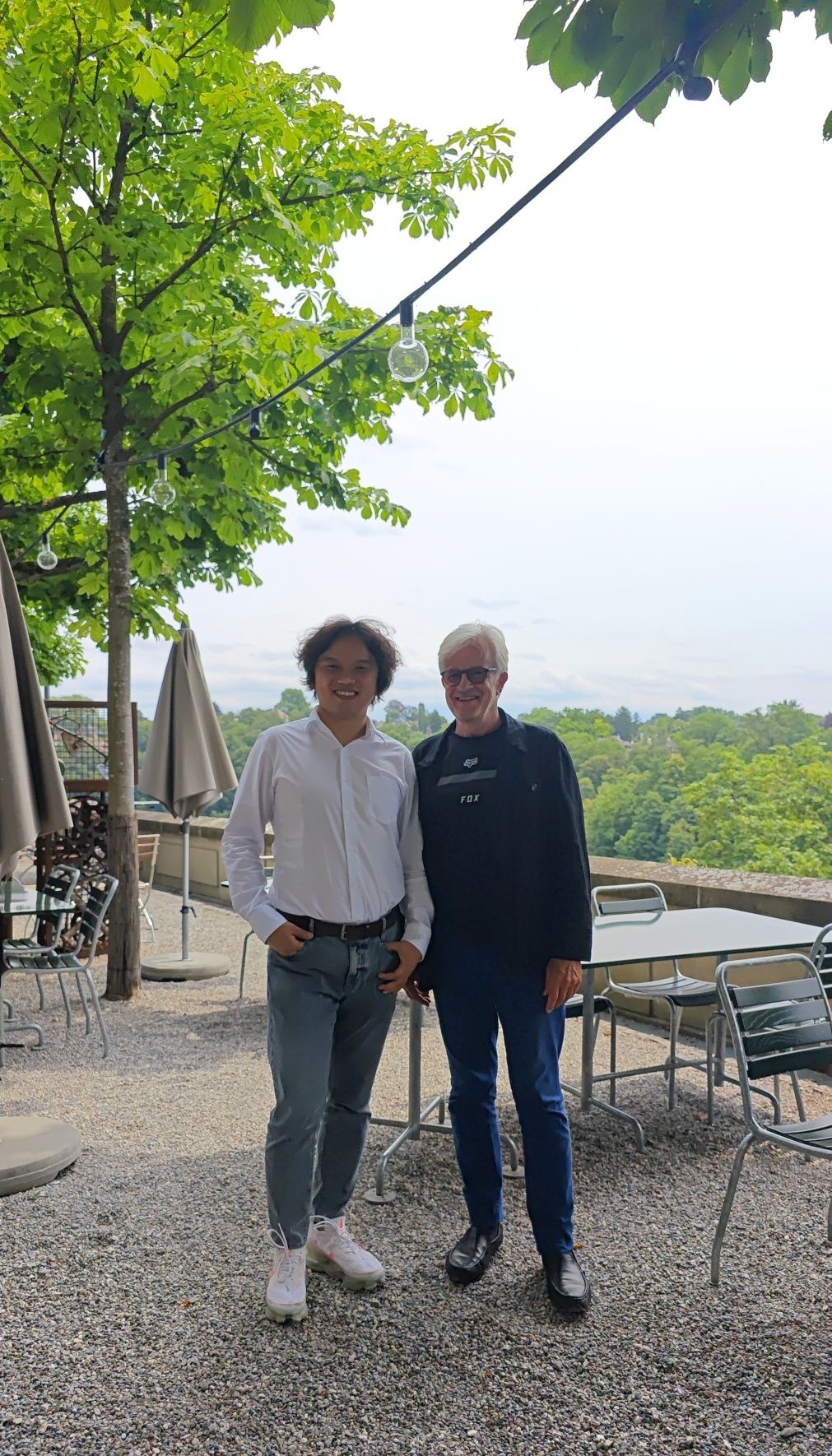
The photograph is cheerfully ordinary: two people smiling outdoors, chairs and tables behind them. Its interest lies in the continuity. One person remembers the work from inside; the other remembers it through a camera. The objects changed. The friendship provided someone who could recognize the earlier version of the ambition.
The important part is under the floor
PIX’s moving-space idea depends on a modular robotic chassis. Think of the chassis as the working base, with the cabin’s purpose designed above it. A shuttle, a retail space and another service can make different demands on the interior while sharing the logic of a platform underneath.
For Yu, that separation creates room to think. A vehicle’s familiar layout carries many decisions made for its familiar job. Change the job and those decisions become available for inspection. Where should people sit? What should the cabin hold? Which parts of the shape follow the function, and which simply follow habit?
The architecture connection becomes concrete here. A room is judged partly by the activity it allows. Applying that approach to a vehicle puts its usable space at the center of the design brief. The moving base becomes the means of delivering that space to a place where it has something useful to do.
There is a pleasant provocation in this arrangement. We spend considerable effort bringing ourselves to services. A movable service reverses the direction of that effort. It also gives the designer a new set of problems: the space must work when it arrives, and it must remain a sensible thing to move.
A custom room needs a way to be made
Customization brings a manufacturing question with it. If different customers want different shapes and functions, how can the resulting hardware be produced efficiently? Yu’s work with digital fabrication addresses that question alongside the vehicle design. The cabin and the production process are parts of the same undertaking.
PIX has used generative design in Autodesk Fusion 360 to explore chassis geometry for different requirements. The company combines this approach with robotics and metal 3D printing. The practical attraction is the possibility of adapting a structure without treating every variation as an entirely unrelated product.
Yu has described a manufacturing ambition involving distributed production and participation by users. It echoes the earlier maker projects, where the ability to design and fabricate belonged close together. He wants flexibility in the finished object and in the means of producing it. Each ambition makes the other harder to dismiss as a drawing exercise.
It is easy to enjoy the appearance of an unconventional vehicle. The less photogenic question is how its parts get made, assembled and adapted. Yu’s interest in that question helps explain why his career keeps crossing the boundary between design and engineering. A configurable room has to survive the factory before it can improve the street.
Leave room for other people’s ideas
Yu’s recruiting philosophy fits this habit of crossing disciplines. In 2021, he emphasized the need for technically committed people and for team members who could approach problems from different angles. He described a company that had grown from roughly a dozen employees to more than a hundred, including colleagues from several countries.
“Having the right talent is crucial for technological innovation, and we needed real technology ‘geeks’.”
Angelo Yu, 2021
The projects also made space for people outside the payroll. PIX’s Self-driving Moving Hackathon invited engineers and enthusiasts to work with vehicle platforms, sensors, computing equipment and software. Yu was listed among the judges. The event offered practical access to hardware that would otherwise be difficult for an individual developer to assemble.
A hackathon has a useful impatience. People have to make decisions, try the machinery and discover where their explanations fail. In this case, the invitation extended from full-size vehicles to small Donkey Car projects. The scale could change; the opportunity to test an idea remained the attraction.
That approach puts a social structure around a technical platform. A chassis becomes more interesting when other people can imagine uses for it. Yu’s early commitment to accessible fabrication and his later interest in autonomous-space platforms meet in that willingness to let someone else arrive with a different brief.
Switzerland, then the street
The Swiss connection eventually extended beyond the filmmaker’s friendship. By January 2025, PIX had established PIX Moving GmbH in Zurich. Its plans included local partnerships with businesses, universities and research institutions. Yu spoke about introducing the company’s robotic vehicles and collaborating in Switzerland as AI and automation developed.
His urban ambition also remained explicit. In his IAA MOBILITY interview, PIX described a vision of serving 100 cities, 1,000 communities and one billion rides. Those are goals, rather than a tally of completed deployments. They show the scale at which Yu wants the moving-space idea to become useful.
100cities
1,000communities
1bnrides
The smaller test is more revealing. In his June 2026 writing, Yu discussed WonderLoop in Guiyang as an early experiment connecting an autonomous route with tourism, experiences and commerce. He described the task of bringing operators and partners together around a route. The vehicle has to find a useful role in a particular place.
That is where the architect’s question encounters an operating schedule. A mobile room requires a reason to arrive, a place to stop and something people want to do inside it. An urban idea acquires details: which activity suits the space, who provides it, and whether people choose to return.
Yu is still working through that question in public. PIX’s October 2026 promotion of his writing asked what follows when the steering wheel disappears, and invited visitors to meet him during the Paris motor show. The argument has traveled far from the small drone. Its practical test remains close to the ground.
There is a modestly comic pleasure in a career devoted to persuading rooms to stop being so sedentary. But Yu’s proposition asks for a serious judgment. A space earns its place through what happens within it. Give that space wheels, and the judgment travels with it. Every arrival becomes another chance to make the idea useful.