Andrew Smith was in sixth grade when he fell for the usual suspects: Ferraris, Lamborghinis, Porsches. A car magazine supplied the temptation. A science teacher supplied the complication. Those beautiful machines, the teacher pointed out the following year, had terrible fuel economy. A boy who liked exploring the woods of northern New England now had two enthusiasms that required some reconciliation.
By eighth grade, Smith was talking about starting an electric-vehicle company. The ambition would take a circuitous route. He would study physics, work in consulting, go to business school, sell equipment for the backs of trucks, and eventually devote himself to vehicles whose working lives unfold between parking spaces and warehouse doors. The Ferrari had rather more exciting holiday plans.
There is a recognizable consistency beneath that change of scenery. Smith has spent his career trying to make environmental technologies commercially useful. The setting grew less picturesque as the application became more specific. Today, as founder and CEO of Outrider, he is working on the short, repetitive journeys that help the rest of the freight system keep its promises.
The electric car came first
During college in the 1990s, Smith managed an electric-vehicle demonstration program. Its raw material was the Geo Metro. The team replaced combustion engines with batteries, beginning with lead-acid technology and later using nickel-metal hydride. It was an early encounter with the practical work of putting an environmental idea into a machine someone could actually use.
He earned his physics degree at Middlebury in 1998. His work before ATDynamics included GE Wind Energy and international economic-development consulting. These experiences put technology alongside business decisions: who would buy something, what it would cost, and what would persuade a customer to change an established habit.
Smith's own account of those early conversions makes the continuity unusually tangible. Years before he was discussing fleets of autonomous electric trucks, he was working with small cars and much older batteries. Hardware changed. So did the scale of the customer. The stubborn commercial question traveled with him: how do you get a useful technology into everyday operation?
“I’ve devoted my career to the commercialization of environmental technologies.”
Andrew Smith, introducing Outrider in 2020
A business at the back of the truck
At Tuck, Smith turned toward the rectangular box being pulled along the highway. A semi-trailer has plenty of room for freight and plenty of opportunity to waste energy pushing through air. ATDynamics, founded in 2006 while he was an MBA student, addressed the drag behind it with attachments called TrailerTails.
The attraction was measurable. TrailerTail attachments could save about five percent of the fuel burned at highway speed. A small percentage becomes interesting when the vehicle spends its working life consuming fuel. A fleet buyer could examine the equipment in the language of operating costs, alongside the environmental argument that had brought Smith to the problem.
By the time STEMCO/EnPro Industries acquired ATDynamics in 2015, more than 40,000 TrailerTails had been deployed across over 500 fleet customers in nine countries. Smith had taken an idea from business school into an industry where equipment must endure repeated use. He later described the experience as an education in the durability that transportation customers require.
After the sale, he spent time with his family and considered what to build next. He also became interested in a different commercial arrangement: a service that customers would use continuously, generating recurring revenue. His next venture would ask him to take responsibility for a broader slice of the customer's operation.
The colleague from the mountains
Smith approached Bob Hall about Outrider in late 2017. They already knew each other from Tuck, where they had shared a house in Norwich, Vermont. Their acquaintance had also survived trips into the mountains, including high-altitude adventures in India. Smith's assessment of Hall was admirably economical: “Bob has incredible grit.”
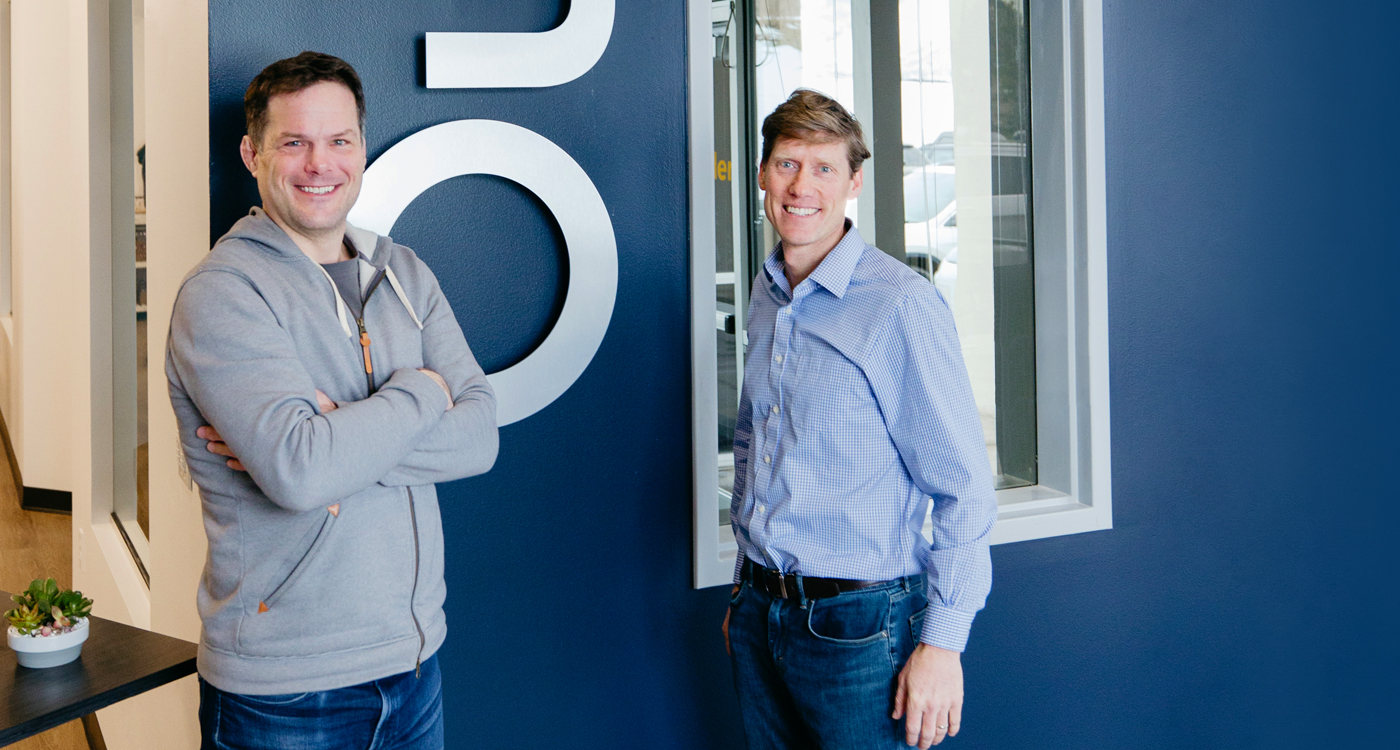
Hall joined as chief operating officer in 2018. Their history offered more than a pleasant story for company introductions. They had watched each other make decisions away from an office, when plans and conditions could change. For a young company facing frequent decisions, familiarity with a colleague's judgment can spare a considerable amount of explanation.
Smith has described a shift in his own priorities between building his first company and his second: far more attention to people. The connection with Hall gives that idea a human scale. An organization combining robotics, cloud software, and freight operations needs people who can solve problems together. A resume tells you certain things. Several days off the grid can add footnotes.
By October 2023, Outrider's team spanned ten countries. The company had grown to 194 employees, compared with 134 the previous year. Smith was building an organization around specialists in industrial autonomy, including safety technology and deep learning. The range of skills illustrates what he was asking people to accomplish together: software had to make decisions that heavy equipment could carry out in a working yard. Hiring was part of delivering the machine.
The yard has its own choreography
Outrider was founded in 2017 and emerged publicly in February 2020 with $53 million in disclosed funding. Its chosen territory was the distribution yard, the space between the warehouse and the open road. Yard trucks move trailers between parking positions and loading docks. The distances are modest; the number of things that must happen correctly is less so.
A vehicle must find the requested trailer, reach it, hitch to it, connect the necessary lines, maneuver it through the yard, and position it at the destination. Then it must leave the trailer and prepare for another job. A truck that can steer itself has completed only part of that sequence. Outrider's TrailerConnect robotic arm deals with the connections that make trailer movement possible.
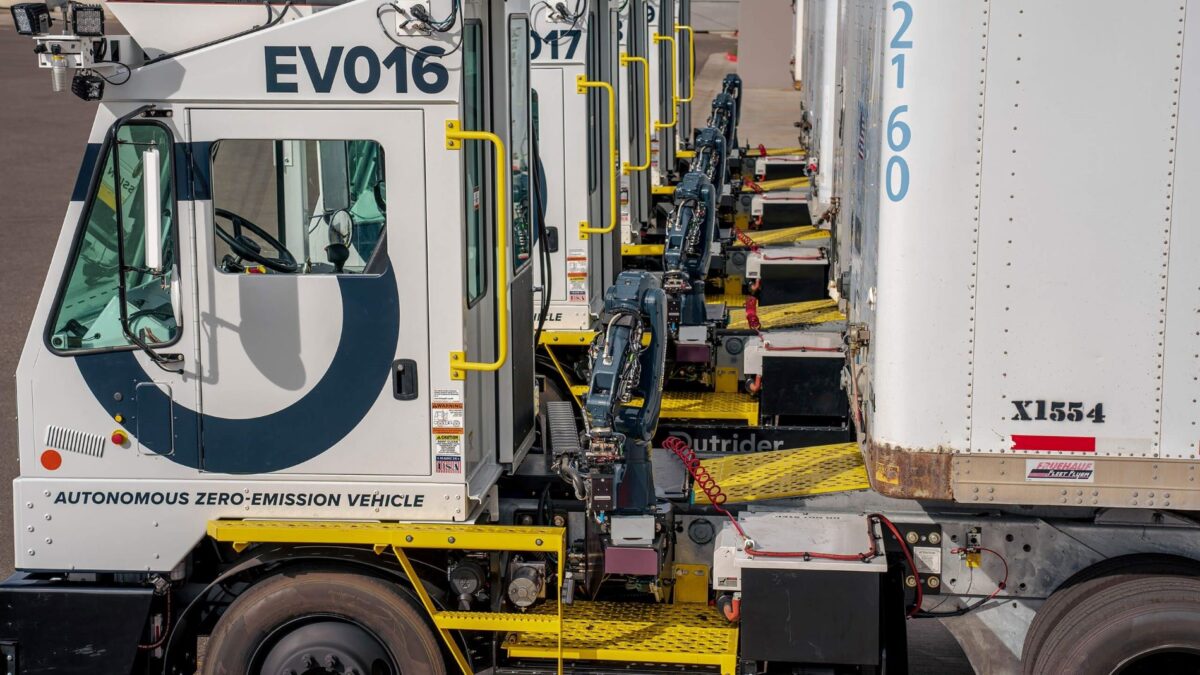
Smith chose a defined industrial setting on private property, with repetitive tasks and clear operational purposes. Even here, the surroundings refuse to behave like a tidy diagram. Trucks, trailers, other vehicles, and people share the space. The company combines vehicle autonomy with management software and site infrastructure so that a movement requested in software can become a completed physical task.
- 01Dispatch
Request a trailer - 02Find + hitch
Meet the right load - 03Connect
Handle the lines - 04Move + dock
Complete the job
Conceptual workflow. The whole sequence matters.
Electric power was part of the approach from the beginning. Smith has pointed to the platform's cleaner operation, stable supply of electricity for onboard systems, and lower mechanical complexity. It is a choice consistent with his early ambition, applied to equipment that works hard over short distances. The journey from a Geo Metro to a yard tractor is long enough to contain an entire career.
What comes after a demonstration
The business has required capital as well as patience. In October 2024, Outrider announced a $62 million Series D led by Koch Disruptive Technologies and New Enterprise Associates. Total equity capital raised had passed $250 million. At that point, the company reported more than 100,000 autonomous trailer moves across customer deployments and its test site.
Those figures describe different things: financial backing and accumulated operating experience. Neither tells a customer, by itself, what tomorrow's shift will look like. For Smith, commercialization keeps returning to the less theatrical work around the vehicle: integration, predictable behavior, testing, and someone ready to resolve a problem.
In January 2025, Outrider reported a tenfold improvement in path-planning speed through reinforcement learning. That measures the speed of planning a path, rather than how fast a truck drives or how much more freight a whole facility handles. The distinction helps explain the kind of progress involved: specific improvements within a system whose parts must work together.
In July 2025, the company announced that TÜV SÜD had preliminarily assessed its functional safety approach and found it aligned with the organization's AV Conformity Framework requirements. Outrider described 14 safety mechanisms in its system. The assessment concerned the approach; the ongoing task was to accumulate evidence of its implementation and effectiveness.
Then came support services, announced in November 2025 for the planned 2026 commercial rollout. A blocked parking space might need a person onsite. A technical problem might require remote assistance. Smith had already acknowledged years earlier that robots would encounter problems. Building a service means making room for those moments in the product itself.
The next trip starts with adoption
On October 1, 2026, Outrider and YMX Logistics announced a five-year, non-exclusive commercial agreement. YMX would lead implementations, finance and operate self-driving fleets, and provide onsite support. Outrider would support deployments and provide remote monitoring and technical assistance. Initial deployments were planned for that year.
The arrangement addresses a familiar barrier in Smith's career: customers have businesses to run while new technology arrives. Asking them to become experts in deploying it adds another job to an already crowded day. A partner responsible for operations and implementation gives the technology a more practical route into the yard.
Smith remains attached to the outdoor world that helped start all this. His documented expeditions include Patagonia, the Himalayas, and Alaska. He has described preserving those experiences for future generations as part of his motivation for reducing fossil-fuel use. The mountains have supplied both a reason to work and, in Hall's case, someone to work with.
The boy with the sports-car enthusiasm ended up concentrating on trailer movements. There is a certain pleasure in the specificity. A requested load reaches the correct door. A truck is ready for its next task. The business succeeds only when such ordinary things happen reliably. Smith has given those short journeys a substantial portion of his life. They have taken him quite a distance.
Keep following the short trip
- Outrider website
- Explore the Outrider company profile
- Andrew Smith on LinkedIn
- Watch: The New Warehouse interview (2025)
- Listen: The Robot Report interview
- Smith on introducing Outrider (2020)
- Tuck: Smith and Hall’s partnership
- Dartmouth: career and ATDynamics record
- FreightWaves: Smith on building a global team
- Smith on cars, conservation, and electric yards
- Outrider: October 2024 financing
- Outrider: reinforcement learning update
- Outrider: functional safety assessment
- Outrider: support services
- Outrider and YMX: October 2026 agreement