Andy Hill announced his next business chapter with twins on the way and a fourteen-month-old at home. In the usual founding story, the entrepreneur waits for a sign. In Hill’s version, the household calendar had apparently supplied several signs to wait. He went ahead anyway. “But when have leaps ever had proper footing?” he asked.
The announcement, in November 2023, introduced Sundial to entrepreneurs and executives. It also admitted something more interesting than a new company name: he had learned how to make money before he had learned how to put it to work. Success had delivered a fresh assignment. The founder was back at the beginning, asking questions.
That admission gives his career a useful shape. Hill’s work has crossed social enterprise, staffing, retail, and investment management. The recurring subject is what happens when a promising idea meets the people who must actually use it. An app needs participants. A recruitment business needs a convincing match. A retailer needs a relationship that survives the transaction. An investment business needs an owner willing to remain responsible after the excitement of the deal has passed.
A startup with room for an empty wallet
Long before Sundial, Hill was working on a way for people to support charities without reaching for their credit cards. Stand4 connected individual participation with corporate sponsorship. Someone could take a small action; a sponsor would provide the funding. The idea gave the person with enthusiasm, but little spare money, a place in the transaction.
Hill is a University of Dayton alumnus from the class of 2012. His early entrepreneurial work included a social media marketing firm started while he was a college sophomore, with clients including Domino’s Pizza. He subsequently worked in merchandising strategy at Office Depot. The route into founding involved both starting something small and seeing how a larger organization operated.
In March 2014, Stand4 tested its concept with Dayton’s basketball audience. A click through the campaign could fund a meal for someone in the local community. Hill later described the university’s participation as proof that the concept had a practical audience. By early 2015, he was discussing an app that linked simple challenges with charitable actions and sent participants updates about their impact.
The important detail was the update. Participation alone can be forgettable; seeing what followed gives it a memory. Stand4’s design tried to shorten the distance between a gesture and its consequence. There is a practical question tucked inside the cheerful app concept: how do you help a person understand that their involvement counted?
The argument against a crowded mind
During those years, Hill also wrote about the way people work. In January 2015, he made a case for giving one task, or one conversation, full attention. He began with admiration for his mother’s ability to handle several responsibilities at once, then questioned the assumption that splitting attention always makes life better.
His examples were ordinary: answering messages in a meeting, making a call while driving, letting another activity intrude on a conversation. The concern was what gets lost when a person is only partly present. The essay makes an interesting companion to a career spent moving among businesses. A crowded calendar and careful attention have to negotiate with each other.
A second piece that month explored empathy in marketing. Hill argued for personal moments that create a connection beyond the familiar measurements of online advertising. Read together, the essays reveal the questions he chose to put in public: how much of ourselves do we give a conversation, and what makes someone remember an interaction?
There is an agreeable inconvenience in that view. A dashboard can make the work look wonderfully tidy. A person arriving with questions, hesitation, and a different idea of what matters tends to spoil the symmetry. Hill’s writing leaves room for that person. The difficulty of measuring a moment does not make the moment disposable.
Priorities you could see on a board
By July 2015, Hill was writing about the working machinery at Stand4. He described a team of more than twenty and the tools it used to coordinate work. Trello cards formed the center of daily standups: rank the tasks so that everyone could see the team’s priorities.
He also described automations for reminders and saving photographs, along with software for preparing for meetings and tracking correspondence. The particular products belong to their moment. The underlying problem remains recognizable to anyone who has worked on a small team: information arrives everywhere, and somebody has to decide what happens first.
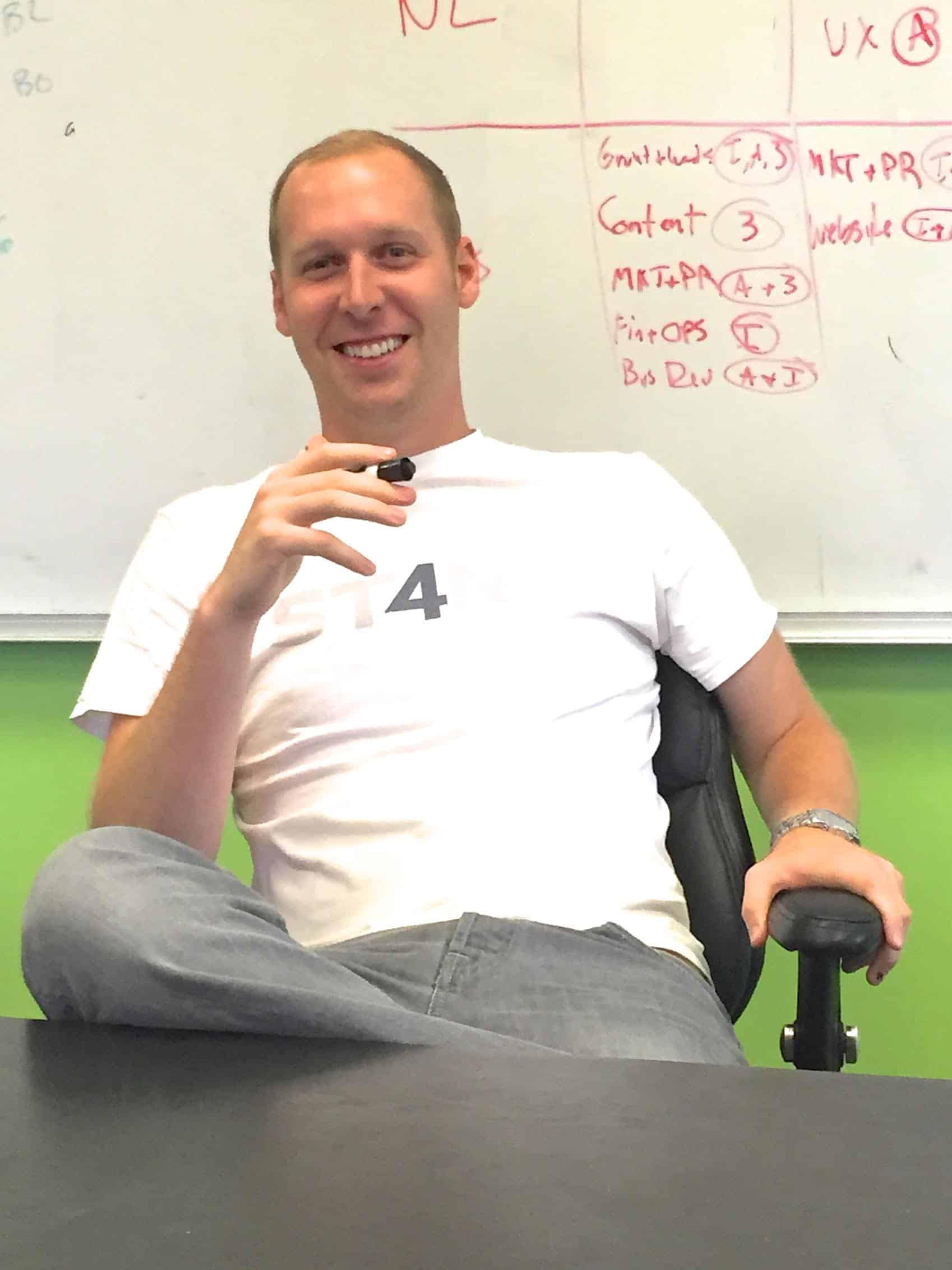
That is a useful counterweight to the romantic picture of a founder. Much of building a company consists of giving an idea an appointment, an owner, and a place on the list. The whiteboard in Hill’s Stand4 photograph is full of that less glamorous work. Even a business organized around doing good needs somebody to remember the follow-up.
A holiday with an unexpected deliverable
In 2018, a trip to Cuba helped set another venture in motion. Hill asked questions about business opportunities, assisted by a friend who spoke Spanish. Conversations about software engineering led toward Siono, a company connecting Latin American engineering talent with businesses in the United States.
The name came from a phrase heard on the trip: sí o no. A short question became a company name. It is the kind of holiday souvenir that later requires payroll.
By the 2022 Inc. 5000 ranking, Siono was number 193, with reported three-year revenue growth of 2,747%. Those are historical company figures, attached to a particular reporting period. They mark a substantial chapter in Hill’s working life without becoming a prediction about the next one.
Hill described founding as an activity he returned to around a full-time job, using breakfasts, dinners, and weekends. “I build companies because I just can’t not.” The line has the advantage of sounding like a confession rather than a management principle. It suggests the appeal lies partly in getting a business into existence, with all the practical obligations that follow.
The customer who came for a sofa
Alongside his ventures, Hill held senior roles at CITY Furniture, including chief revenue officer. In 2021, he spoke about how online research was changing the work of people on the showroom floor. The shopper arriving in person could already know a good deal about the product.
“For most of us, furniture isn’t an impulse purchase,” he said. Closing rates mattered, but he also wanted associates to consider the quality of the experience and the relationship they had created. The purchase was part of a longer interaction, beginning before the customer walked through the door.
That year, he was among the South Florida Business Journal’s 40 Under 40 honorees. The recognition belongs to his retail chapter, where the demands were different from those of an app launch: existing customers, established operations, and a team adapting to changes in how people shopped.
A sofa is a surprisingly useful test of business theory. It costs money, occupies space, and invites strong opinions from everyone who expects to sit on it. A customer cannot be reduced to a conversion rate without leaving much of the decision outside the calculation. Hill’s comments show an executive interested in what the numbers alone would miss.
A founder becomes a client
Sundial grew from a problem Hill encountered after a liquidity event. He visited established investment firms and found their approach poorly matched to what he wanted. Eventually, he met Greg Babij, an experienced portfolio manager whose background included trading, derivatives, and alternatives.
The two discussed how a portfolio should be constructed and what the money needed to support. Their initial work was for themselves. Friends began asking questions and seeking opportunities to invest alongside them. A personal arrangement developed into a business serving other families.
Hill is Sundial’s founder and CEO; Babij is founder and chief investment officer. The partnership combines an entrepreneur’s operating experience with an investment professional’s expertise. Its relevance to Hill’s story is simple: becoming successful in one kind of work did not remove the need to find someone who knew another kind.
Today the platform includes private equity, real estate, hedge funds, systematic equities, and venture capital, with a multi-family office serving founders and their families. Those are the firm’s stated areas of work. The central editorial question is how Hill’s experience of running companies carries into the businesses and relationships he now helps oversee.
What a century-old surveyor has to do with it
On November 8, 2024, Sundial announced its acquisition of Johnston’s Surveying, an Osceola County business dating to 1920. The announcement described a firm with twenty-six employees, twenty of them county residents, providing services including property mapping and survey data.
Here was an investment with a working history long enough to make the word startup seem rather impatient. Hill emphasized continuity and growth. “Our goal is to build companies that last,” he said.
The proposed expansion was a plan, with Johnston’s continuing to operate from its Osceola base. That distinction matters to the story: acquiring an established business creates a responsibility to the work already taking place. Customers still need accurate information. Employees still need a company that functions. A new owner’s arrival does not clear the desk.
“Our goal is to build companies that last.”
Andy Hill, on the Johnston’s Surveying acquisition
Sundial Holdings describes an evergreen model: acquire controlling interests in established businesses, support their operations, and distribute excess cash flow. Its stated approach avoids acquisition debt and a fixed exit timetable. Those are design choices, with the emphasis placed on operating income and continued ownership.
- 01AcquireControl an established B2B business
- 02SupportImprove sales, systems, and operations
- 03DistributeShare excess operating cash flow
- 04RecycleIf sold, recycle principal
The fax machine gets another chapter
A public Sundial Growth Manager job listing makes the operating ambition unusually concrete. It describes target businesses whose marketing can amount to a fax machine and a good reputation. The assignment is to build a more deliberate way of finding customers in companies that have largely depended on referrals.
That detail brings the story back to Hill’s early work in marketing. An established firm may already have the hard part: useful work, repeat customers, and years of earned trust. Improving the way new customers discover it requires attention to what made the company worth buying in the first place.
Hill’s next chapter is therefore being written in two places at once: among families deciding what their capital should do, and inside businesses with work to get through on Monday. The thread from Stand4’s impact updates to a surveyor’s continuing operations is an interest in the consequences after the initial action. The deal closes. The work carries on.