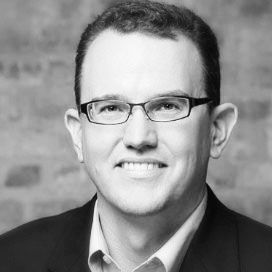
Andy Clark has spent much of his career making rooms work better. Sometimes the room was literal: a former carpet warehouse in Indianapolis where founders could trade kitchen tables for colleagues, fast Wi-Fi and a useful introduction. Sometimes it was software: one place where a nonprofit board could keep its meetings, documents and decisions. Now the room is a category, and his task as chief marketing officer of Remodel Health is to help a growing company make a complicated business legible.
Look at his résumé quickly and it resembles a very productive shuffle. Siemens. Aprimo. ANGEL Learning. ExactTarget. Appirio. 250ok. Boardable. A handful of companies started, advised or sold. Two Indiana coworking communities. Boards, investments, partnerships and, eventually, a C-suite role in benefits software.
Look again and the sequence becomes tidier. Clark keeps finding systems with needless friction, then moving between the technical, commercial and human sides until the gears catch. His career is less a ladder than a circuit board. The value lives in the connections.
The engineer learns to market
Clark studied industrial engineering at Purdue University from 1991 to 1995. The degree is an unexpectedly good opening for a marketing executive. Industrial engineers concern themselves with flow: how people, information and materials move through a system, where time disappears, and which constraint is quietly bossing everyone around.
After Purdue, he went into technical sales at Siemens. Then came Aprimo, the Indianapolis marketing-software company, where he worked as an application consultant. By 1999, he had also earned an MBA in marketing from Butler University. The two educations gave him a durable bilingualism. He could speak to the machine and to the market.
At Walker Information he moved through marketing and product work. At ANGEL Learning he led professional services. At ExactTarget he worked on strategic partnerships. These were not ornamental stops. Indianapolis enterprise software in the 2000s was a practical school in implementation, recurring revenue and the awkward art of persuading large organizations to change how they operate.
The Clark circuit: one skill carried through four arenas
Clark later led Appirio’s marketing technology practice while simultaneously showing a fondness for ventures that were closer to the ground. HoverCrowd, which he co-founded and led, was acquired. At email analytics company 250ok, he served as chief operating officer. The industries varied; the job underneath often involved translating between product, sales, services and the next stage of scale.
A warehouse full of serendipity
In 2012, Clark helped found The Speak Easy with a group of Indianapolis entrepreneurs and advisers. Its first home was a former carpet warehouse south of Broad Ripple. There were couches, beer, events and a membership model aimed at people whose companies had outgrown the isolation of coffee shops but had not yet earned a proper office lease.
The décor was casual. The infrastructure was serious. A young company could get a desk, but the more valuable amenity was proximity. Founders met investors. Designers met clients. A nervous email could be walked over to someone with experience, not submitted to the lonely tribunal of another browser tab.
“The whole goal is to remove barriers to help companies accelerate quicker, better, faster.”Andy Clark, on The Speak Easy’s expansion
The quote contains the Clark operating manual in one sentence. The barrier might be real estate, a missing introduction, a chaotic inbox or a market that needs explaining. Removing it is not glamorous work. It is useful work, and usefulness compounds.
When The Speak Easy prepared a downtown expansion, Clark approached Butler University about a partnership. The result linked a working entrepreneurial community with students and faculty. He also helped establish zWORKS in Zionsville. Both efforts treated a startup ecosystem as something physical and tended, not a slogan printed over a skyline.
When the inbox becomes a product brief
Boardable began with a less photogenic room: the board meeting. Clark and fellow founder Jeb Banner had each served on several boards. They knew the peculiar sprawl of the work: invitations in email, files in Dropbox, minutes somewhere else, and important context distributed among whichever people happened to remember it.
In 2016, Clark, Banner, Joe Downey, Jason Ward and Chris Lucas co-founded a company to put those jobs into one web application. The earliest customers were nonprofits, organizations whose directors could ill afford to donate their attention to document archaeology. Boardable gathered meetings, polls, discussions, contacts and records in one place.
The company was born from observed annoyance rather than a fashionable category thesis. That gave it a plain advantage: the founders understood the user because they were the user. Clark brought another advantage. He had worked inside enough SaaS companies to understand fundraising, operating cadence and the difference between a promising tool and a company prepared to sell it repeatedly.
Keep a list of workflows that competent people hate. Repeated frustration is often unpaid product research.
Banner later described Clark’s arrival around the rebuilding of the minimum viable product as an accelerant. In a podcast conversation, host Omer Khan compressed that judgment into a nickname: “Handy Andy.” It lands because Clark’s role was not mystical. He knew whom to call, how funding worked, and what a young software company would need next.
By 2022, Clark was Boardable’s co-founder and COO. When Banner handed the chief executive role to Jeff Middlesworth, he praised Clark and the board for supporting a low-drama transition. Smooth succession rarely trends. It does, however, tell you something about adults sharing a conference table.
The advisor steps inside
In 2023, Clark began advising companies through 550 Advisors and working with Remodel Health. The assignment grew consequential. He helped the Indianapolis company through the process associated with a $100 million growth investment from Oak HC/FT, announced in December 2024. Remodel leaders later credited him publicly with playing an integral role.
Advisory work can end with a presentation and a courteous calendar invitation for next quarter. This relationship went the other direction. Clark joined Remodel Health as chief marketing officer in February 2026, moving from the person beside the machinery to the person accountable for part of it.
The company provides software and services for employers moving from traditional group plans to individual coverage arrangements. Clark has described the next phase in the language of an operator: technology, partnerships and talent. He told Mergermarket that Remodel intended to pursue at least two acquisitions in the following 24 months, looking at profitable technology and service businesses beyond the startup phase. He also outlined plans to add staff across sales, marketing, technology and advisory work.
“Employers want more flexibility, greater cost predictability, and a better consumer experience.”Andy Clark, on the market shift Remodel Health is pursuing
There is ambition here, but it is ambition with nouns attached. Payroll integration. Financial technology. Employee navigation. Partnerships. Teams. The engineer remains visible inside the marketer: identify the adjacent systems, find the points of friction, and decide which connection should be built, bought or borrowed.
A career with connective tissue
Clark’s Indianapolis is not merely a location under his name. It is a network he has helped assemble across several decades. Purdue supplied the engineer. Butler sharpened the marketer. Enterprise software companies taught scale. The Speak Easy and zWORKS made introductions easier. Boardable turned lived frustration into a product. Advisory work connected capital with a company, then pulled the advisor into an executive seat.
The chronology is useful because it resists a popular fiction about careers: that coherence requires sameness. Clark did not stay in one function. He kept returning to one kind of problem. How do you help capable people move through a system with less waste and more confidence?
There is a playful modesty in the “Handy Andy” nickname. Handy things are rarely the centerpiece of the room. They are the hinge, the adapter, the well-placed outlet. Yet rooms fail without them.
At Remodel Health, the scale is larger and the category more complex. The old method still fits: make the system clearer, bring the right parties together, and remove obstacles that have been mistaken for permanent features. Thirty years in, Clark is still arranging the room.
Three moves worth borrowing
First, pay attention to irritation before it becomes a pitch deck. Boardable came from the tedious reality of board service. The Speak Easy came from the lonely reality of starting a company without a workplace or nearby peers. In both cases, the complaint contained the design brief. Clark and his collaborators did not need to invent demand. They needed to notice it accurately.
Second, build around the next useful exchange. A shared workspace matters because of who crosses the room. A board platform matters because a decision no longer gets buried in an inbox. A strategic partnership matters because two systems become more valuable together. The practical unit of Clark’s career is not attention. It is movement.
Third, let expertise travel. Engineering can improve marketing. Board service can inspire software. Advising can become operating. A city can be both home and laboratory. The career that looks nonlinear on paper may be accumulating a very specific advantage: seeing the same friction from enough angles to recognize it early.