Who They Are Now
A healthcare budget, not a healthcare plan
Open enrollment season arrives. Somewhere, an HR manager at a 40-person company stares at the same impossible spreadsheet she stares at every year: one group health plan, one network, one set of deductibles, applied to forty people who want forty different things. The 26-year-old who never visits a doctor pays the same as the family of five. Everyone is mildly unhappy. This is the design.
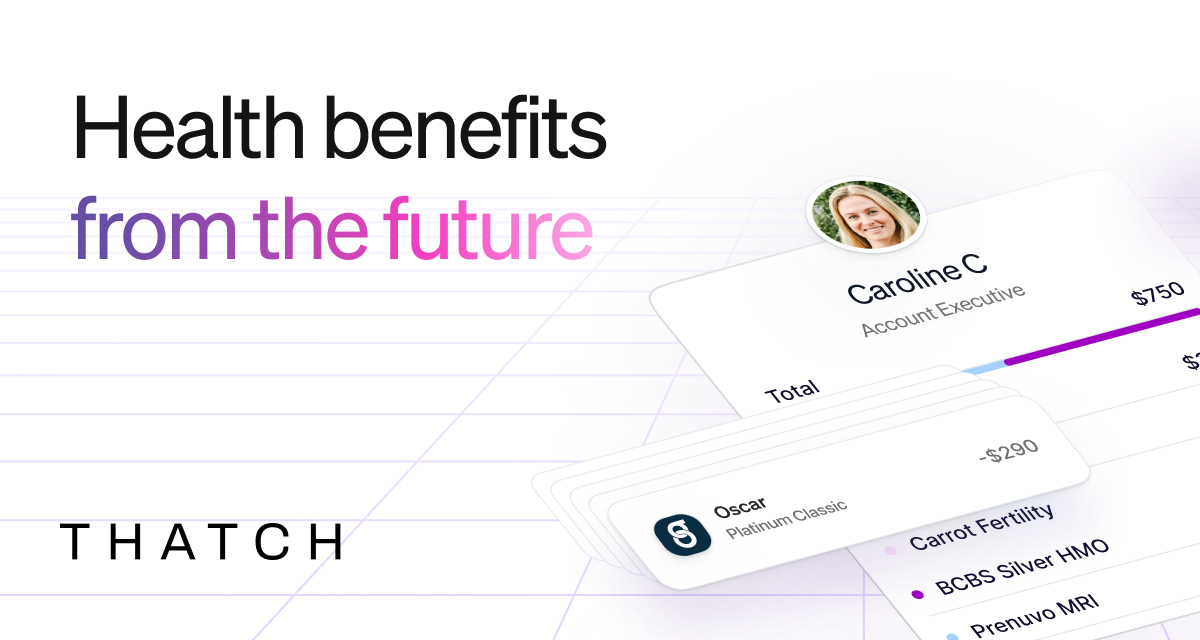
Thatch built a company around the suspicion that it doesn't have to be. Instead of buying a single plan and forcing everyone into it, an employer using Thatch hands each employee a tax-free monthly amount - a budget - and lets them shop. Medical, dental, vision. Keep what's left for copays and prescriptions on a debit card. The HR manager picks a number, not a network.
It's a small idea with a long fuse: stop choosing health plans on behalf of people, and let them choose for themselves.
- The Thatch thesis, in one sentence
The plumbing underneath has an unglamorous name - ICHRA, the Individual Coverage Health Reimbursement Arrangement - and a regulatory backstory that only an actuary could love. But the pitch is plain enough that a16z, General Catalyst, ADP, and Index Ventures have collectively wired about $84.5 million toward it. More than 1,000 businesses now run benefits this way.
The Problem They Saw
Why is your doctor tied to your desk?
Employer-sponsored health insurance is a historical accident. It started as a workaround to wartime wage caps in the 1940s and somehow became the architecture of American healthcare. The result: roughly half the country gets its coverage through an employer, which means changing jobs can mean changing doctors, and losing a job can mean losing care.
For the employer, group insurance is a guessing game played a year in advance. You pick a plan in the fall, lock in the premium, and hope the workforce's needs match the bet. They rarely do. Premiums climb. Choice shrinks. The 26-year-old subsidizes risk he doesn't have; the family pays for a network that doesn't include their pediatrician.
Health insurance got bolted onto employment by accident. Thatch's question is why it should stay there.
- The case for unbundling
The founders had a more personal version of the problem. Chris Ellis and Adam Stevenson each lost a parent to cancer when they were young, and watched their families navigate a payments system that seemed designed to be navigated by no one. That experience is the kind of thing a press release would call "formative." It is also, plainly, why two engineers ended up building an insurance company.
The Founders' Bet
A cancer researcher and a Stripe engineer walk into insurance
Chris Ellis started his career at the bench - a cancer researcher at MIT - before moving into software sales and product roles at Sophia Genetics and Agilent. Adam Stevenson spent four years inside the machine at health insurer Humana, bootstrapped a couple of SaaS companies, then landed at Stripe, where he spent seven years building and leading customer engineering teams. One understood the disease economy; the other understood how to move money over an API.
They founded Thatch in October 2021 and emerged from stealth in February 2023 with a $5.6 million seed round co-led by Andreessen Horowitz and Google Ventures. The bet was specific: ICHRA - made usable by an IRS rule that only took effect in 2020 - was the legal mechanism that would finally let employers fund individual coverage at scale, and almost nobody had built good software for it yet.
Being early to a regulatory mechanism is a peculiar kind of advantage. It is not a patent and not a moat, exactly - it is just a head start on software that is genuinely hard to get right, in a category where getting it wrong means someone's claim doesn't get paid. Thatch bet that the boring parts - compliance, plan data, payments, support - were the whole game.
The Product
Four pieces, one idea
What Thatch sells looks simple from the outside and is fiendish underneath. The employer sets a budget. The employee shops. The money moves, tax-free. Making those three sentences true requires four products working in concert.
The Budget Engine
The ICHRA administration layer - employers allocate a tax-free monthly healthcare budget per employee, with the compliance handled.
The Marketplace
An AI-assisted shopping experience where employees compare medical, dental and vision plans from carriers like Anthem, Oscar, Aetna and UnitedHealthcare.
The Thatch Card
A debit card that lets employees spend whatever budget is left over on qualified care - copays, prescriptions, treatment.
The API
An embeddable service so payroll and HR platforms can build ICHRA benefits straight into their own products.
Pick a plan, keep the change. The leftover budget on a debit card is the detail that makes the whole thing feel like yours.
- On the part employees actually notice
The API is the quiet strategic move. By letting other platforms embed ICHRA, Thatch stops being just an app you log into and starts being infrastructure other companies build on - which is exactly the kind of thing that turns a startup into a standard.
The Proof
The part where the numbers talk
Conviction is cheap; capital is less so. Thatch has raised across three rounds in under four years, each larger than the last, with its Series B reportedly landing at roughly three times the valuation of its Series A. The investor roster reads like a who's-who of people who are usually right.
Funding, round by round
EQUITY RAISED PER ROUND // USD MILLIONS
Total: ~$84.5M since 2021. Lead investors: a16z + GV (seed), General Catalyst (A), Index Ventures (B). Bars scaled for readability.
The customer number is the one that should make a skeptic pause: more than 1,000 businesses, from startups to enterprises, running benefits this way since the platform launched in 2023. That is not a pilot. ADP - the largest payroll company on earth - embedded Thatch's ICHRA benefits into its platform and invested through ADP Ventures, which is the corporate equivalent of saying "we checked your work."
When the biggest payroll provider in the world embeds your product and writes you a check, that's not a logo slide. That's a verdict.
- On the ADP partnership
For credibility, Thatch also recruited Gary Daniels, the former CEO of UnitedHealthcare's Pacific Northwest division, as Chief Growth Officer - a hire that signals to risk-averse benefits buyers that the grown-ups are in the room. CB Insights ranked the company #5 on its 2025 list of the 50 most innovative insurtech startups. Thatch was two years old.
The Mission
Personal, portable, accessible
Thatch states its goal as making health benefits "personal, portable, and accessible for every American." Strip the polish off and it's a structural argument: if your coverage belongs to you instead of your employer, then quitting a job, getting laid off, or going freelance stops being a medical event.
"Portable" is the load-bearing word. Group insurance ends when employment ends. Individual coverage funded by an ICHRA budget travels differently - the plan is yours, chosen by you, and the employer is simply funding it. It is a quiet reframing of a system most people assume is fixed.
The future we're creating at Thatch is one where businesses can provide employees with a tax-free healthcare budget.
- Thatch, on what it is building
Whether that future arrives at scale is still an open question. ICHRA adoption is growing fast but remains a sliver of the overall market, and incumbents are large, slow, and very much awake. Thatch is not alone - Take Command, Remodel Health, Stretch Dollar and others are chasing the same opening. The category is real. The winner is not yet decided.
Why It Matters Tomorrow
Back to that spreadsheet
Return to the HR manager and her impossible spreadsheet. In the old version, open enrollment is a negotiation she loses on everyone's behalf - one plan, forty compromises, a premium that goes up no matter what she does. The whole exercise is an apology dressed as a benefit.
In the Thatch version, the spreadsheet has one cell that matters: a number. She sets the budget. The 26-year-old picks a cheap high-deductible plan and pockets the difference on a debit card. The family of five buys the network with their pediatrician in it. Nobody is forced into a compromise designed for an average person who doesn't exist.
The old benefit was a plan you were assigned. The new one is a choice you get to make. That swap is the entire company.
- The closing argument
That is Thatch's bet, reduced to its smallest form: that "here is your plan" was always the wrong sentence, and "here is your budget" is the right one. It is early. The incumbents are enormous. The regulatory tailwind could shift. But for the first time in roughly eighty years, the question of whether your doctor has to be tied to your desk is, at least, being asked by someone with $84.5 million and a working product. The spreadsheet, finally, has fewer tabs.
- Both co-founders lost a parent to cancer young - the reason two engineers ended up building an insurance company.
- CEO Chris Ellis began his career as a cancer researcher at MIT before pivoting to software.
- The entire model depends on ICHRA, a benefit type that only became usable under IRS rules starting in 2020.
- Thatch's X handle is @thatch_ai - despite being a health benefits company, not an AI lab.
- The Series B reportedly landed at roughly 3x the company's Series A valuation.