At the bottom of an aircraft staircase in Burbank, Andrew Levy was handing passengers commemorative boarding passes. It was April 28, 2021. His new airline, Avelo, was about to fly to Santa Rosa, and its founder had given himself a job that required neither a law degree nor a finance background: welcoming people aboard. Upstairs, a captain distributed luggage tags. Around the gate, cameras competed for views of two purple-tailed jets. An airline was becoming real, one scanned ticket at a time.
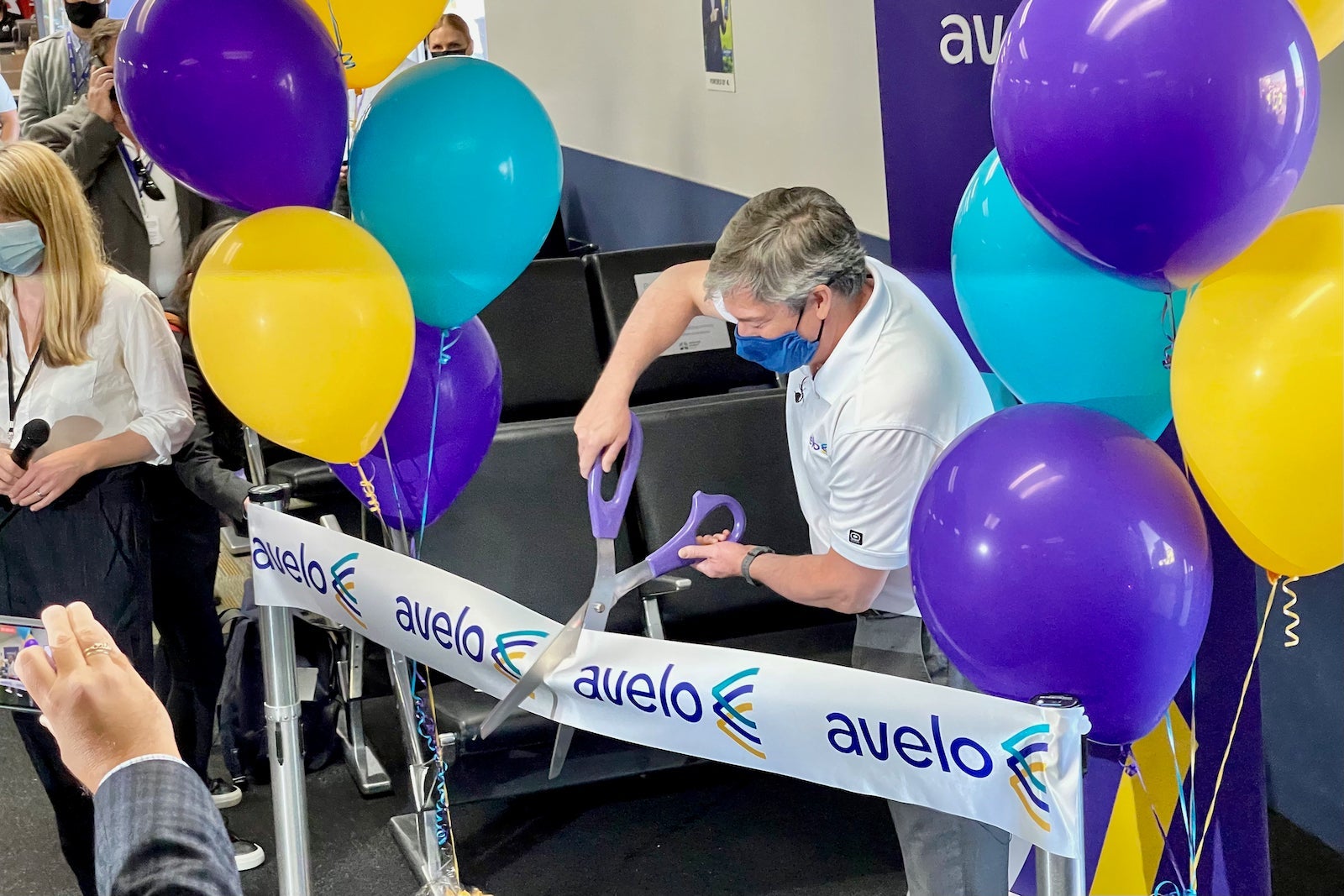
There had been a ribbon, balloons and scissors large enough to suggest a municipal infrastructure project. Those are the easy accessories of a launch. The difficult part was persuading a stranger to entrust a holiday, a family visit or an entire afternoon to a company whose name still needed explaining.
Levy had spent years inside airlines of very different sizes. Now he was asking a rather modest question with expensive consequences: what if the useful airport was the one people drove past on their way to the famous one?
A lawyer walks into a startup
Levy’s route into aviation began near the end of law school at Emory University in Atlanta. A college friend was working on ValuJet, a new airline. Levy joined him and discovered, within weeks, that he liked the pace of an entrepreneurial company. Aircraft became interesting through the business, rather than the other way around. He has said he was never one of those children consumed by aviation.
He had earned his bachelor’s degree at Washington University in St. Louis before taking his JD at Emory. His working life subsequently included telecommunications and investment roles as well as airlines. That broader background matters: a route network can be examined as a set of commercial decisions, even when the equipment inspires an enthusiasm usually reserved for sports teams.
Maury Gallagher became his central professional connection. Their paths ran through ValuJet, telecommunications and Allegiant. Levy has described Gallagher as the most influential person in his career and life. The relationship helped give him a long apprenticeship in building businesses where the arithmetic can be unforgiving.
At Allegiant, the apprenticeship turned into substantial responsibility. He joined in 2001, became chief financial officer in 2007, president in 2009 and chief operating officer in 2013. These were overlapping jobs, encompassing planning, money and the work of moving aircraft and people. A spreadsheet could propose a route; the operation still had to deliver it.
Forty-six quarters, then another beginning
When Levy resigned in October 2014, Allegiant described a company that had grown from one aircraft into a billion-dollar leisure-travel business during his tenure. It had recorded 46 consecutive profitable quarters. Those figures belonged to a team, and Gallagher’s farewell acknowledged Levy’s contribution to building it.
Levy’s own departure statement was revealing. He expressed pride in the company, said he retained a significant investment and explained that he wanted to pursue further entrepreneurial opportunities. Leaving did not require declaring the old venture a mistake. Success could be something to leave, too.
For a while, the next chapter involved a much larger enterprise. United appointed him executive vice president and chief financial officer in August 2016. CEO Oscar Munoz pointed to his experience in operations as well as finance. United was recruiting someone who understood how a low-cost competitor worked from the inside.
Levy’s career had now placed him on both sides of an industry divide: the small carrier finding an opening and the large carrier serving a sprawling network. When he returned to building, he brought an unusually practical view of the incumbents. Their scale was visible. So were the places they chose not to serve.
The airport is part of the ticket
Avelo’s public debut in April 2021 came with $125 million in private equity and three 189-seat Boeing 737-800s. Its opening plan connected Hollywood Burbank Airport with 11 destinations across the western United States. The first flight left for Charles M. Schulz-Sonoma County Airport. The introductory fare was $19, a number well suited to getting attention for an unfamiliar name.
Yet the fare alone did not explain Levy’s interest in Santa Rosa. On launch day, he recalled having watched that market for about 15 years. The MD-80s used during his Allegiant years could not handle the runway. With different aircraft, a long-observed opportunity became a possible first route. Patience, in this instance, had an aircraft specification attached.
He was also precise about convenience. Burbank would not be the right airport for everyone in Southern California. Mesa would not suit every Phoenix resident. The proposition depended on where people actually lived and wanted to go. A smaller airport is useful when it removes a drive, a queue or a connection from someone’s particular journey.
The cabin carried the same mixture of economy and choice. The launch aircraft seated 189 passengers, with 60 seats offering extra legroom. Customers could buy additions to a basic trip. There was no need for every passenger to purchase the same collection of comforts, although anyone comparing fares needed to count the extras they intended to use.
Levy’s first-day confidence also had an ordinary operational interruption attached. A reservation-system outage had lasted more than four days shortly before the inaugural flight. Building a new airline included the familiar indignity of waiting for the technology to behave. Purple balloons could do little about that.
A business built beside the big airports
The East Coast offered a second demonstration. On November 3, 2021, Avelo began flying from Tweed-New Haven to Orlando. During that inaugural journey, Levy walked through the aircraft thanking passengers. The setting had changed by a continent; the founder was again doing the small, repetitive work of introducing the airline in person.
By February 2023, the company was opening a base at Wilmington, Delaware. Scheduled airline service returned to a state that had lost it when Frontier withdrew the previous year. For a young carrier, an overlooked airport could provide a place to become familiar rather than remain an occasional name on a departures board.
Outside Avelo, Levy kept connections to other parts of aviation. He has served on Copa’s board since 2016. AerSale appointed him a director in April 2023; he also chairs its audit committee. One company carries passengers through a Latin American network, while the other supplies aircraft, parts and services. His professional world extends well beyond the routes carrying Avelo’s name.
There are quieter biographical details, too. He lives in Houston, speaks Spanish through his Argentine roots and has listed tennis, travel and family time among his interests. In June 2024, he was named an EY Entrepreneur Of The Year Gulf South regional winner. Recognition arrived after the launch celebrations, when the work had become considerably less ceremonial.
The charter decision and its reversal
The search for financial stability also brought a decision that made Levy and Avelo targets of protests. In 2025, the airline agreed to operate deportation charters from Mesa, using three Boeing 737-800s. Levy defended the arrangement as a way to support expansion and preserve employment. New Haven Mayor Justin Elicker objected, and campaigners called for a boycott.
By January 2026, Avelo said it would leave the program and close its Mesa base. The airline had worked as a subcontractor to CSI Aviation. Its explanation for withdrawing was commercial: the revenue had not been predictable enough to outweigh the operational demands and expense. Campaigners welcomed the retreat.
The episode belongs in an account of Levy’s leadership because it involved his stated priorities colliding in public. A contract presented as financial support for the passenger business became a source of opposition in communities that passenger business served. The subsequent withdrawal was consequential for the operation and for the airline’s relationship with those communities.
“We are the tortoise.”
Andrew Levy · May 2026
Fifty aircraft, with room to say no
Another decision was already changing the company’s future. In September 2025, Avelo placed a firm order for 50 Embraer E195-E2 aircraft, with purchase rights for 50 more. Deliveries were expected to begin in the first half of 2027. The distinction matters: 50 aircraft were ordered; the additional 50 represented a choice.
The planned 140-seat cabin has two seats on either side of the aisle. There is no middle seat to negotiate over. More consequential for the business, the aircraft’s short-field capability suits airports with runway constraints. The order was intended to complement the Boeing fleet, while giving Avelo another way to serve its chosen markets.
Deliveries expected from the first half of 2027. Purchase rights are optional; they are not aircraft already committed to the fleet.
In January 2026, Avelo announced recapitalization and a narrower operating plan. It would concentrate on New Haven, Wilmington in Delaware, Concord and Lakeland, with McKinney in North Texas to follow. Mesa, Raleigh-Durham and Wilmington in North Carolina would lose their bases. Six 737-700s would leave the fleet. Growth involved subtraction as well as additions.
At an industry gathering that May, Levy used a deliberately unglamorous animal to explain his approach: “We are the tortoise.” He wanted stronger finances and measured expansion. He also discussed how a smaller aircraft could support more frequent flights, giving travelers a more useful schedule. A cheap seat is less helpful if it flies on the wrong day.
He identified another obstacle: getting travelers to discover smaller airports through flight-search tools. For an airline built around alternatives, appearing in someone’s search is part of the job. Having an airport nearby does not automatically put it into a traveler’s mental map.
The next boarding pass
In August 2026, Avelo announced it had carried its ten-millionth customer. By October, the company was preparing to begin McKinney service on November 11 and had announced a network there that would reach 11 destinations. These were plans with dates attached, rather than evidence that the work was finished.
Levy’s story keeps returning to the distance between a plausible idea and a useful flight. A law graduate can learn airline economics. An experienced executive can raise money and order aircraft. But the passenger still needs the airport to be convenient, the departure to fit and the company to earn another booking. The oversized scissors have long since done their job. The boarding passes remain the test.