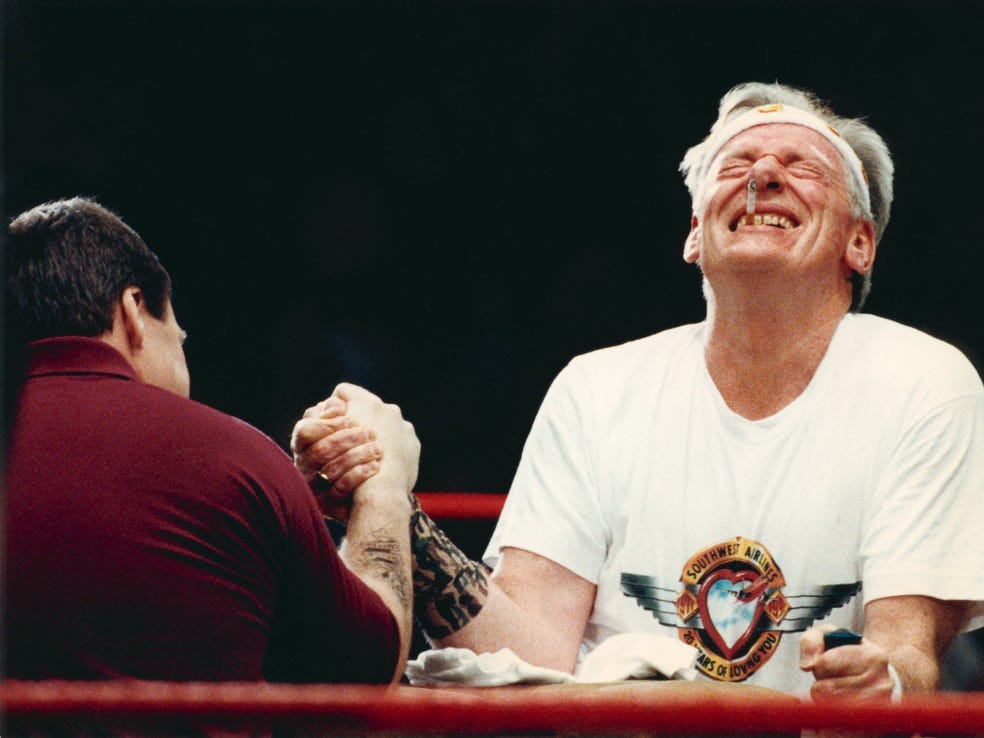
On March 20, 1992, Herb Kelleher arrived at the Dallas Sportatorium in a white bathrobe and black boots. A sweatband held back his hair. Somewhere beneath the costume was the chairman and chief executive of Southwest Airlines, a lawyer who had spent years defending his company in court. This morning, he had found another venue for dispute resolution. It had a wrestling ring.
The disagreement concerned an advertising slogan. Southwest was using “Just Plane Smart”; Stevens Aviation, a South Carolina aviation business, had “Plane Smart.” A Stevens executive suggested letting the bosses arm-wrestle for the rights. Kelleher accepted. Kurt Herwald, Stevens’ chief executive, would supply the opposition. Southwest supplied a remarkably enthusiastic willingness to make its own boss look absurd.
Kelleher lost the deciding contest. Both companies made charitable donations, and Herwald let Southwest keep using its slogan. A dispute had become a shared production, with employees as the audience and the executives as the entertainment. The former trial lawyer had given his opponent the happy ending. For an airline selling friendliness alongside transportation, that was useful work.
A New Jersey lawyer, three Texas cities
Kelleher was born in Camden, New Jersey, on March 12, 1931, and grew up in nearby Audubon. His later Texas identity could obscure the route he took there. At Wesleyan University he studied English, graduating in 1953. He earned a law degree at New York University in 1956. Literature and law are reasonable preparation for a career spent choosing words carefully, even when those words sound cheerfully unconsidered.
He married Joan Negley in 1955. Texas became home, and by the mid-1960s he was practicing law in San Antonio. One of his clients, Rollin King, had an idea for an airline linking Dallas, Houston and San Antonio. The distances made a short flight attractive. Keeping the service within Texas offered a way to operate outside the federal economic rules governing interstate airlines.
Air Southwest was incorporated in 1967. The celebrated cocktail napkin belongs to the company’s founding lore: a triangle, three cities, an idea made conveniently portable. The literal napkin is disputed. There is no need to preserve it as a relic to understand what followed. A proposed airline had to survive its existing competitors before it could carry anybody.
Legal opposition delayed the start for years. Kelleher represented the venture through the fights that preceded its first scheduled flights on June 18, 1971. His early contribution was the patient, technical labor of keeping an enterprise legally possible. Before there could be a funny announcement in the cabin, somebody had to win permission for the cabin to leave the ground.
The ten minutes belonged to everybody
Getting airborne did not settle the arithmetic. In 1972 Southwest sold its fourth aircraft and faced the problem of flying a four-plane schedule with three. President Lamar Muse and terminal operations chief Bill Franklin were central to the response. The required turnaround was ten minutes. That meant unloading, cleaning, replenishing and boarding with a speed that left little room for departmental grandeur.
Crews studied the work, borrowed inspiration from racing pit stops and attacked delays together. Pilots could help clean. People could empty trash or replenish supplies regardless of rank. Kelleher participated in that shared work, too. The episode matters partly because it resists the tidy version of business history in which a charismatic founder personally invents every good idea.
Consider what a quick turn asks of a company. A late handoff becomes somebody else’s problem immediately. A title cannot move a suitcase. An employee who notices a better sequence may be more useful than an executive who delivers a stirring speech about efficiency. Cooperation has to survive contact with the next arriving aircraft.
The ten-minute turn was a response to a particular emergency, and later operational requirements made that original target impractical. Its larger principle endured: an airplane earns revenue by carrying people, and keeping it idle has a cost. Southwest’s reputation for fun grew beside an unforgiving interest in how minutes were spent.
Same schedule. Fewer planes. Everybody helped at the gate.
A cheap ticket takes expensive thinking
Kelleher became chairman in 1978 and took on the president and chief executive roles in 1981. He held those latter jobs until 2001. The long interval between helping establish the business and running it is easy to lose in the shorthand of a founder’s biography. Southwest had other leaders, and Kelleher had already spent years learning its problems.
The operating choices reinforced one another. A fleet built around Boeing 737s reduced the variety pilots and mechanics needed to master. Simple onboard service avoided the expense and complexity of full meals. Frequent, direct flights gave customers a practical reason to choose the airline. A lower fare needed an operation capable of supporting it.
That helps explain why the costumes were compatible with the numbers. Humor could make inexpensive travel feel sociable. It could also give a customer a story worth repeating. Yet no joke could pay for an inefficient fleet indefinitely. The business required both the invitation and the machinery behind it.
In 2008, the year Kelleher entered the National Aviation Hall of Fame, Southwest had recorded 35 consecutive profitable years. That is a useful historical measure, with a date attached. It describes a result built over many working days, across fuel bills, schedules, labor agreements and decisions about where the airline should grow.
“We take our competition seriously, but not ourselves.”
Herb Kelleher
Colleen kept the promise in circulation
A portrait of Kelleher alone leaves too much out. Colleen Barrett worked with him at his law firm before joining Southwest in 1978. She later became the airline’s president. Her work helped turn employee care and customer service into routines: correspondence, recognition, attention to detail, and the daily expectation that people would be treated decently.
A company can announce that employees matter in the time it takes to print a poster. Remembering them requires an organization. Barrett supplied much of that persistence. The partnership helps explain how Kelleher’s public warmth could travel beyond the particular room he happened to be entertaining.
His argument put employees at the beginning of the business relationship. Treat them well, and they would be better placed to look after passengers; satisfied customers would help produce the results shareholders wanted. It was an order of operations, with consequences for whose concerns management ought to hear first.
The approach included unions. Kelleher described labor representatives as partners, while acknowledging that negotiations could involve fierce arguments. An agreement was supposed to end the quarrel, rather than provide material for the next generation’s feud. That distinction required discipline from an executive who plainly enjoyed a good fight.
- 01Care for employees
- 02Equip them to care for customers
- 03Earn repeat business
The listener beneath the noise
For all his public exuberance, Kelleher could be an unexpectedly attentive audience. Technology executive Charlie Feld arrived for a 2001 meeting carrying a pen and a yellow pad, prepared to explain information technology through the airline’s business. Kelleher asked about Feld’s family and career. As Feld drew, Kelleher kept responding with stories.
Feld worried that he had failed to get his message across. Years later, when he brought Kelleher a book manuscript, Kelleher remembered the old drawings and urged him to recover their simplicity. A conversation that had seemed to wander had apparently landed. Feld’s recollection offers a quieter explanation for some of the loyalty Kelleher attracted: people discovered he had been paying attention.
There were less polished details. His office had no windows, and his desk had no drawers for papers to vanish into. He read widely and liked military history. He could play Elvis in public and then return to the dense business of an airline. A person with both habits was bound to make an awkward subject for anyone selling a single approved executive personality.
His old competitor Robert Crandall, who ran American Airlines, remembered exchanging gags with him. After Crandall joked about Southwest’s whale-painted Shamu airplane, Kelleher sent chocolate pudding with a label extending the joke. Their companies competed; their executives could still enjoy the correspondence. The pudding probably made a better delivery than another legal envelope.
What remains after the laughter
Kelleher relinquished the chairmanship in 2008 and became chairman emeritus. In 2014 a road leading to Dallas Love Field was renamed Herb Kelleher Way. The honor put his name on an ordinary part of a journey: the approach to an airport whose continued commercial life he had helped defend.
He died on January 3, 2019, aged 87. His ambition had been public and practical: make flying affordable to more people, and build a business in which employees had a stake. The airline was the means. Tickets, jobs and the chance to go somewhere gave the idea its substance.
His story also needs an ending that allows time to pass. In February 2025, Southwest announced the elimination of about 1,750 roles, focused almost entirely on corporate overhead and leadership. The company described the decision as unprecedented in its history. Those were decisions made years after Kelleher’s death, under different leadership, and they gave the old employee-first promise a new context.
A legacy can be tested by what later managers choose to preserve. Kelleher left specific examples available for inspection: court arguments, a simpler operation, work shared at the gate, and a willingness to let other people have the spotlight. None requires copying his costumes. The bathrobe was already taken.
Return to the Sportatorium. The boss has lost, the rival has been generous, and everybody has a story. Kelleher understood how much an executive could accomplish while surrendering a little dignity. He could make employees laugh at him and still ask them to take the next departure seriously. The flight, after all, had a schedule.
Spend a little more time with Herb
- Watch: Kelleher in conversation at Stanford
- Watch: the June 2001 television interview
- Read: a visit to his office in 1996
- Read: Charlie Feld remembers the yellow pad
- Read: Southwest’s February 2025 workforce announcement
- Explore Southwest Airlines
- Herb Kelleher: biography and chronology
Photography: Southwest Airlines, via Business Insider. Profile photograph supplied separately: SouthwestArchive / Wikimedia Commons, CC BY-SA 4.0.
