Jimmy Dempsey became an airline chief executive and promptly set about arranging for fewer airplanes. In February 2026, barely a month after his permanent appointment at Frontier, the carrier announced a proposed deal to return 24 leased Airbus A320neos early. An airline executive announcing aircraft returns has a certain comic disadvantage. Nobody puts a photograph of an empty parking space on the cover of the annual report.
Yet the subtraction was central to his argument. Frontier could put its remaining aircraft to more work, reduce the cost of carrying underused equipment and give its operation time to settle. Dempsey had spent much of his career on the financial side of low fares. Now he was responsible for whether that arithmetic survived contact with the gate, the schedule and the person waiting to get home.
By July, there was encouraging news and an awkward companion. Second-quarter revenue reached $1.279 billion, up 38 percent from a year earlier. Frontier also recorded a $90 million net loss, or a $22 million loss after its specified adjustments. Both belonged in the same account of his first year. Selling more travel and earning money from it remain separate accomplishments.
That gap makes Dempsey an interesting person to watch. His route to the job runs through accountancy, investor relations, treasury and nearly twelve years inside Frontier. He arrived with considerable experience of the machinery behind a low fare. The CEO position asks him to make that machinery produce an airline people will choose again.
An education in the price of flying
The formal name is James G. Dempsey. The name used by colleagues, and in his own professional profile, is Jimmy. He holds a Bachelor of Commerce from University College Dublin and is a fellow of the Institute of Chartered Accountants in Ireland. Before his airline appointments, he worked in management roles at PricewaterhouseCoopers from 2000 to 2003.
Ryanair brought him into investor relations in 2003. The job placed him between a business selling inexpensive tickets and investors who expected an explanation of how those tickets could support growth. In July 2006 he became treasurer, a position he held until April 2014. Aircraft financing, fuel and the cost of operating an expanding carrier became part of his working terrain.
When Frontier recruited him in May 2014, it specifically credited his contribution to financing Ryanair's growth, managing fuel costs and reducing operating costs. Ryanair was then carrying 81 million passengers annually. That figure described the airline he helped finance; it was no claim that a treasurer had personally filled every seat. Aviation has quite enough elaborate seating arrangements already.
The experience gave his move to Denver a clear logic. Frontier was pursuing an ultra-low-cost model and needed a CFO familiar with its demands. David Siegel was CEO when Dempsey joined. Dempsey's expertise concerned the decisions behind the ticket price: how aircraft are funded, what fuel costs and how much overhead each passenger must carry.
Investor relations
Chief financial officer
President & CEO
Nine years behind the numbers
Dempsey joined Frontier as CFO in 2014 and added the executive vice president title in December 2019. His next promotion, in October 2023, changed the scope of his work. As president, he took responsibility for Commercial, Customer Care, and Operations Research, Design and Planning. Mark Mitchell moved into the CFO role, and both reported to then-CEO Barry Biffle.
The list of responsibilities is revealing. Pricing and selling a flight sit beside dealing with the customer who bought it. Planning a network sits beside designing the operation that must deliver it. Dempsey's career was moving outward from finance into the places where a financial assumption becomes somebody's actual journey.
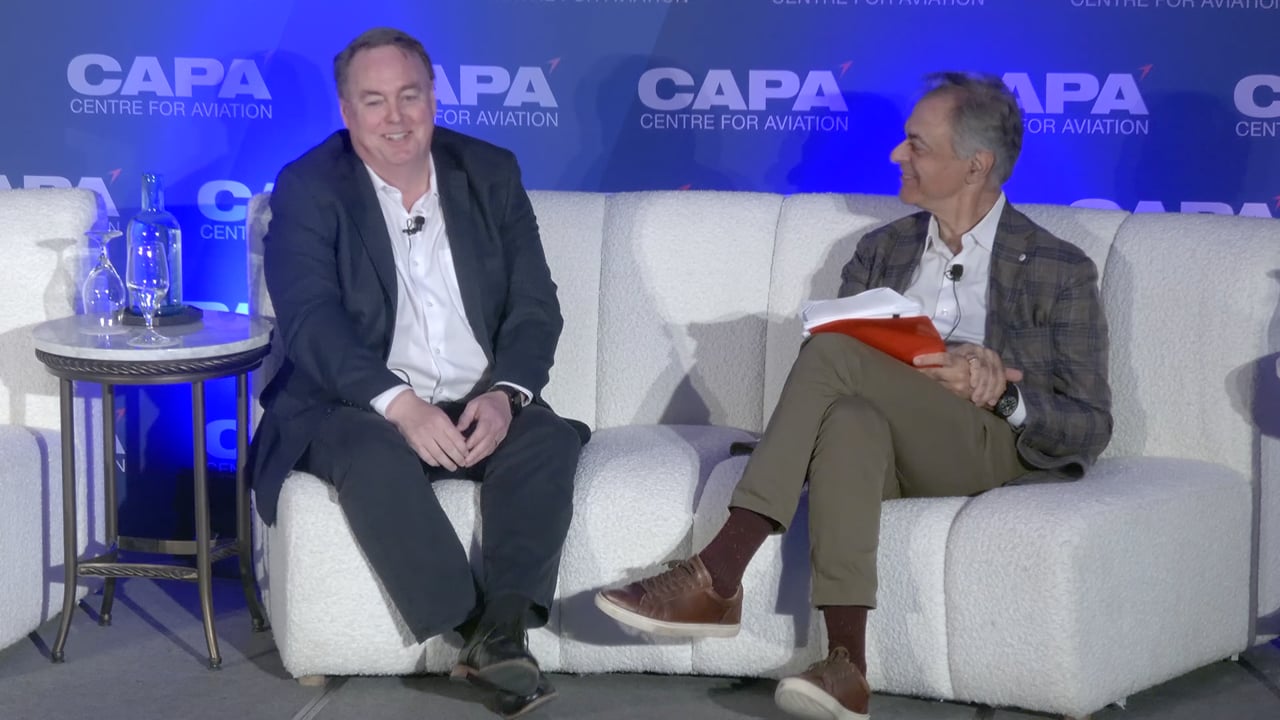
There were public appearances along the way. At the CAPA Airline Leader Summit Americas in May 2024, he sat down with Korn Ferry's Michael Bell for an interview as Frontier's president. In a separate glimpse away from conference seating, Mark Hiller posted about playing alongside him at Frontier's Folds of Honor golf tournament. The documented extracurricular detail is modest: a day on the links for a charitable event.
Then came a compressed succession. On December 15, 2025, Frontier named him interim CEO as Biffle moved into an advisory capacity through the end of that month. The board made Dempsey president and CEO, and a director, effective January 7, 2026. Bill Franke, the board chair, backed someone who had already spent more than a decade inside the business.
The Ryanair lesson has an American complication
At a J.P. Morgan conference in March 2026, Dempsey was asked about the contrast between Ryanair's profitability and the difficulties of the American ultra-low-cost model. His answer included a distinction that rarely appears in a photograph of an airplane: credit card loyalty programs. In his account, their importance to major American airlines changes the competitive setting.
That is a useful clue to how he sees the job. An aircraft carries the passenger once. A rewards program can keep the airline in the passenger's spending decisions between trips. Competing on the fare alone leaves part of that relationship to somebody else. Dempsey's American assignment therefore involves a broader question than reproducing the carrier he knew in Europe.
Frontier's response included renewing its long-running Barclays credit card partnership in June 2026. The relationship already spanned more than twenty years. The renewal accompanied efforts to expand Frontier Miles benefits and customer engagement. An airline associated with discretionary extras was investing more attention in the reasons a traveler might stay attached to it.
For Dempsey, that creates a particular balancing act. Every extra benefit has to fit a business built around low costs, while every saving still has to leave a trip worth buying. The appeal of the strategy lies in connecting those decisions. Its difficulty lies in doing so flight after flight, without letting either side consume the other.
A cheap seat still comes with an expectation of arriving.
THE PASSENGER’S SIDE OF THE EQUATION
A smaller fleet, a fuller working day
His early fleet decisions were tangible. February's AerCap announcement proposed returning 24 aircraft whose leases otherwise had years to run. By the end of June, all 24 had been returned. Frontier finished the quarter with 165 Airbus aircraft. The proposal had become an operational change, with real costs attached to getting out of the old arrangements.
In August, the adjustment continued. Frontier agreed to terminate leases on another 13 A320neos, with returns scheduled for the second half of 2026. Separately, it agreed to lease ten A321neos from AerCap for delivery from late 2026 into early 2027. The stated objective was similar capacity with fewer aircraft. These were distinct transactions, rather than a second announcement of February's returns.
The attraction is understandable even without a spreadsheet. An airline pays for access to an airplane while it waits on the ground as well as when it flies. Using the fleet more productively can spread fixed expenses over more flying. Making that work requires a schedule the operation can actually deliver. A plane cannot earn its way out of a badly arranged day merely by looking busy.
scheduled to return
agreed for lease
The fare buys an expectation
Dempsey's February message included a plain admission: “We know that we need to do better”. He set out priorities covering fleet size, cost discipline, operational reliability and customer loyalty. Reducing cancellations and improving punctuality were part of the same program as changing the aircraft commitments. The passenger's clock had a place beside the company's balance sheet.
The planned product changes were equally instructive: first-class seating, Wi-Fi, improvements to the website and app, and better digital communications. These were intended investments, with implementation extending into 2027. Dempsey was asking Frontier to keep its price appeal while making the experience easier to buy, use and repeat. A cheap seat still comes with an expectation of arriving.
In July, Frontier named Starlink as its connectivity choice and said its first equipped aircraft was planned for early 2027. “We're continuing to invest” was Dempsey's compact description of the direction. The announcement also described possible operational uses for connectivity across flight crews, maintenance and ground teams. Even a passenger amenity had a second life in the working of the airline.
Frontier’s second quarter, in $ millions
A result still being written
The first-quarter figures had already shown how untidy a change of direction can look in the accounts. Frontier reported a $272 million net loss, including a substantial charge connected with early lease terminations; its adjusted net loss was $68 million. By the second quarter, revenue had risen sharply and the adjusted loss was smaller. Neither comparison turns an unfinished recovery into a completed one.
Dempsey continued taking questions in public. A September 23 episode of Airlines Confidential featured his conversation with Scott McCartney from the American Bar Association's air and space law meeting in Denver. It placed the former finance executive before another audience interested in the practical future of running an airline.
His stated ambition is sustained profitability, with more value for customers, employees and shareholders. The vocabulary is familiar. The choices give it substance: return aircraft, revise commitments, develop loyalty, improve reliability, add selected amenities. Each carries a cost and a promise. His first year has supplied decisions to examine rather than a victory to declare.
The story of Jimmy Dempsey is, for now, a story about what a finance education can do when it acquires the whole operation. He knows how to explain the economics of an inexpensive ticket. His next results will help show whether Frontier can make those economics serve the person holding it. The fare gets a traveler to consider the airline. The journey has to earn the next booking.
Continue the conversation
- Professional profile on LinkedIn
- Frontier Airlines website
- CAPA video interview, May 2024
- Airlines Confidential conversation, September 2026
- CEO appointment announcement
- Second-quarter 2026 financial results
- August aircraft agreements
- Frontier’s YouTube channel
JIMMY DEMPSEY / CAREER & FIRST-YEAR DECISIONS