In March 2005, Andrew “Flip” Filipowski appeared before an audience at Harvard Business School and offered a rather awkward thought for the setting: the classroom could become a place to postpone failure. He had come to discuss opportunities after the internet boom. He arrived with unusually substantial qualifications in both halves of that proposition.
Six years earlier, Computer Associates had bought Platinum technology, the software company he founded, for $3.5 billion. Four years after that sale, his next venture, divine, entered bankruptcy. By the time he faced the Harvard audience, he was building again, at SilkRoad Technology. A comfortable retirement had somehow failed to make the agenda.
That sequence makes Filipowski an interesting person to consult about entrepreneurship. The success was large enough to encourage imitation. The failure was public enough to discourage it. He kept working through both, carrying an unfashionable interest in the software businesses use when nobody is watching: databases, hiring systems, the machinery beneath the screen.
The software underneath everything
Filipowski was born in Chicago in 1950 and grew up on the North Side with Polish-born parents. Long before Fluree, his current company, he worked at Cullinet, where he became chief operating officer. His career developed around enterprise software, a business whose products rarely get invited to dinner conversation but often keep the dinner host’s employer functioning.
He founded Platinum in 1987. The company sold tools for managing the complicated computer systems of large organizations. Its expansion combined product development with acquisitions, bringing separate pieces of software into a larger business. Filipowski’s responsibilities ranged from sales and support to product development and long-term strategy. The showmanship came with an operating job.
The proposed sale to Computer Associates was announced in March 1999. At the initial approach, Filipowski had insisted the company was not for sale. Negotiations changed that answer. By May, the transaction was complete. Platinum had grown from a startup to a company with roughly $1 billion in revenue and a place among the software industry’s largest businesses.
There is an understandable temptation to stop his biography there. A founder builds, a buyer arrives, the number acquires nine zeroes. Everyone can leave the theatre feeling that the plot has been resolved. Filipowski was already moving into another plot, with a different business model and a considerably less cooperative ending.
A company called divine meets the market
Divine began in 1999 as an incubator for internet businesses. It was intended to help create a network of companies that could support one another. Chicago’s hopes for a larger place in the internet economy became attached to it. High-profile investors included Michael Jordan and William Wrigley Jr. A proposed campus on Goose Island gave the ambition a physical address.
Then the market changed. The company moved away from its original incubator model and began assembling software and services businesses through acquisitions. By November 2001, it had acquired or agreed to acquire 29 companies since the previous autumn. Filipowski was trying a method that had helped build Platinum, this time among businesses battered by a weakening economy.
The method did not produce the same result. Divine filed for Chapter 11 protection in February 2003. The name, always styled with a lowercase “d,” had left itself exceptionally exposed to newspaper headline writers. For shareholders and employees, the consequences were considerably less amusing.
In a 2006 interview, Filipowski described how difficult it had been to recover his enthusiasm for starting companies. He acknowledged the losses investors had suffered. He also described a more cautious approach to staffing and capital. Experience had introduced qualifications into a vocabulary previously associated with expansion.
“far more interested in risking only my own capital”
Flip Filipowski, reflecting in 2006
His account gave friends and family a substantial part in getting him back to work. There was no clean conversion of disaster into a clever business maxim. The practical response was another company, followed by the less quotable work of finding customers and keeping them.
The comeback had an HR department
SilkRoad Technology, co-founded with Brian Platz in 2003, sold software for the employee’s journey through a company. Recruiting, joining, learning and performance management became connected products. Its names had a pleasingly literal streak: OpenHire helped with recruiting; RedCarpet handled onboarding; GreenLight supported learning. Someone had evidently decided enterprise software could use a better welcome.
By November 2010, SilkRoad was serving more than 1,500 customers in over 50 countries. It announced a $40 million equity round led by Intel Capital and Tenaya Capital. Its customer base included 62 Fortune 500 companies. Whatever else this represented for Filipowski personally, it was a business with paying users, international offices and another round of product work to fund.
During a 2011 visit to Australia, he discussed the economics of subscription software in distinctly practical terms. Maintaining one configurable service could reduce the burden of supporting many different versions. Revenue, however, arrived gradually. Sales and marketing costs still arrived on schedule. A subscription business needed enough capital and patience to survive the interval.
Filipowski’s 2011 point: recurring revenue changes how long a growing software company must finance itself.
This was a founder talking about the distance between a sale and a sustainable business. He understood both the attraction of the new delivery model and its appetite for money. SilkRoad later became Rival, announcing the change in November 2023. Filipowski’s connection to Rival belongs to its founding and earlier leadership as SilkRoad, before the new name arrived.
Two partners, another stubborn problem
Platz remained central to the next chapter. Their partnership continued into Fluree, incorporated in 2016. They had repeatedly encountered a problem while building software: applications needed to share information, but the systems holding it made that sharing difficult. Questions about ownership, security and history complicated even apparently straightforward exchanges.
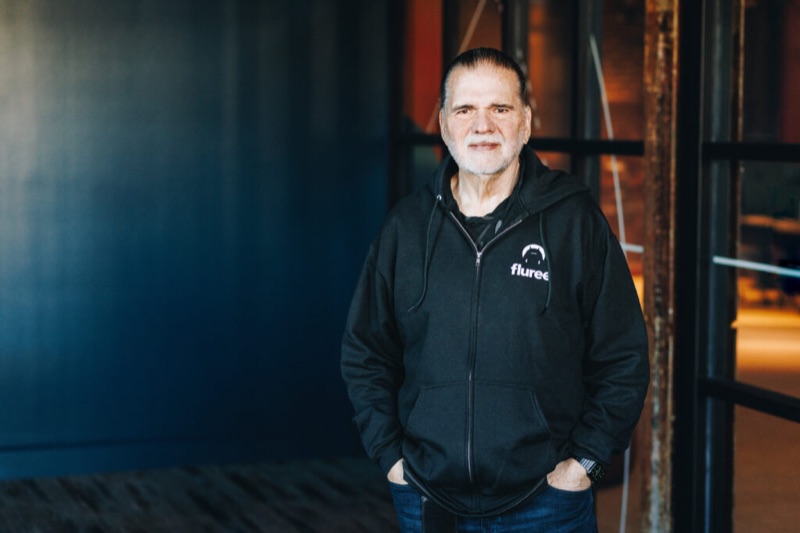
The pair spent years experimenting. Platz later described discarding and rebuilding the technology repeatedly. Their earlier businesses had given them firsthand experience of the problem; they still needed to produce a workable answer. Familiarity with a difficulty is useful, but it does not write the software.
Fluree’s approach brought database management together with a record of changes that could be checked. In their 2018 Epicenter conversation, the founders discussed keeping historical context and making information easier to audit. Their proposed audience was the organization trying to establish what had happened to its data, rather than a trader looking for the next coin.
A $4.73 million seed round followed in 2019, led by 4490 Ventures with participation from Revolution’s Rise of the Rest Seed Fund. The company had previously funded itself. The financing supported product development and efforts to reach enterprise customers. The order mattered: there had been substantial building before the outside funding announcement.
A headquarters with something to prove
Fluree established itself in Winston-Salem’s Bailey Power Plant. For the founders, the location carried some history. SilkRoad had begun in Winston-Salem before investor pressure helped move its headquarters to Chicago. With Fluree, they chose the North Carolina city again. Platz was open about wanting to demonstrate that a technology company could grow there.
The setting makes a useful counterpoint to Filipowski’s Chicago reputation. His career has involved large deals and broad networks, but the work could also happen in a converted power plant, among a smaller community of founders, universities and local business leaders. An impressive address is pleasant. Access to people who can help solve a problem has more immediate uses.
They also incorporated Fluree as a public benefit corporation. Its stated mission included helping people move into new careers through training and assistance. That put a human question beside the technical one: what happens to workers as the software changes? For a founder whose previous company sold employee-management tools, the concern had a recognizable continuity.
The past keeps its own records
In June 2026, Fluree announced general availability of a knowledge graph database designed for AI applications. The company emphasized the ability to trace answers back through the underlying information and enforce access rules within the data system. Filipowski’s current position is chair of the board and co-founder. His longstanding interest in enterprise information has found another generation of customers asking questions of it.
His own past also remained active. On September 2, 2026, the Eleventh Circuit affirmed a decision upholding the IRS’s rejection of his offer to settle approximately $140 million in tax liabilities for $1.5 million. The dispute arose from losses claimed through a partnership after the Platinum sale. Filipowski challenged the rejection; the court upheld it on public policy grounds. The ruling is part of the continuing financial aftermath of a transaction made more than a quarter-century earlier.
It complicates any tidy account of success, collapse and recovery. Companies can be sold, renamed or rebuilt while earlier decisions continue to have consequences. A career does not advance through chapters with a solicitor standing by to close each one.
At Harvard in 2005, Filipowski had explained his approach with characteristic flexibility: “I believe in assessing the current environment and taking advantage of it.” He also told the audience about a $40,000 investment in a pet business that had produced royalty checks worth millions. He had expected little from it. Even someone accustomed to large deals could be surprised by a small one.
That willingness to keep making things, alongside an uneven record of what those things became, gives his story its tension. Platinum, divine, SilkRoad and Fluree offer different answers to the same recurring question: what should he build next? The answer has rarely required a change of profession. Usually, it has required going back to work.
Follow the work
- Fluree: current leadership
- Andrew “Flip” Filipowski on LinkedIn
- SilkRoad becomes Rival
- The Harvard entrepreneurship conversation
- The 2006 Terry Savage interview
- Listen: Filipowski and Platz on Epicenter
- Fluree’s June 2026 announcement
- September 2026 appellate opinion
- Filipowski’s Crypto Briefing writing