At an art auction on the Hawaiian island of Lanai, Andrew Conrad outbid David Murdock. For most people, beating the billionaire who owned the island might have been sufficient entertainment for one evening. For Conrad, it became the beginning of a business relationship. Murdock, the Dole chairman, would become a patron, collaborator, and friend. Years later, Conrad would help negotiate a transaction in which that friendship was a complication.
There is something revealing about encountering Conrad through a bidding paddle rather than a laboratory bench. He trained as a scientist and became a founder, but his career also runs through introductions, persuasion, and the confidence to enter rooms where somebody else appears to own the furniture. At different moments, those rooms belonged to a fruit-company tycoon, Google, and a venture firm assembled by people he already knew.
In February 2024, he joined S32 as a general partner. By September 2026, he was joining the board of Basecamp Research following a financing led by the firm. Between those dates lies the latest change in his working life: the founder of Verily, once responsible for building a company inside Alphabet, now helps other founders build theirs. The change of seat makes his earlier career worth another look.
Malibu, a moped, and a laboratory
Conrad grew up in Malibu and became an enthusiastic surfer. His later appearance retained something of that upbringing: informal clothes, loose gray-blond hair, and a substantial goatee. Corporate photography can do a great deal to a person, but it has never quite made Conrad look as though his natural habitat is an earnings presentation. The seaside beginning is a small biographical detail with considerable staying power.
At the University of California, Los Angeles, he earned a bachelor’s degree in neurobiology and a doctorate in cell biology. During his graduate-student years, he rode a moped and wore torn jeans. The wardrobe sounds relaxed; the subjects required precision. His subsequent move into business did not erase that technical education. It gave him a second language to use alongside it, one spoken by customers, investors, and prospective colleagues.
In 1991, Conrad co-founded the National Genetics Institute with Mike Aicher. Aicher served as its chief executive, while Conrad’s work included the chief scientific role. The distinction matters in a career often compressed into a sequence of famous employers. Before Google, there was a company to build with other people, and the work extended well beyond having an interesting idea. A laboratory business needed organization, customers, and a reason to keep choosing it.
LabCorp announced its completed acquisition of the Los Angeles company on August 1, 2000. That date puts an early exit roughly nine years after the founding. It also places Conrad’s first company-building chapter well before the modern enthusiasm for giving every promising project a grandiose label. He went on to become LabCorp’s chief scientific officer. By the time Google recruited him, he had experienced both an independent enterprise and life inside a much larger organization.
- 1991Co-founds National Genetics Institute
- 2000LabCorp announces NGI acquisition
- 2013Joins Google X
- 2015Leads the company that becomes Verily
- 2023Moves to executive chairman
- 2024Joins S32 as general partner
- 2026Joins Basecamp Research’s board
When an old friend is on the other side
The relationship with Murdock brought Conrad onto boards including Dole and Castle & Cooke. It also brought a more exacting question: what happens when a friend’s preferred outcome conflicts with a director’s responsibilities? In 2013, Murdock sought to take Dole private. Conrad chaired the special committee evaluating the proposal. Personal familiarity, useful for getting work started, now required scrutiny of its own.
The committee resisted Murdock’s initial price. The eventual deal closed at $13.50 a share, and shareholders later sued. In the 2015 litigation, the Delaware court found Murdock and Dole executive Michael Carter liable for more than $148 million in damages. Conrad was not held liable. The judge, having initially been concerned about Conrad’s ties to Murdock, concluded after hearing him testify that he had acted independently.
This episode complicates the easy description of Conrad as a well-connected executive. Connections can open a door; they can also make an independent decision harder to explain. At Dole, his conduct had to stand apart from his proximity to the person making the offer. The distinction is especially relevant to his later career in venture capital, a business where a long acquaintance can help secure a meeting but cannot settle every question that follows.
A very old word for a new company
Conrad joined Google X in 2013. Two years later, the group he led became a separate Alphabet company. In December 2015, Google Life Sciences acquired a new name: Verily. The word meant “truly” or “certainly,” and sounded as though it had arrived from a considerably earlier edition of the English language. Among the invented syllables of technology branding, it had the peculiar advantage of already being a word.
The choice carried an aspiration toward truth. It also supplied a small clue to Conrad’s approach to assembling people. Engineers and chemists belonged in the same undertaking as people thinking about human behavior and the reasons behind it. He made room in his explanation of the company for philosophy, an unusual discipline to name in a discussion of technical hiring.
“A philosopher might be as important as a chemist,” he said in 2015. It is a compact statement of organizational taste: a difficult problem may require people whose training does not resemble your own. For a founder with a doctorate, that is a useful admission. Expertise can tell you what a technique will do. Somebody still has to ask why the undertaking makes sense, and what the people involved will make of it.
His time around Google extended across organizational boundaries. He held positions at GV and X and worked with teams at DeepMind, Google Cloud, and Google AI. Those names describe different kinds of work, from investing to computing infrastructure to research. The common thread in his biography is his movement among them. A person can understand an institution through its hierarchy, or through the colleagues and teams he learns to call.
“A philosopher might be as important as a chemist.”
Andrew Conrad · 2015
The handover has a date
On January 3, 2023, Stephen Gillett began his tenure as Verily’s chief executive. Conrad moved into the executive chairman role. A founder’s departure from the chief executive’s desk is often narrated as if it happens in a single dramatic instant. Here, there were separate steps: a change in operating leadership, a chairmanship, and then a move to another organization. The sequence deserves to be kept intact.
Gillett had already worked at Verily as chief operating officer and president. His first-day message to employees described learning from colleagues and preparing refinements to the strategy and operating model. That vocabulary belongs to an organization with an existing staff, accumulated capabilities, and decisions about how to use them. It marks a different stage from gathering an early team around a new undertaking.
Conrad’s next appointment arrived the following year. S32, founded by Bill Maris, announced him as a general partner on February 22, 2024. Maris had recruited him to Google and had known him for more than 25 years. Andy Harrison, S32’s chief executive, had also worked at Verily and X. The new position therefore involved a reunion as well as a change of profession. Several of the people around the table already knew how the others worked.
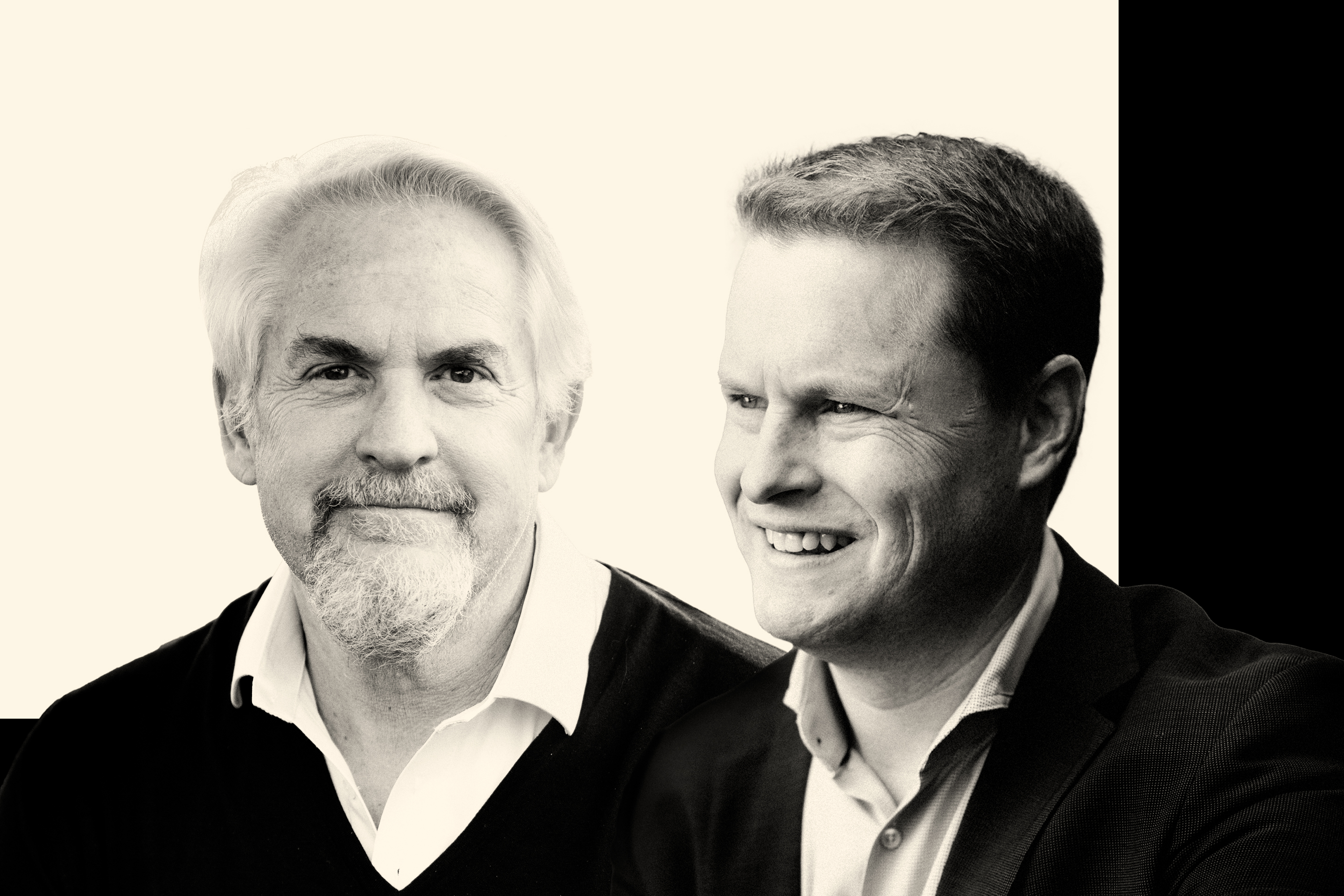
Two Andys, several decades of history
The photograph of Conrad and Harrison has the visual economy of a two-person partnership: Conrad on the left, Harrison on the right, both familiar with the professional world they shared. They share a first name and a stretch of professional history. At S32, their titles differ. Conrad is a general partner; Harrison is the firm’s chief executive as well as a general partner. Readers of technology biographies are entitled to a little help with the Andys.
Conrad explained his decision to join in terms of respect and trust. “I have known the S32 team for many years,” he said when the appointment was announced. The sentence is modest beside the elaborate vocabulary that often accompanies venture appointments. It is also specific. He had already worked in the same institutional orbit as the people now asking him to help evaluate and support other businesses.
The firm invests across areas including artificial intelligence, enterprise software, cybersecurity, and quantum computing. Conrad also appeared among the advisors announced at SandboxAQ’s independent launch in 2022. The appointments put him in conversations where technical claims, commercial ambitions, and organizational choices meet. Scientific training is relevant to those conversations; so is having signed up to build something and then lived through the less photogenic parts of running it.
Back at the beginning, from a different chair
The September 23, 2026 announcement from Basecamp Research made the investor chapter concrete. The company raised a $140 million Series C led by S32, and Conrad joined its board. Basecamp has its headquarters in London and offices and laboratories in Cambridge, Massachusetts. The appointment extends a career spent crossing between research organizations and business organizations into another company working with artificial intelligence and biological data.
There is a pleasing continuity in that move. The UCLA graduate who helped establish a laboratory business now sits on the board of a company building around data and models. The tools and institutional setting have changed. The practical questions remain recognizable: which people should work together, what the enterprise can establish, and how an organization should develop around the work. A new technology does not abolish the need for those judgments.
Conrad’s biography resists a tidy ascent through increasingly impressive job titles. It contains an acquisition, a Hawaiian auction, a difficult board assignment, a company born inside Google, a leadership handover, and a return to familiar colleagues. Each changes the meaning of the next. S32 gives him a position from which to encounter beginnings repeatedly. For somebody whose career has depended on entering a new room, the latest room contains a succession of founders arriving with something unfinished.
Continue the conversation
Explore Conrad’s S32 biography, the announcement of his appointment, and the story behind Verily’s name.
Watch Andrew Conrad at WSJD Live. Read the September 2026 Basecamp Research announcement and the account of the Dole board’s independence.