Andrea Tarrell's first Salesforce roadmap was drawn by hand. A sales leader brought her a sketch of what he wanted the company's newly purchased system to do. The installation itself had arrived with less ceremony: a salesperson had put licenses on a credit card, customized the software too eagerly, then spread administrator access around. Tarrell was a marketer, not a systems architect. She was offered a bargain. Learn the platform, figure out the drawing, and the company would send her to Dreamforce.
She heard the part about San Francisco. Tarrell had never been to California. She said yes.
The trip in 2011 introduced her to a world of marketing automation products, user groups and technical possibility. She returned to work, implemented Salesforce, added Pardot alongside HubSpot and became the person with her hands on the keyboard. The episode has the loose geometry of a career accident. It also contains nearly everything that followed: an unclear problem, an invitation to learn in public and a willingness to move before the map was finished.
The gap everyone could see
Tarrell had studied political science and Spanish literature at Marquette University, imagining government or politics before choosing marketing communications. Her route through the working world crossed three different vantage points: the marketer buying services, the digital agency creating campaigns and the Salesforce consultancy implementing systems. Each did part of the job well. The handoff between them was where things became slippery.
Agencies could design a campaign and report its leads. When a client asked which leads became opportunities, the conversation often stopped at Salesforce. Technical consultants could configure Salesforce all day. Ask what nurture sequence should run, or how the database should connect to advertising and social campaigns, and their confidence thinned. Marketing lived upstream. Sales lived downstream. Customers were expected to assemble the bridge.
The missing middle Sercante was built to occupy
Tarrell started The Spot for Pardot as a way to explore that territory. She had spent years blogging for other companies. Writing about problems she cared about felt cathartic, powered by what she called pent-up creative energy and no shortage of opinions. The blog gave Pardot practitioners useful answers. It gave Tarrell a place to sharpen her own. Before the consultancy had a payroll, its worldview had readers.
Sercante followed in 2017. Tarrell designed it as the partner she had wanted while working client-side: strategy, creative thinking, technical execution and analytics around one table. The company name was invented, distinct enough that her phone spent years correcting it to “Servante.” The joke lasted almost as long as the first growth chapter.
Say the number out loud
Tarrell gave the first year a target of $1 million in revenue. She has recalled telling people about it sheepishly. Naming a large goal creates a particular kind of exposure. It also makes the ambition available to collaborators. People and opportunities began appearing around the intention, she said. Sercante reached the number.
By the end of 2024, Tarrell reported that Sercante had recorded more than 20 percent growth for seven consecutive years, welcomed its 90th employee, earned more than 50 new AI certifications and completed its largest multi-cloud project. The firm operated across five countries and 26 US states. It also ranked No. 2,970 on the 2024 Inc. 5000.
A seven-year streak, measured honestly
Reported annual growth2018-2024
The bars show a streak, not revenue. Sercante did not publish annual figures for each year, so the graphic refuses the tempting fiction of exact scale. The useful fact is the consistency. Consulting companies grow through people, and each added person makes culture, training and judgment harder to reproduce. Tarrell's answer was less a manual than a posture: wayfinding.
Inside Sercante, a wayfinder was someone willing to charge into the unknown and trust the team to discover an answer. The word left room for competence without pretending certainty. That distinction suited a Salesforce ecosystem whose products, names and integrations kept changing. It also suited Tarrell's own leadership advice. Good leaders ask strong questions and keep an open mind, she has said. They look for abundance, generosity and paths where more than one party wins.
A company with a public commons
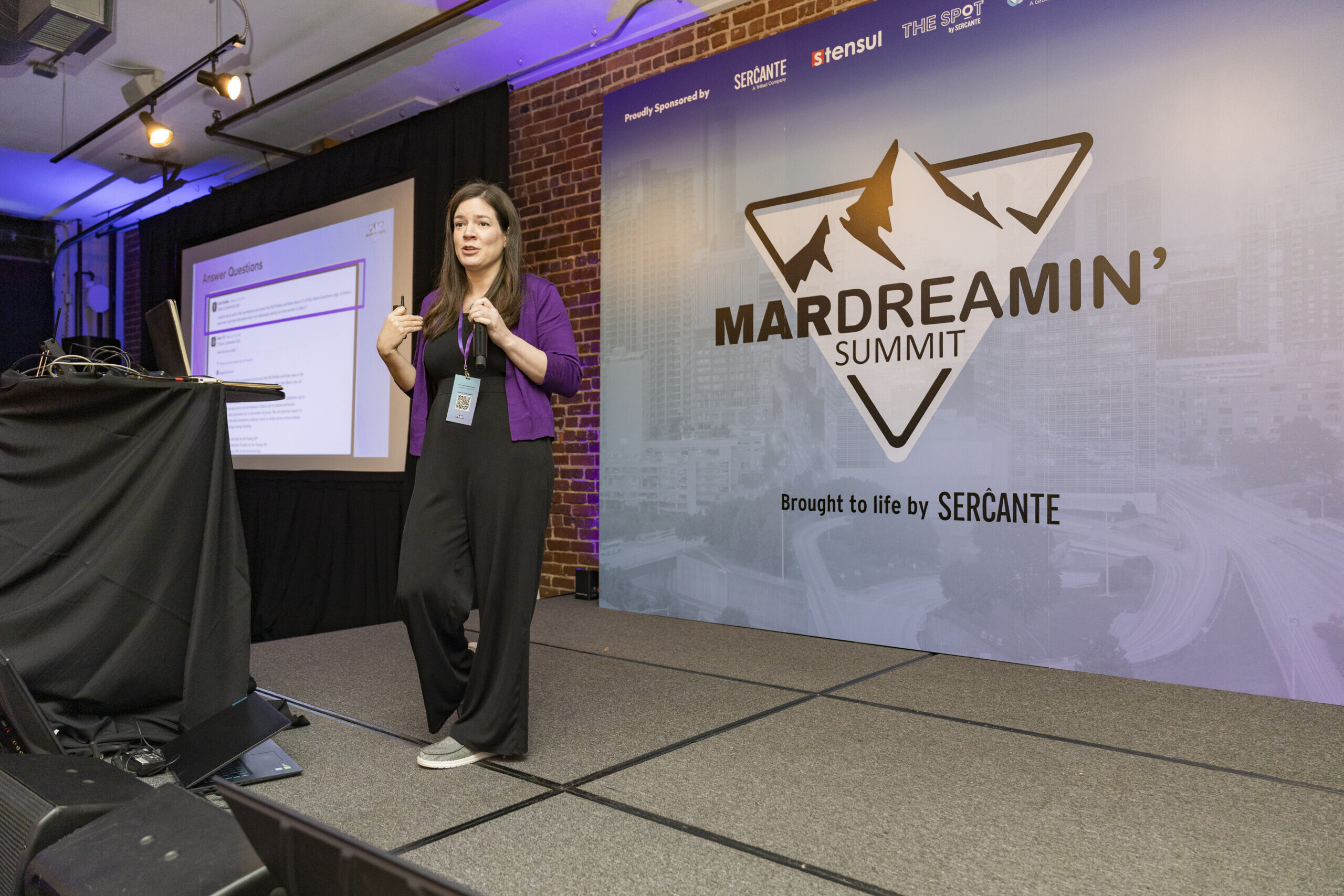
The Spot evolved from Tarrell's personal outlet into a broader Sercante publication. MarDreamin' turned education into a gathering. Tarrell served as a Salesforce MVP and Marketing Champion, while participating in YPO, Entrepreneurs' Organization and peer groups across the ecosystem. Those communities were more than distribution channels. She used them as an operating instrument.
Release notes, in her view, told perhaps 10 percent of the story. The rest emerged when practitioners tested a feature, found the bugs and compared what happened. She applied the same idea to executive work. Headlines about the economy or the technology business could sound definitive. Conversations with other CEOs revealed whether their customers and teams were experiencing the same reality. Peer exchange was a way to check the instrument panel.
There was generosity in that loop. Early in her career, Tarrell cold-messaged people to ask for coffee or advice. Maybe one in five accepted. Later, when strangers made similar requests of her, she said she tried to say yes nearly every time. Knowledge traveled because someone left a door open.
That sentence risks sounding decorative until it is applied to automation. Tarrell has long argued that software should begin with a business need. A consultant should resist arriving with a familiar solution and forcing the customer's problem to fit it. In 2026, as AI moved from novelty to operating pressure, she made the human argument more explicit. Technology was becoming easier to build. People and process were becoming harder.
Employees were hearing executives demand AI adoption while companies used AI as the public explanation for job cuts. Trust weakened before implementation began. Existing governance models moved too slowly for rapid experiments, while reckless experimentation could still expose customers and companies. Tarrell's frame was practical: define the acceptable “blast radius,” distinguish reversible decisions from irreversible ones, and measure gains in quality as seriously as gains in time.
Her optimism about AI was conditional. The glossy vision of a system choosing the audience, writing the campaign, contacting customers and informing sales depends on connected, usable data. “Whose data is that?” was her skeptical question. Data unification was the missing link. The machine could accelerate the work only after the organization had done the unglamorous work of connecting it.
Sweaty palms in the Sky Lounge
In May 2024, Trilliad acquired Sercante. Tarrell joined the larger company to lead its technology consulting service line and serve as a board advisor. The announcement described strategic fit: Sercante's Salesforce expertise alongside services spanning sales, marketing and customer success. The lived moment was more intimate. Tarrell sat in an airport Sky Lounge waiting to sign over what she called her baby. Her palms were sweaty. Several emotions competed for space.
A year later, she wrote candidly about the impatience of integration. Patience was not a top virtue. She could see the desired outcome and wanted to take every next step immediately: more acquisitions, new services, new teams. The combined company had to move deliberately enough to make the change last. A founder practiced wayfinding inside someone else's larger map.
Her August 2026 announcement counted the tenure precisely: eight years, eight months and eight beautiful days. Tarrell was leaving both the Sercante CEO role and her position as Trilliad's President of Tech Services. She celebrated the people who had chosen to spend their talent inside Sercante's virtual walls, the clients who had trusted them and the memorable firsts employees achieved there.
There was no polished reveal for what came next. Tarrell said she wanted a fresh challenge and was unsure what it would be. The uncertainty feels consistent. Her career began with a system she did not know, a picture she had not drawn and a plane ticket she wanted. Sercante began as a blog exploring an idea. Its culture turned navigation without a complete map into a shared capability.
Founders are often asked to provide certainty for everyone else. Tarrell's more useful contribution may be a method for moving without it: learn close to the work, ask the customer before choosing the tool, put strong peers in the loop, say the ambitious number aloud and let the next step reveal some of the one after it. The missing middle is rarely empty. It is where the unclaimed work waits.