Before André Christ sold enterprise software, he sold a service that tennis players understood immediately: he strung their rackets. It was an early way to earn money, and a pleasingly tangible one. The work had a clear purpose: get a racket ready for the court. Decades later, after building LeanIX and taking it into SAP, he has returned to the same sport with a rather larger logistical assignment. He owns a tournament.
There is an obvious temptation to make this a story about winning. A founder builds a company, sells it, then gets to spend more time around tennis. Yet the interesting part is the work he has chosen to take on. The Bonn Open needs players, partners, an audience and a team capable of making tournament week happen. Christ has exchanged a global software operation for an event people can walk into.
The location makes the choice more revealing. Bonn was where he grew up, where he helped start LeanIX in 2012, and where the company remained headquartered as it expanded abroad. His next chapter has brought him closer to the place he never entirely left.
A spreadsheet with ambitions
The origin of LeanIX was an office problem with considerable staying power. As an internal consultant at DHL, Christ helped IT leaders with projects. Before getting to the substance, he had to collect information about the systems they used. He assembled it manually in Excel. Tools existed to help, but learning to operate them could become a project of its own.
Christ and his then boss, Jörg Beyer, saw room for something easier to use. They founded LeanIX in Bonn. The underlying question was straightforward enough for anyone who has inherited a crowded cupboard: what have we got, and how does it all fit together? Inside a large organisation, the contents happen to include applications, versions, owners and dependencies. Opening the door is only the beginning.
His education had crossed economics and information systems, taking him through Bonn, Münster and Montpellier. His early work also crossed worlds: freelance development, an internship at High-Tech Gründerfonds and consulting inside a large corporation. That combination put business decisions and software decisions within the same field of view. LeanIX would spend years working in the space between them.
Enterprise architecture is an imposing name for a practical need. Before a company changes its technology, it helps to understand what is already there. LeanIX made that information easier to see and share. A map can be valuable precisely because the people consulting it did not draw every road.
A small company learns to travel
The early business had the usual imbalance between what customers needed to believe and what a tiny team could comfortably display. When a corporate prospect asked to visit, the founders considered recruiting friends to look like employees. The anecdote stops at the consideration. Even so, the predicament is familiar: a buyer wants evidence of permanence; a startup is still working out where everyone might sit.
Christ knew the customer’s side of that encounter. He had worked inside a company where buying software involved procurement, legal questions and several people with a say. That experience gave him a vocabulary for selling to large organisations. The founders financed the business themselves for three years, supplementing product work with consulting. Their evenings had rather less leisure in them than the word “founder” sometimes suggests.
“Selling to enterprise requires persistence, but also diligence.”
André Christ, 2021
By 2017, LeanIX had 80 German customers and a new $7.5 million funding round led by DTCP. Expansion into the United States was a stated purpose of the money. A product conceived in Bonn had reached the point where its founders needed to build an organisation across the Atlantic.
That involved travel and relocation. Christ spent weeks visiting American customers and conferences. Beyer moved to Boston to open the office; other senior colleagues followed. Regional leadership mattered too. There is a physical dimension to international software sales that the word “cloud” rather conveniently conceals. Someone still has to understand the people at the other end.
The effort produced a substantial American business. At the 2023 acquisition briefing, around 30 percent of LeanIX’s customers were in the United States, accounting for roughly half its revenue. Those figures describe the business at that moment. They also explain why a company headquartered in Bonn could attract attention far beyond Germany.
LeanIX’s US business at the September 2023 acquisition briefing.
The coach in the boardroom
One of Christ’s professional relationships began on a tennis court. Jörg Binnenbrücker coached him when he was young and later became a LeanIX investor through Capnamic. That is an unusually long introduction to a founder. Before there were board papers, there were lessons.
Looking back, Binnenbrücker remembered discipline, a competitive streak and a willingness to be coached. He also recalled questioning the size of the enterprise architecture opportunity. Christ believed the market would grow. The founder’s job, in that exchange, required enough confidence to disagree with someone whose advice he valued.
The relationship continued through hiring, expansion and the work of the board. Binnenbrücker praised the preparation behind meetings and Christ’s readiness to test feedback. His account gives learning an operational meaning: ask concrete questions, try an idea, examine what happens. A person can listen carefully without handing over the responsibility for deciding.
That detail adds texture to the familiar founder portrait. Competitiveness explains wanting a result. Coachability helps explain how someone improves the way they pursue it. On court, and later in a software business, Christ had people around him who could offer an informed second opinion.
Selling the map, staying for the work
LeanIX expanded its product scope as well as its geography. In 2021, it acquired Cleanshelf, a SaaS management provider with operations in the United States and Slovenia. The combination addressed another version of the visibility problem: software subscriptions could accumulate across a company, leaving people with an incomplete picture of what they were buying and using.
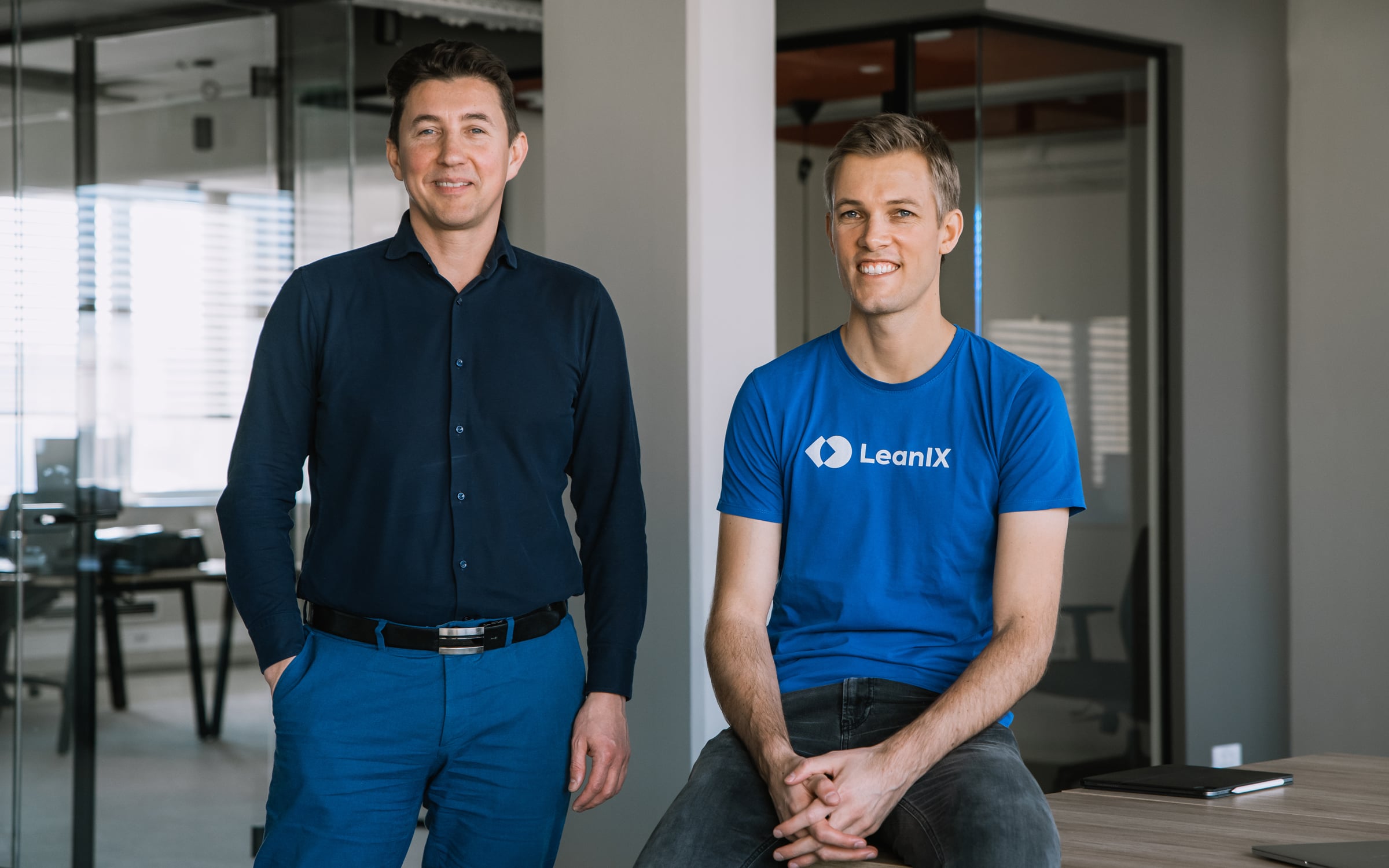
In September 2023, SAP announced an agreement to acquire LeanIX. More than 1,000 companies were using the product globally, including half the DAX 40. SAP wanted to connect a view of applications with its business process tools, including Signavio. LeanIX would continue to serve technology environments beyond SAP’s own products.
The acquisition made strategic sense as a pairing of questions. How does a business work? Which applications support that work? Decisions become harder when those answers live in separate conversations. Putting them together was central to SAP’s stated plan for its transformation portfolio.
Completion was announced in November. Christ stayed to lead the business inside SAP. The move also returned him to a corporate setting, something he could recognise from DHL. In a December interview, he joked about the relative size of the two employers. The founder had already experienced life inside an organisation larger than his new parent company.
He remained close to the product. A 2025 conversation about enterprise sales discussed his continuing habit of conducting demonstrations after the acquisition. It is a small but useful detail. A demo keeps an executive within reach of the questions a customer asks when the software is actually on the screen.
In July 2025, the separate LeanIX legal entities were merged into SAP. Christ described continuing as General Manager and Chief Product Officer. The work increasingly included AI: by 2026, he was discussing how an established enterprise SaaS product could change its architecture and development practices while serving existing customers. Years of accumulated product work brought possibilities and obligations together.
The next match is in Bonn
Dominik Rose took over SAP LeanIX on July 1, 2026. Christ left SAP at the end of that month, closing a professional chapter of more than fourteen years. His farewell thanked customers, colleagues and SAP leaders, and pointed towards the Bonn Open.
The tournament commitment had started earlier. He had supported the event as an adviser before taking it over as organiser. With tournament director Rebecca Quebbemann, he set out to build a lasting event in the region. The host club’s members agreed that the tournament could remain at TC Blau-Gelb Bonn-Beuel through 2030. Long-term ambition had acquired a place on the calendar.
An ATP Challenger event also has a particular role in a player’s career. It offers competition and ranking points on the route through professional tennis. Christ has spoken about wanting young people to experience that world close to home. For someone whose own tennis coach became part of his business life, the idea of a local sporting encounter having consequences later is hardly abstract.
His interest in enterprise technology continues. In October 2026, he publicly disclosed an angel investment in Conduct, whose product addresses complex enterprise systems. The connection to his earlier work is clear enough: understanding the software a business depends on remains a problem he is willing to back.
But the tournament gives the new chapter its shape. A software company can serve customers who never visit Bonn. A tennis event asks them to come. There will be a court, a crowd and a programme that has to run. Christ began by making other people’s rackets ready to play. He is now helping arrange the occasion.
Follow the next set
Conversations, company history and Christ’s work today.