At MediaMarktSaturn, a retailer selling the devices that make modern life run, the technology behind the business had become difficult to see. Applications were scattered across national operations. People knew their own corners. The whole picture was another matter. “We didn’t have a grip on our IT landscape or application portfolio,” recalled its global head of enterprise architecture, Krishnan Venkatasubramanian.
- SAP LeanIX maps applications to the work they support.
- Shared data helps teams spot duplication, risk and dependencies.
- Pricing follows application count, with unlimited users.
The retailer used SAP LeanIX to document applications across 11 countries. Redundancies became visible. Within 12 months, it had decommissioned 10% of its portfolio. The revealing detail is the sequence: first establish what exists, then decide what can disappear. Buying software helped the business stop maintaining other software.
of applications
decommissioned
within 12 months
01 / The same questions. Again.
LeanIX began with a familiar irritation made expensive by scale. Jörg Beyer, formerly a DHL CIO, and consultant André Christ repeatedly found that information about an organization’s technology was unavailable when a project needed it. Collecting it could require workshops with country teams around the world. The next project would need answers again.
Existing enterprise architecture tools did not persuade them. In the company’s account of its origins, the tools were costly, complicated and dependent on trained specialists. The founders wanted more people to understand the estate. They founded LeanIX in Bonn in January 2012; the first version arrived that August. Christ later described approximately three years without external funding.
This background explains the product’s bias. Enterprise architecture can sound like an exercise in drawing elaborate boxes. LeanIX makes the boxes answer everyday questions: who owns this application, what does it support, and what else will be affected if we change it?
02 / A map with consequences
Its Application Portfolio Management product collects an inventory and connects applications to business capabilities. Those connections give technical facts a business address. An application is easier to discuss when everyone can see which work depends on it. Reports assess technical fit, functional fit and cost; collaboration features help people supply and maintain the information.
Technology Risk and Compliance adds lifecycle and obsolescence information. Architecture and Road Map Planning helps teams describe a target estate and sequence changes toward it. Professional services assist with implementation. The expertise here is the relationship between systems, business activity and change, rather than simply counting software licenses.
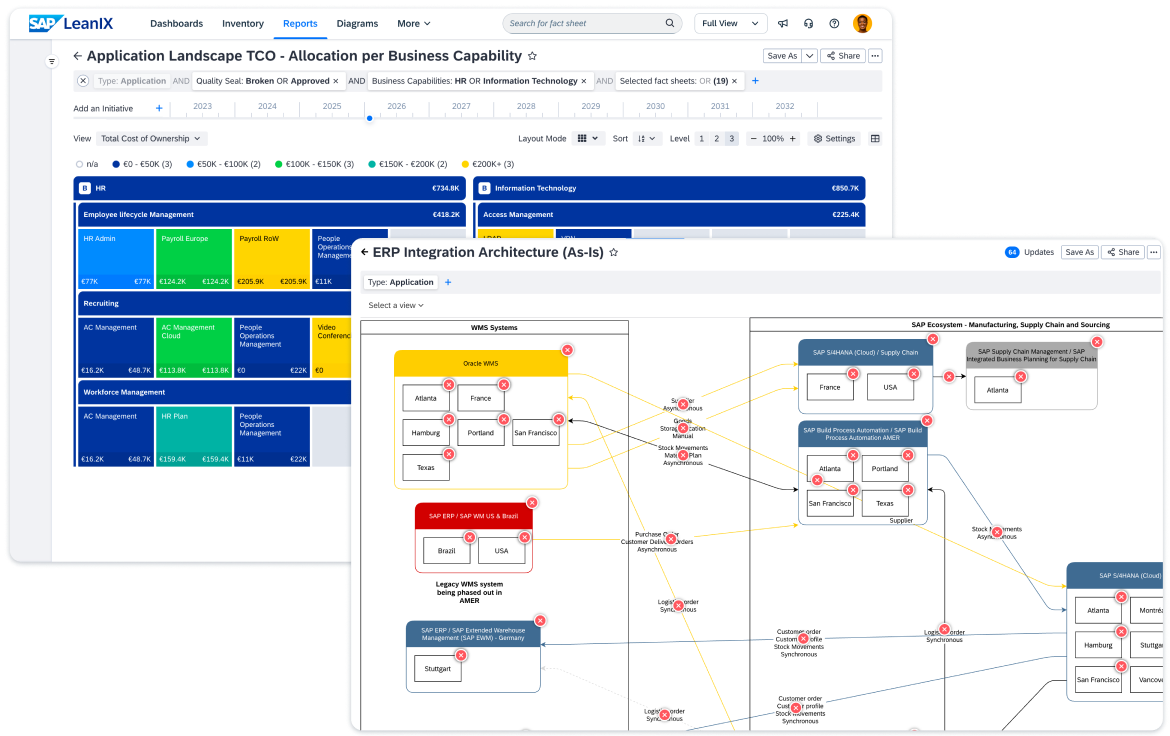
Integrations matter because another hand-maintained database would recreate the founders’ original headache. LeanIX connects with tools including ServiceNow, Jira, SAP Signavio and GitHub Enterprise. The GitHub integration, described in May 2025, brings self-built software into view. An application written inside the business can become a blind spot just as easily as one purchased outside it.
03 / The investment that looked different
A Virgin Australia example shows why the map matters beyond tidiness. In an IT steering committee meeting, an investment proposal offered neither an attractive return nor a large cost reduction. It looked unlikely to win approval. Then the airline’s chief customer and digital officer consulted the road map in LeanIX.
Without the investment, the application was heading toward a red risk status. The proposal was approved. In LeanIX’s published account, the architecture team did not need to intervene: the committee could interpret the evidence itself. What changed the decision was the visibility of future risk alongside the immediate financial case.
A useful map changes the questions in the meeting.
Why the airline example matters
That is a practical description of the customer: enterprise architects building the picture, with executives, application owners and transformation teams using it. Volkswagen, Adidas, Bosch and DHL appear among LeanIX’s customers. A Gainsight case study describes LeanIX’s growth from 100 to 1,500 customers.
04 / Why SAP wanted the map
Investors had already funded the expansion: a $30 million Series C in 2018, followed by an $80 million Series D led by Goldman Sachs Growth in 2020. Cumulative venture funding exceeded $120 million. SAP completed its acquisition in November 2023, after a long partnership.
The fit is understandable. SAP Signavio examines business processes; LeanIX maps the applications and architecture supporting them. Connecting those views helps teams plan transformations such as ERP modernization. SAP explicitly said LeanIX would continue serving non-SAP landscapes. Its relevance depends on seeing the estate, including the parts supplied by somebody else.
Ardoq and OrbusInfinity offer alternative enterprise architecture platforms. LeanIX’s case rests on application portfolio information, broad participation and integrations with the transformation toolkit. Those are reasons to evaluate it, rather than proof that every organization needs it.
The company applied a similar emphasis on participation internally. In 2021, its NewWork initiative let employees and teams choose how to balance office and remote work, while retaining opportunities to meet. That is a historical policy rather than a promise about today’s SAP workplace, but it fits the founding idea: useful information should travel beyond the specialist who first collected it.
05 / The work the software leaves you
The pricing unit is an application, with unlimited users. That encourages participation without adding a seat charge for each colleague. Buyers still need to weigh subscription and implementation costs against the decisions the inventory will support. For a small, stable estate, the overhead may outweigh the benefit.
LeanIX’s own December 2025 customer survey makes the human constraint plain: 61% of 225 enterprise architecture managers cited insufficient IT-business collaboration as their biggest rationalization challenge. Shared information helps; it does not settle ownership disputes. An inventory without people responsible for its accuracy will lose value.
A sensible rollout therefore starts with a decision worth making, rather than an ambition to document everything. Pick a business capability, find the applications supporting it, and ask their owners to verify the relationships. Establish which costs and risks would change if an application disappeared. This is an editorial prescription, not a guaranteed implementation schedule. It follows the product’s underlying logic: documentation has a purpose when it lets people compare realistic choices.
By January 2026, LeanIX was highlighting AI-assisted inventory building, total-cost-of-ownership analysis and AI agent oversight. Faster data entry is useful, provided somebody checks the result. The lesson readers can copy is smaller than a software purchase: name an owner, record purpose and dependencies, review the evidence together, then act. A map earns its keep when someone uses it.