An expensive salesperson comes with an attractive proposition: perhaps their address book can save you several years. Evgeny Sergeev tried that route at Ideals. More than ten hires and hundreds of thousands of dollars later, sales were close to zero. Prospects checked the unfamiliar company and stopped there. The software could work perfectly. The introduction could be impeccable. Neither supplied a reputation.
It is an unusually useful failure to put near the beginning of a founder’s story. Sergeev’s subsequent career keeps returning to the same practical question: how does a stranger become safe to do business with? At Ideals, which he co-founded in 2008, that question sits inside the product. At Pragmatech, where he is a partner, it sits inside the investment thesis.
A virtual data room is a place to share sensitive documents during a transaction. Its customers are preparing to make consequential decisions with people they may barely know. Before they can trust one another, they must trust the room. Before they trust the room, they must trust its maker. There is quite a queue at the door.
The boy at the blackboard
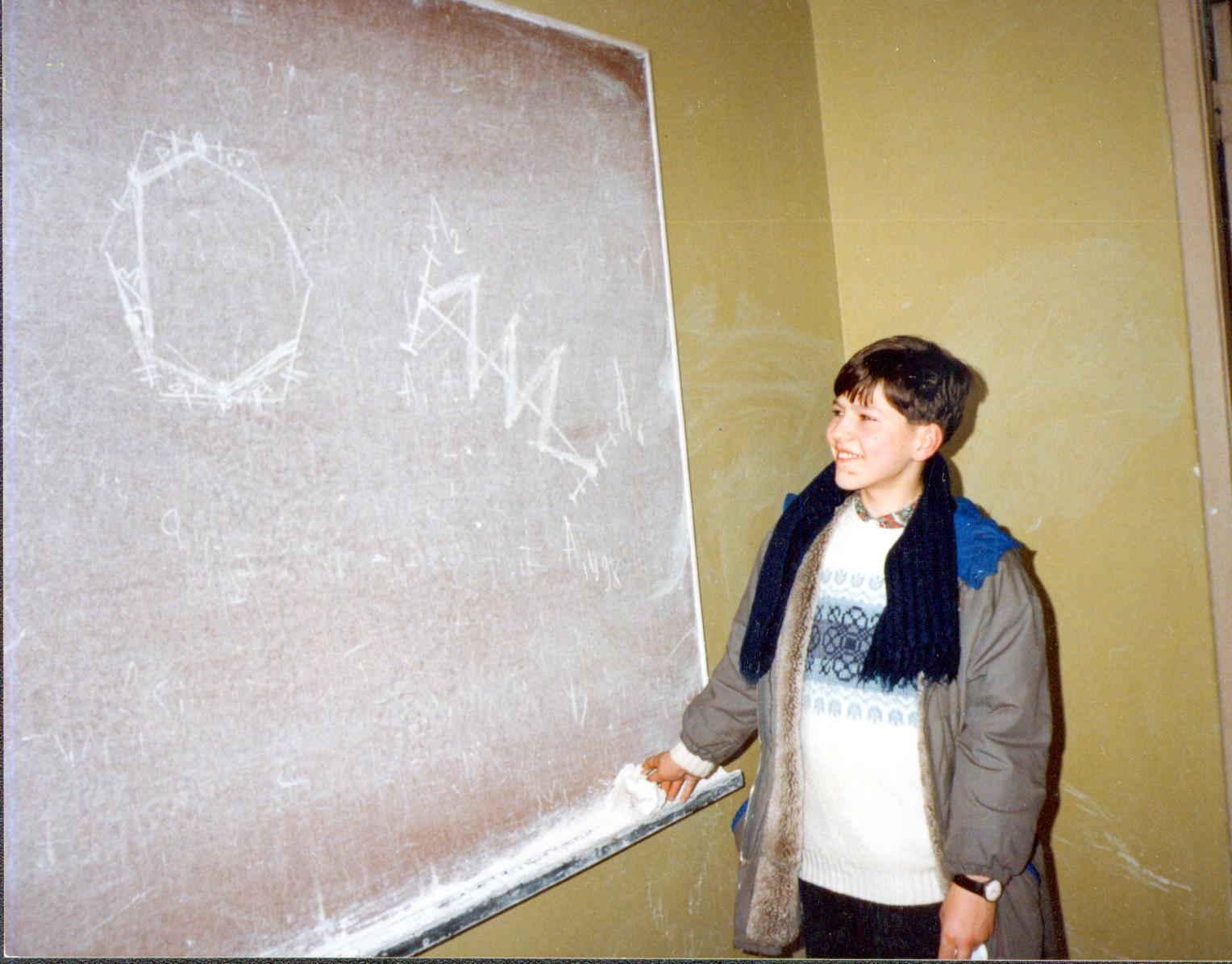
Sergeev began programming in sixth grade and spent an eighth-grade holiday writing a checkers game. He later attended the Moscow Institute of Physics and Technology, worked at Microsoft, and helped build Genesis as well as Ideals. The school photograph supplies a less ceremonial introduction: a teenager beside a board, explaining how something works.
Pragmatech’s account of his background puts research and engineering before investing. That sequence matters. An engineer can inspect a mechanism, discover where it fails, and change it. A commercial relationship is less obliging. The buyer brings memories, colleagues, procurement rules and consequences that never appear in a software specification.
Seen through that distinction, his career becomes a study in enlarging the problem. Building the application is one task. Building the conditions under which someone will buy and continue using it is another substantial piece of work. The second task eventually became part of what he offers other founders.
A room with several locks
Ideals’ present-day product makes the work concrete. Its platform includes document management, multiple permission levels, questions and answers, reporting and project archives. Each function addresses a different worry in the transaction. Who can see the file? Who can print it? Which question still needs an answer? What survives when the deal closes?
The company describes its founding problem as the combination of slow platforms and inadequate security. Speed and control make awkward companions: removing a step may make a process faster while removing a safeguard. The product’s job is to make those demands coexist without asking the customer to referee every exchange.
In a message accompanying a private-equity report on 2022, Sergeev treated increasing complexity as a reason to develop technology that helps customers manage it. That is an engineer’s response to a busy room: begin examining the arrangement.
“For us, complexity is not a bad thing.”
Evgeny Sergeev, 2022 private-equity report
There is a modest appeal to a business whose usefulness can be described in such ordinary questions. The transaction gets the announcement. The permissions, archives and unanswered queries have already done their work by then.
The brand has to enter first
Years after those early sales disappointments, the company undertook a broad identity redesign. Design lead Marcel Bittencourt dates the work to 2024 and 2025, with a launch in November 2024. Its commercial brief included attracting larger transactions, expressing product differences more clearly and presenting a consistent identity across markets.
Typography, colour, photography and interface components might seem a long way from an engineer’s starting point. They become less decorative when a prospective customer is deciding whether an unfamiliar provider looks capable of handling a sensitive deal. A coherent presentation gives the product a fairer hearing. It still has to pass the examination.
Sergeev’s public message about the refreshed brand linked it to the data-room experience and transparent pricing. That pairing is revealing. Appearance gets someone to look; understandable costs help someone decide. The bill is part of the customer experience, however reluctantly it is invited to the design meeting.
The redesign belongs in his story because it takes the original reputation problem seriously. Established businesses have to keep explaining themselves, too. Familiarity is useful, but a company that grows into different markets and larger projects needs its public face to keep up.
India, and the value of knowing the room
Expansion offers a sterner test than a new visual identity. In April 2025, Sergeev explained Ideals’ acquisition of EthosData in terms of the Indian market. He singled out the combination of the Ideals platform and a local team with experience in Indian mergers and acquisitions, naming country head Harsh Batra.
The practical promise covered permission controls, reporting, security and clearer pricing. These are things a customer can question before signing. They also explain why acquiring a provider can involve much more than adding software: the people already understand the conversations that surround its use.
One existing relationship gives that argument a human scale. TVS Supply Chain Solutions had used EthosData and continued after it became part of Ideals in 2024. R Viswanathan, its head of M&A, explained the choice: “We now use Ideals for all our M&A deals because people matter.”
TVS’ experience combines document controls and support alongside the technology. Its continued use of the service tests the commercial logic behind the acquisition: a buyer can carry confidence in a team across a change of ownership.
Hiring for the business ahead
By October 2025, the organisation had changed considerably. Ideals described a team that had grown from 150 to 450 people, spread across more than 30 countries. Its plans then envisaged 800 to 900 people over the following four to five years. That was an ambition, with years of hiring still attached.
The same account put sales and marketing at roughly 80 percent of the hiring plan. For an engineering founder, that is a consequential allocation. Distribution requires its own expertise, and international growth requires enough people to make a promise in one time zone and keep it in another.
A later recruiting message featuring Sergeev invited people into the global sales team and emphasised craftsmanship and performance. Recruiting language always carries an element of invitation. The choices behind it are more concrete: which functions get resources, which people make decisions, and what standard the next hire is expected to meet.
Company size is useful context, but it does not explain a founder on its own. Here the interesting movement is toward a broader organisation capable of delivering the service repeatedly. Software makes a promise every time somebody logs in. Someone has to keep arranging the people behind it.
Taking the lesson to other founders
When Pragmatech announced itself in 2020, Sergeev identified a regional imbalance. Eastern Europe had considerable technical ability, yet relatively few people with experience building global B2B marketing and sales. The fund’s purpose included supplying that expertise alongside capital. Its debut investment was in HR service Hurma System.
That diagnosis makes his investor role a continuation of the operating story. A founder who has already built the product can still be inexperienced at reaching buyers abroad. Money extends the runway. Experienced help can change what happens during those extra months.
Today Pragmatech describes a focus on early European teams, with a preference for founders from Central and Eastern Europe and initial tickets up to $500,000. Its stated interests include AI-powered workflow software. It also looks for customer references, trusted brands and distribution that competitors would struggle to reproduce.
Those criteria put commercial relationships beside technical capability. On the fund’s website, JENTIS founder Thomas Tauchner credits Sergeev and fellow partner Artem Yaremchuk with practical help in sales and operations. His testimony describes the kind of assistance the original investment thesis promised.
Contracts, data, and the next decision
Two investments show where that approach has travelled. Pragmatech backed Della AI, whose technology helped legal professionals examine contracts by asking questions. In 2022, Sergeev spoke of supporting founder Christophe Frèrebeau’s team with hiring and operations. Wolters Kluwer announced its acquisition of Della AI on December 30 that year.
The acquisition announcement described multilingual contract review and the technology’s place within its legal software business. For Sergeev, the connection is familiar: valuable documents, specialised professional work and decisions that become easier when information is accessible. The application differs from a data room; the working territory overlaps.
Pragmatech also participated in JENTIS’ €11 million Series A in November 2023. The Austrian company works on server-side tracking and first-party data capture. Sergeev’s accompanying comments focused on demand for the product and its international development. Again, the investment involves the collection and controlled use of information inside a business.
These are separate companies with their own founders. Their place in Sergeev’s story is the opportunity to apply operating experience beyond Ideals. His career began with making systems work. It has come to include helping other people make their systems commercially credible. Somewhere between the working product and the signed agreement, another person must decide to believe you. Sergeev has spent a considerable part of his career attending to that moment.