Anand Sanwal once gave his company a name that a prospective customer could not bring himself to buy. ChubbyBrain sounded jaunty enough for a startup. It sounded less convenient inside an investment bank. The banker liked the product and the data; the name presented a problem. Sanwal and his co-founder, Jonathan Sherry, changed it to CB Insights. The initials survived, a small souvenir of a business learning to behave in public.
The episode offers a useful introduction to Sanwal. There is the joke, the commercial problem, then the willingness to change something when reality objects. Over the years, his work has returned to that sequence. He has sold intelligence to people paid to know things, written business emails that ended with a declaration of love, and voluntarily surrendered the chief executive’s chair. His next institution involves younger customers and considerably more homework.
Today, the CB Insights co-founder and executive chair is also co-founder and head of school at Forge Prep. The school, in Livingston, New Jersey, puts practical work and independent judgment at the center of its model. The move makes an unusual career turn. It also raises a familiar Sanwal question: how much of what looks respectable is actually useful?
The customer gets a vote
Before the newsletters and conference stages, Sanwal worked inside American Express, managing its $50 million Chairman’s Innovation Fund and the CFO’s strategic planning group. He had studied chemical engineering at the University of Pennsylvania and finance and accounting at Wharton. His earlier career included Kozmo.com, the delivery startup whose trajectory supplied a rather brisk education in the dot-com era.
At American Express, he encountered a practical frustration: finding dependable information about private companies. These businesses could matter enormously to an investment decision while remaining awkwardly difficult to understand. Publicly available clues existed. They were scattered among announcements, hiring activity, websites and other material that did not arrive neatly arranged for a decision-maker.
The opportunity was to organize those clues into something someone would pay for. The original venture took several attempts to reach that point. Sanwal has described paying two early employees from personal savings while prospective buyers remained unconvinced. He and Sherry were close to abandoning the effort before the subscription business began selling under the CB Insights name in February 2010. Bain Capital Ventures became its first customer.
There is little glamour in that version of the founding story. It contains unanswered pitches, a shrinking cushion and a product that needed a paying audience. For someone who would later advocate real-world work as an education, it is a useful piece of biography: the lesson came with an invoice, and sometimes without one.
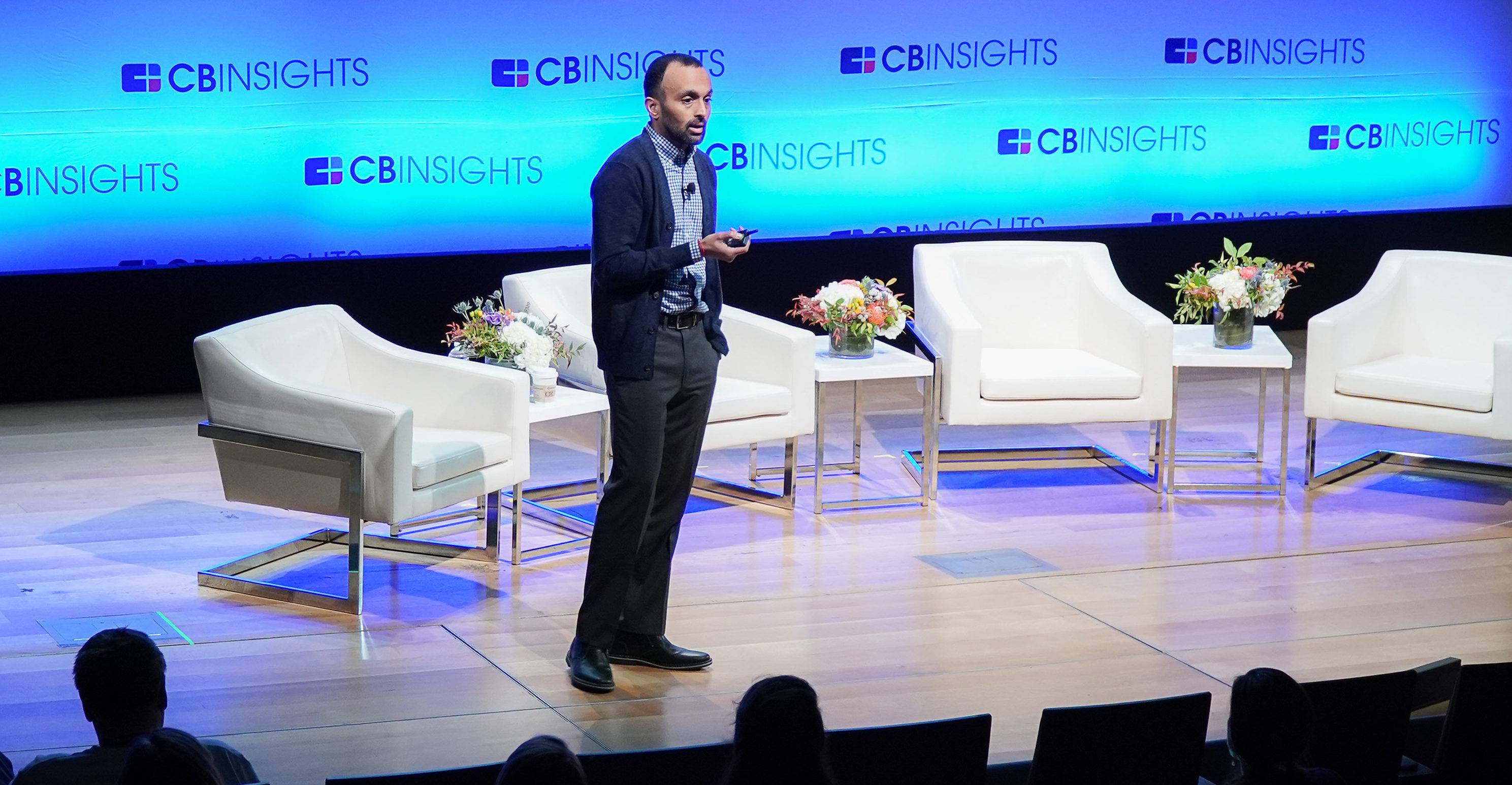
Love, with a subscription attached
Sanwal’s most recognizable invention may have been a tone of voice. The early CB Insights newsletter was dutiful and restrained. Then he began letting more personality into the room. Opinions appeared alongside the research. The writing grew conversational. Business readers were treated as people who might enjoy themselves while learning something.
Eventually came the sign-off: “I love you.” In a market-intelligence email, that is a fairly economical way to make a reader look twice. The experiment was meant to find out whether people were paying attention. It generated replies, including affectionate responses from readers. The joke acquired a life beyond its original test.
“We thought that B2B had to be boring,” he recalled. That assumption had cost the company a recognizable voice. Abandoning it made the work easier to pass along. You could forward useful data; you could also forward an email that sounded like someone had enjoyed writing it. The combination gave CB Insights a route into inboxes that a solemn research abstract might never have reached.
The comedy also had an edge. In April 2016, CB Insights announced a fictitious $40 million ChubbyBrain Ventures fund. Its appeal for diverse applicants specified Harvard, Stanford or Wharton. The joke drew congratulations and employment inquiries. A parody of venture-capital manners had proved capable of passing as venture-capital news. Sanwal had found an audience willing to believe the punchline was a business plan.
“We thought that B2B
Anand Sanwal, recalling the early newsletter
had to be boring.”
Sixty-six people before the round
Behind the jokes sat a subscription business with a demanding economic discipline. Sanwal preferred the phrase “revenue-funded” to bootstrapped. It puts the customer in the sentence, where a company that needs receipts tends to keep them.
At SaaStr, he described building the team to 66 people before raising $10 million. His talk, “Don’t Do These 68 Things in Your SaaS Company,” presented company building as a collection of mistakes worth examining. The delivery was brisk and irreverent. Even the presentation of revenue became an opportunity to tease the industry’s fascination with financing announcements.
The underlying business offered companies and investors a way to navigate technology markets. The free writing introduced readers to the work; paid subscriptions supplied deeper intelligence. Humor could earn attention, but customers still needed information that justified the bill. The newsletter and the product had different jobs, joined by the same need to be useful.
By July 2021, the flagship newsletter reached more than 750,000 readers, while the company’s newsletters together were approaching a million subscribers. Those are historical figures, a snapshot of how far the experiment had traveled. A business associated with databases had also become a publisher with a distinctive relationship to its audience. Somewhere along the way, the financial world had learned to tolerate affection in its inbox.
Flagship newsletter subscribers, historical snapshots. Bars use 750,000 as the scale maximum; 2021 exceeded that figure.
A resignation from the wrong job
On January 4, 2024, Sanwal announced that he had decided to “fire” himself after 14 years as chief executive. He would become founder and executive chairman. The language was mischievous; the reasoning was fairly exact.
As CB Insights grew, his time had shifted toward internal operations and management. Those responsibilities mattered, he explained, but they drew him away from the work he liked and believed he did well: talking with customers, understanding their problems and translating those conversations into products. His new role would focus on customers, product, content and partnerships, including the possibilities of generative AI.
There is a revealing admission inside the announcement. Building an organization and wanting every job that organization eventually produces are separate matters. A founder can be good at creating the business that makes his own working day less satisfying. Sanwal’s response was to change his position within it.
In a later conversation about leadership, he also acknowledged a cost of early survival habits. Taking almost anyone with money as a customer can help a young business stay alive. At greater scale, that breadth can make it harder to decide whom the company serves. Focus then becomes an operating requirement. The same approach that helped at one stage may need replacing at the next. He was willing to apply that logic to himself.
From CEO to executive chair at CB Insights.
Introduces the Schools of Entrepreneuring.
Announces adolescent Montessori training.
The founder returns to homework
By May 2024, Sanwal had publicly introduced another project: the Schools of Entrepreneuring. He envisioned physical schools where young people would learn through building and operating real ventures. Entrepreneurship would be the vehicle for developing judgment, communication and independence. The ambition extended beyond a single campus, though ambition and an operating network are different stages of a project.
The personal provocation came at home. In Forge Prep’s manifesto, he describes his daughter asking when she would ever use the material she was studying. His own answer amounted to an admission that he had done similar work decades earlier and she simply had to get through it. It is an uncomfortable parental position: defending an activity while conceding its doubtful purpose.
Sanwal responded by becoming a student himself. In November 2024, he announced that he had enrolled in the Association Montessori Internationale’s adolescent teaching program, describing a 17-month course of study. Interviews and reading had taken him some distance. He wanted classroom observation and direct experience too.
He was interested in Montessori’s emphasis on independence, meaningful work and adults who guide rather than supply every answer. He also wrote that he intended to draw on several educational traditions. The move gives his criticism of schooling an obligation: learning the craft he proposes to change. An entrepreneur with opinions about education is familiar enough. An entrepreneur signing up for homework is a more interesting development.
A thousand dollars, and something to show
The educational project acquired a practical companion in October 2024. Sanwal and his friend Raj Shah launched the Forge Fellowship with $500,000. It offered $1,000 grants to middle and high school entrepreneurs, without taking equity or making loans. The amount was small enough to be comprehensible to a young builder and large enough to help an idea meet the world.
That program fits his recurring interest in evidence of capability. In an April 2025 essay, he called the emerging preference for demonstrated work the “Proof Economy.” A finished project, a working business or something useful created for other people could reveal abilities that a title or credential leaves obscure. His argument asks parents to pay closer attention to what children can make and solve.
Forge Prep carries that argument into its curriculum. Students work through challenges, supported by guides, and build a record of demonstrated skills. The published model combines academic knowledge with what the school calls power skills. Its challenge sequence moves from preparation to exploration to production. The intended endpoint is something a student can show, explain and defend.
There is a recognizable family resemblance to his first business. Scattered information had to become intelligence someone could use. Here, knowledge has to become work that demonstrates understanding. A school transcript and a market-intelligence subscription occupy different worlds, but both invite a question about what the recipient can actually do with them.
A Forge Fellowship grant for a young entrepreneur.
No equity taken. No loan to repay.
The next test has real customers
Sanwal has kept his appetite for experiments. In a public post, he described building an AI head of school trained on Forge’s website, essays, handbook and job specifications. After all that preparation, a leading question was still about tuition. A founder may reorganize an institution’s philosophy; a parent will quite reasonably ask what it costs.
He also reported that the tool sometimes hallucinated and asked people to test its answers. That detail matters. His public writing can be certain, even combative, about what established institutions get wrong. Operating an alternative supplies a steady source of particulars that broad arguments cannot settle.
The interesting part of this next chapter will be those particulars: the work students complete, the judgment they develop and the feedback the school receives. Sanwal has already learned that a customer can reject a name, an inbox can reward an unexpected joke, and a founder can outgrow his own job description.
At CB Insights, he made a habit of questioning the respectable way to do things. At Forge Prep, he has given that habit a timetable, a curriculum and people to answer to. His education in usefulness continues. This time, he is assigning some of the homework.
Keep following the questions
Essays, conversations and the work in progress.