A hospital television seems an unlikely place to look for the future of telehealth. Yet Amwell sells a kit that turns one into a connection to a remote care team. The patient stays in bed. A clinician appears on screen. The interesting part is everything required to make that ordinary encounter happen: the right room, the right person, the right workflow, and somebody responsible for what follows.
- Amwell sells the infrastructure behind virtual care to hospitals, insurers, and government organizations.
- Its bet extends beyond appointments into behavioral health, automation, and bedside devices.
- The business is losing less money. It has yet to prove the turnaround is complete.
That is a useful way into Amwell. The company founded in 2006 by physician brothers Ido and Roy Schoenberg connects patients and clinicians, but its enterprise proposition reaches further. A hospital buying its software wants virtual care to work inside the institution it already runs. An insurer wants members to find care through benefits they already have. Amwell wants to supply the connections.
The appointment is only the beginning
The early picture of telehealth was delightfully simple: a patient with a minor complaint opens a screen and finds a doctor. The pandemic made that picture familiar. It also exposed how much medicine happens outside it. Specialists consult. Nurses coordinate discharges. Patients need help between appointments. Each encounter belongs to a longer chain.
In April 2021, Amwell unveiled Converge, a platform intended to bring its programs, devices, and third-party applications together on one code base. Roy Schoenberg called it “Digital distribution of care.” The distinction mattered commercially: a company selling an appointment competes for that appointment; a company embedded in clinical workflows can become part of how an organization operates.
Amwell’s buyers are health systems, health plans, and government healthcare organizations. Its current materials describe roughly 50 health plan clients and approximately 90 million members with Amwell as a covered benefit. That last number describes eligibility. It does not count people actually using the service. The platform handled 4.5 million visits in 2025, a different measure with a different meaning.
A camera needs a hospital around it
Consider the electronic health record, where clinical work already lives. Amwell supports integrations with Epic and Oracle Cerner. M Health Fairview and LMH Health appear in its customer examples. For clinicians, the attraction is practical: starting virtual care within existing systems reduces the need to move between separate tools. For patients, familiar entry points can remove another obstacle to showing up.
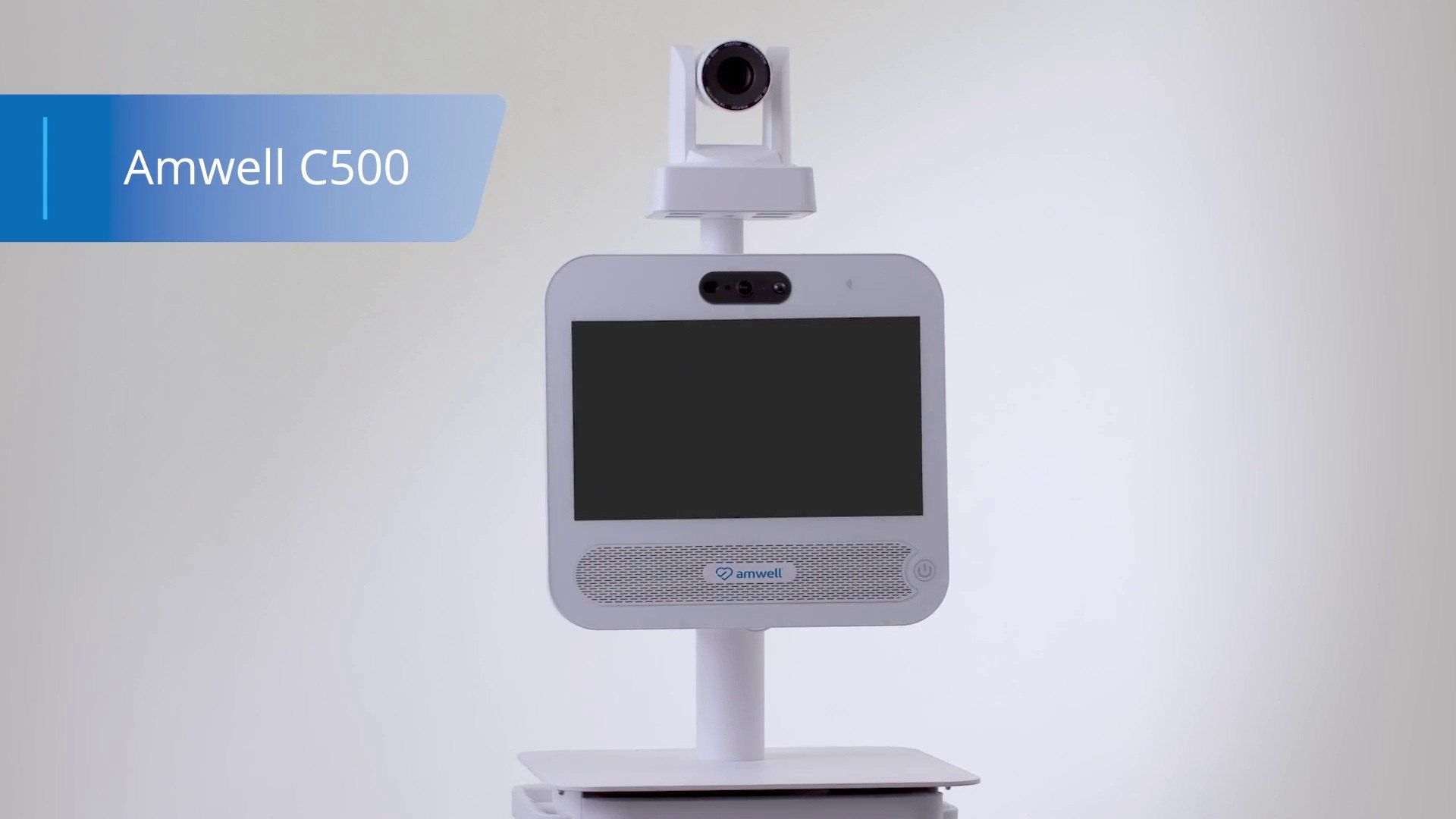
The physical products make the strategy unusually tangible. Carepoint carts connect remote specialists to hospital patients; supported peripherals can transmit diagnostic information. TV kits turn existing room televisions into access points. The hardware gives Amwell a role in places where the patient is already receiving in-person care. A remote clinician can join a local team rather than requiring the whole encounter to move online.
There is also clinical labor. Affiliated Amwell Medical Group supplies virtual providers when customers need capacity. SilverCloud adds digital behavioral health programs. Automated Care Programs support engagement between encounters. These pieces serve different jobs, which is precisely the argument for connecting them. The patient should not need to understand the vendor map to find the next step.
Conceptual care pathways, not a prescribed treatment sequence.
The bill for connecting everything
Building that breadth required money. The September 2020 IPO and concurrent Google investment generated approximately $922 million in gross proceeds to Amwell, before fees and expenses. Google’s $100 million placement accompanied a strategic Google Cloud collaboration. In 2021, Amwell announced the SilverCloud and Conversa acquisitions for approximately $320 million combined, using cash and stock.
The spending bought a broader product proposition, not an automatic economic victory. Amwell’s 2025 annual filing acknowledges customer churn during re-platforming and market consolidation. The friction appeared in keeping customers through a difficult transition. Even customers persuaded by a platform’s destination still have to survive the journey there.
Management subsequently narrowed the portfolio. In January 2025, Amwell sold its hospital psychiatric care business to Avel eCare for approximately $21 million at closing plus an earn-out. It retained other behavioral health offerings. The stated rationale emphasized the unified platform and a greater software contribution. Selling clinician time and selling reusable software produce different cost structures; the distinction had become consequential.
Smaller losses. Still a loss.
The company earns platform subscription fees, clinician visit revenue, and money from other offerings such as services and hardware. In 2025, subscriptions contributed $132.4 million of $249.3 million total revenue. Net loss was $95.0 million, down from $212.6 million in 2024. That is a substantial improvement with a substantial loss still attached.
Loss narrowed by about 55%. Bars show loss magnitude, not revenue.
The August 2026 results continued that pattern: second-quarter revenue of $52.0 million and a $9.6 million net loss. Adjusted EBITDA loss was $1.2 million, a separate, non-GAAP measure. Management still targeted positive operating cash flow in the fourth quarter. A target belongs in the future tense.
Government work offers another test. Leidos announced a DHA virtual health task order involving Converge in 2023, worth up to $180 million if all options were exercised. That figure covered the task order, not Amwell’s disclosed share. In September 2026, the VA issued a nonbinding letter of intent for Amwell’s platform. It represented procurement interest, explicitly subject to a definitive contract.
Make the next step obvious
By September 2026, Ido Schoenberg was describing a change in emphasis: the obstacle was adoption and trust. His original access problem had acquired a second layer. Adding more digital services could leave people navigating more entrances, forms, and unfamiliar experiences.
“Innovation was never our bottleneck.”Ido Schoenberg, September 2026
The practical lesson is to evaluate the handoff. Can a patient enter through a familiar channel? Can the clinician act inside an existing workflow? Can the organization see whether care happened? Those questions travel well beyond healthcare. They also explain the limits: integration cannot supply missing staff, repair every reimbursement problem, or make unsuitable care appropriate for a screen.
Amwell competes with Teladoc and Caregility, video platforms such as Zoom, and EHR vendors that can also be partners. Its pitch combines software, clinical programs, and devices under the customer’s existing relationships. Buyers must judge that combination against the cost and effort of implementation.
For a buyer needing only video, Amwell’s broader platform may be unnecessary. Its case becomes stronger when multiple programs, clinical teams, and settings need to work together. The company’s unfinished experiment is whether making those connections useful can also make its own economics work.