The bus was an awkward gift for a mathematics student. Amos Haggiag’s father, a finance executive in public transportation, had a question about how the industry arranged its vehicles and drivers. The work cost a great deal, depended heavily on manual planning, and seemed open to improvement. His son was studying mathematics and computer science. Perhaps he could have a look.
It was 2004. Haggiag had met Eitan Yanovsky at Ben-Gurion University, and the two began considering the problem together. A decade passed before they founded Optibus. In between came degrees, jobs, evenings, weekends and repeated encounters with the inconvenient details of running buses. The question had acquired something like tenure.
The question also supplied an unlikely beach conversation. Haggiag remembers telling Yanovsky about it during a summer vacation. Both had enjoyed riddles since childhood, and the planning challenge appealed to that appetite. The familiar traveling-salesman problem offered a point of comparison: a task that sounds straightforward until the possible combinations begin multiplying.
Haggiag now leads a company whose software helps agencies and operators plan and run public transportation across countries. Yet the beginning remains unusually modest: a father describing an expensive operational headache to a son who did not yet know how to solve it. There was plenty of mathematics available. Certainty took longer.
The neighborhood computer department, aged ten
Haggiag grew up in Tel Aviv. His first computer arrived when he was seven, a substantial family purchase that initially served the worthy purpose of playing games. Getting those games to work required tinkering. Soon he was writing scripts for the pleasure of making the machine do something new. By ten, he recalls, neighbors were bringing him their computer problems.
He also spent much of his childhood outside with friends. He credits their adventures with building his confidence. The combination has persisted: the technical founder who enjoys kite surfing and rock climbing is comfortable describing himself as both a computer enthusiast and an outdoors person. A screen could occupy him; it did not claim the entire child.
At university, mathematics and computer science gave those interests a more formal vocabulary. He completed his undergraduate studies in 2007. His subsequent engineering career included machine-learning work at Siemens and Collarity, then a senior software development role at Microsoft. There he worked on personalization technology, including the Cortana personal assistant. He had found interesting work before becoming a founder.
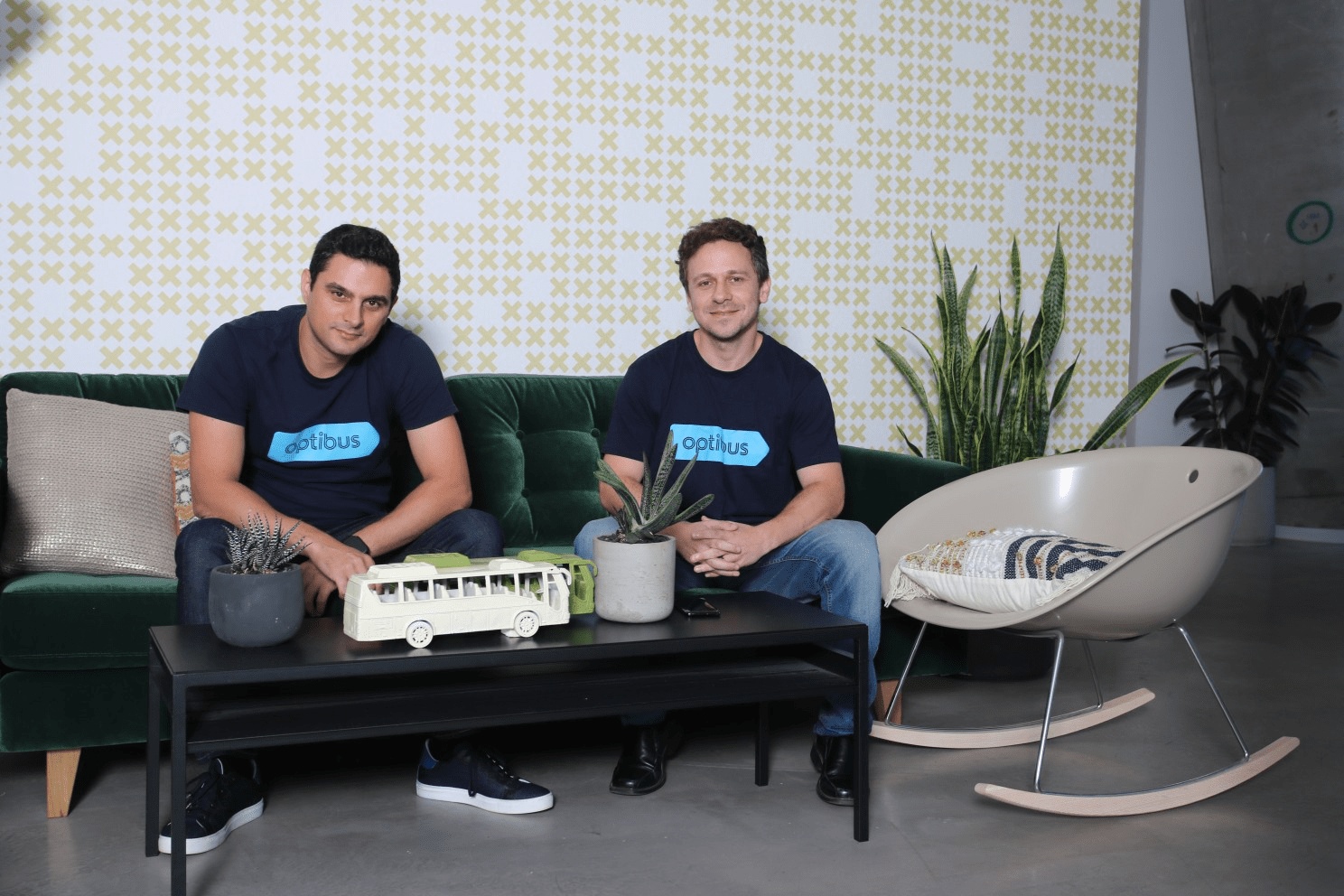
Ten years, then a basement
Meanwhile, the bus problem kept calling. Haggiag and Yanovsky worked on algorithms in their spare time, met transport operators and learned from the results. They were building an understanding of the industry alongside the software. A theoretically attractive assignment still had to accommodate the people and equipment expected to carry it out.
A bus schedule contains a small society. Routes need timetables. Trips need vehicles. Vehicles need drivers, and drivers need workable shifts and breaks. An adjustment in one place changes the available choices elsewhere. The familiar bus-stop timetable is the tidy public face of a much less tidy allocation problem.
In 2014, Haggiag left Microsoft. He has described the first working arrangement as the two founders in the basement of his house, without money or the institutional comfort they had left behind. The decision was difficult because they liked their jobs. Entrepreneurship arrived with an opportunity cost that was personal and immediate.
Years later, asked what he would change, Haggiag said he wished he had started Optibus earlier. He connected the delay to confidence: they had not been sure how large the opportunity was. That admission gives the ten-year prehistory an interesting tension. Persistence helped produce the company, while its founder still wonders whether he waited too long.
- 2004A question at university
- 2014Optibus becomes a company
- 2022$100m Series D
- 2026Agent + real-time tools
A very small company meets very large buses
Early customers brought another kind of acceleration. Large transport operators were willing to work with the small company because the planning problem mattered enough to justify considering a newcomer. Those contracts put demands on a product still in its early form. Haggiag remembers difficult customer conversations and the work required to make the software ready for enterprise use.
There was a practical way to make the sale less abstract. Optibus could take an operator’s data, run its algorithms and demonstrate potential improvements before a purchase. The customer could examine an alternative plan for its own operation. Haggiag has repeatedly linked that ability to show financial value with the company’s early growth.
He also came to appreciate the planners whose manual methods had first seemed so inefficient. “We eventually learned what an amazing job they were doing,” he said. Experience was carrying a formidable load. Software had to earn its place beside that experience.
By May 2022, Optibus had announced a $100 million funding round at a $1.3 billion valuation. Haggiag’s explanation of competition was less glamorous than the financing: operators still needed a reason to change established habits. A spreadsheet has an advantage that rarely appears in a product demonstration. Everyone already knows where it lives.
“We eventually learned what an amazing job they were doing.”
Amos Haggiag, on public transport planners
The algorithm needs a local accent
International growth brought a distinction that software companies can underestimate. A German operator wants evidence that a system understands Germany. Successful installations in Britain or the United States help, but they do not settle questions about local rules, unions and working practices. Haggiag describes winning initial local references as part of the work of entering a market.
At SaaStock in 2024, he discussed the risk customers take when choosing software for an essential operation. If it fails, buses may arrive late or fail to arrive, and passengers may receive incorrect information. The buyer needs confidence in the organization delivering the product as well as the product itself. Regional understanding becomes part of that reassurance.
He has described concrete routines for keeping a dispersed company connected: monthly all-hands meetings that begin with the vision, mission and values, presentations that show employees what other departments are doing, and visits to offices for roundtable conversations. Those repetitions matter when colleagues no longer share a room. Decisions have to travel through people who understand the purpose behind them.
His own job changed with the organization. He could no longer speak directly to every employee each day. Leadership increasingly involved communicating through managers, reinforcing priorities and helping teams understand work happening elsewhere. By early 2026, a revenue gathering in Madrid brought colleagues from ten countries together across sales, marketing, customer success and product. The mathematical founder was spending time on another coordination problem: his company.
Company-reported reach in the June 2026 Agent announcement. These figures describe the platform’s footprint.
The bus has a charging appointment
Electrification gives Haggiag’s original problem new dimensions. In a 2023 interview, he described the decisions involved: when a vehicle should charge, for how long, with which charger, and in what order relative to the rest of the fleet. Those choices must fit the vehicle schedule and the driver’s day. Buying the bus starts a considerable planning exercise.
He has argued for transportation systems that connect different modes, including trains, buses, smaller shared services and micromobility. He is also cautious about treating an on-demand vehicle as a universal answer. Moving large numbers of people through a city presents different demands from serving a lightly used area. The appropriate service depends on the place and the passengers.
That view is consistent with the company he built: each new promise has operational consequences. More electric vehicles mean more charging decisions. A different service pattern means different resource requirements. For a founder drawn to complicated allocation problems, the industry has proved a dependable supplier.
Now the timetable can answer back
On June 17, 2026, Optibus launched its Agent, with Haggiag and Yanovsky participating in the launch webinar. The product brings natural-language interaction into planning, scheduling and operations. Announced tasks include finding eligible drivers, checking compliance rules and helping users investigate schedules. Haggiag described the proposition as “your team’s expertise, multiplied by AI.”
The company’s subsequent webinar recap described a specific division of labor. The agent translates a user’s intent into settings for the existing optimization engine. People review proposed actions before they are applied. The years spent developing the underlying algorithms still matter; the new interface sits alongside that accumulated work.
September brought the Real-Time Suite, designed to use existing vehicle-tracking systems and schedule data to improve arrival estimates, detect detours and support dispatchers. Haggiag emphasized extracting more value from equipment agencies already own. It is a practical continuation of his original interest: what better decisions could the same operation make with better tools?
Live service feedback returns to the next plan. Conceptual illustration of the planning and operations cycle.
The verdict comes at the bus stop
For all the machinery behind the service, Haggiag’s stated ambition is increasingly concerned with what passengers notice. Reflecting on Optibus’s first decade in 2024, he described a next chapter focused more directly on the rider: better reliability, frequency and convenience, making public transportation a preferred way to travel.
There is a personal connection to that ambition. He has spoken about taking public transport in Tel Aviv from childhood and still recognizing routes he used when young. The network is familiar territory as well as a technical subject. Its resistance to change has been part of his experience as a passenger.
The company’s reach now gives the original question a different scale. But a passenger waiting for a bus has little reason to admire the complexity behind it. Haggiag has chosen a field in which much of the work can remain invisible when it succeeds. Somewhere beyond the algorithms, the depot and the charging plan, a person wants to get going. The bus has to turn up.
Follow the route
More from Haggiag, plus conversations worth watching.
- Optibus website · Company profile
- Amos Haggiag on LinkedIn · Twitter / X
- The founder’s story: childhood, customers and growth
- Listen: the Mobility Innovators conversation
- Watch: Haggiag’s lessons from building Optibus
- Watch: scaling across countries and cities
- An interview on electric buses and connected mobility
- The September 2026 Real-Time Suite announcement
- Inside the Agent launch: demos and questions
- Haggiag’s writing for METRO · Forbes Technology Council author profile