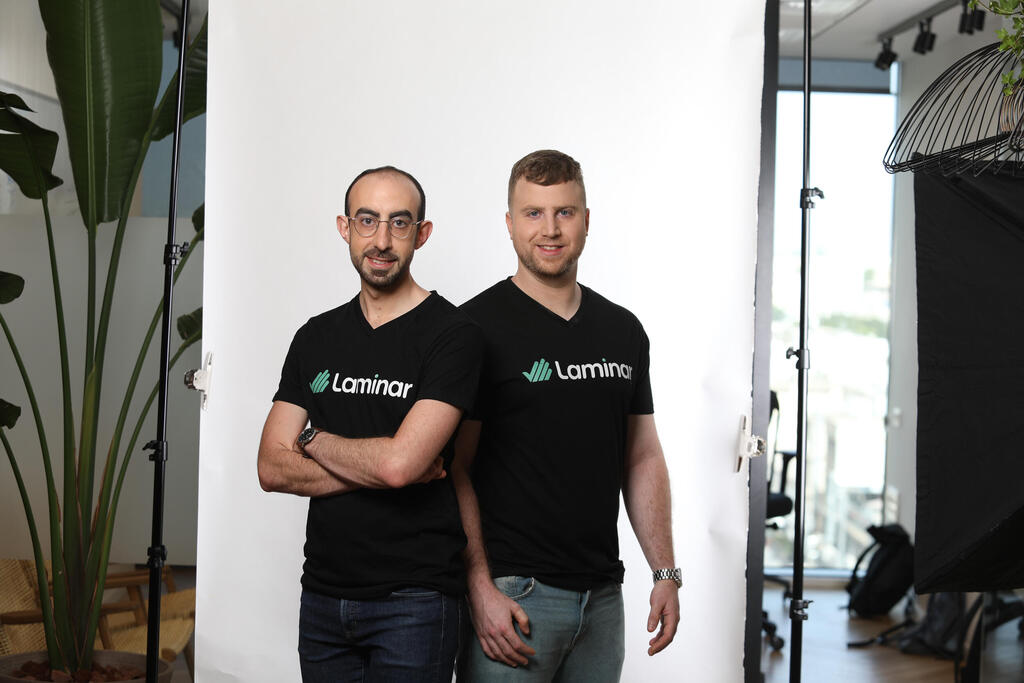
Amit Shaked was 14 when he met Oran Avraham in a program that let them attend university early. They were the youngest students in the class. There are elaborate theories about choosing a co-founder; theirs began with having someone their own age to talk to. The friendship lasted. So did the idea that they would eventually build a security company together.
By 2020, that idea had become Laminar, with Shaked as chief executive and Avraham as chief technology officer. Its subject was something businesses were accumulating faster than they could account for: data in the public cloud. The company would help find it, classify it and work out what needed protection. A teenage partnership had acquired a very adult problem.
There is a pleasing mismatch in this story. Shaked's education began unusually early, his career followed a deliberate route, and his company was named for smooth flow. Yet the opportunity depended on disorder. Companies could make copies, build services and move information with remarkable ease. Keeping track of the consequences was harder. Somewhere between the convenience and the accounting, a business appeared.
An education in scale
Shaked grew up in Givatayim and moved to Tel Aviv at 18. His father ran a civil engineering company; his mother worked in computing. Excellence was a household expectation. He has recalled that a score of 96 invited questions about the missing four points. Mathematics suited him, but his interests also extended to literature, art and fashion. The future security founder had room for things that would never appear in a product specification.
He earned a bachelor's degree in mathematics and computer science at the Open University of Israel and a master's in computer science at Tel Aviv University. His service in Unit 8200 included engineering and management work. At Magic Leap, the augmented reality company, he led teams working on deep learning and artificial intelligence. These were jobs with technical substance before there was a company to pitch.
He and Avraham also gave themselves different views of startup life. Shaked went into a much larger organization, while Avraham joined Medigate early. In Shaked's account, the choice let him see how a business worked at scale. Their eventual partnership brought together people who had stayed in touch while learning from different stages of company building. A shared history did not require identical apprenticeships.
That distinction matters when looking at the chief executive title. Shaked arrived at it with experience building software and leading technical teams. The business problem and the engineering problem could be discussed in the same conversation. His education had given him a way to examine a system; the next step was persuading an organization that its own system needed examining.
“We are friends first and business partners second”
Amit Shaked and Oran Avraham · 2021
The cloud had a lost-property problem
Laminar's proposition started with a practical question: where is the sensitive information? In its account of shadow data, the company described forgotten test environments, leftover migration copies, backups and sensitive material buried in logs. These were ordinary by-products of work. The phrase sounds rather sinister; some of the underlying trouble is closer to leaving the spare keys in a drawer and forgetting which drawer.
The consequences are less charming. An organization can make careful rules for a database it knows about while overlooking a copy that contains the same information. Laminar's four-part approach was to discover, prioritize, secure and monitor. Finding data established the inventory. Classification helped distinguish sensitive material. Risk assessment gave security teams an order of work, and monitoring acknowledged that the environment would keep changing.
The way the software fitted into that environment was part of the argument. Laminar used cloud-native interfaces and an agentless, asynchronous approach. Its design aimed to let security work happen without placing an inspection point in the path of every data movement. In a December 2021 interview, Shaked discussed the approach with Alan Shimel. The operational ambition was clear: make protection fit the pace at which people were already working.
A separate piece Shaked co-wrote with Francesco Marzoni, then chief data and analytics officer at Ingka Group, made the organizational case. People responsible for using data and people responsible for protecting it needed a workable shared model. Redundant connections and isolated systems made both jobs harder. Policies governing access could give developers a clearer route to the information they were allowed to use.
The argument helps explain Shaked's place in a crowded security business. A founder has to describe a threat, but also understand why customers keep creating the conditions for it. Those customers want to build applications and extract useful information. A tool that simply adds delay has its own sales problem. Laminar's pitch treated useful access as part of the task, which gave its security work a business purpose beyond saying no.
- 01DiscoverFind and classify the data
- 02PrioritizeIdentify the risks that matter
- 03SecureAddress exposure and controls
- 04MonitorKeep watching as data changes
A company becomes public, then gets bought
Laminar emerged from stealth in November 2021 with a $32 million Series A and $37 million in total funding. Insight Partners led the round, with SentinelOne, TLV Partners and Meron Capital participating. The company planned to expand engineering, sales and its security research team. Its public arrival made the founders' old ambition visible in a different form: a budget, a hiring plan and investors expecting a business.
In June 2022, an additional $30 million brought total funding to $67 million. Tiger Global Management and Salesforce Ventures joined the investor group. Shaked's announcement outlined spending on product development, sales, marketing and a global team. He also thanked a long list of security and data executives he was learning from. For a company built around discovering information, the customer conversations were another kind of ongoing research.
He and Avraham appeared on Forbes Israel's 30 Under 30 list in 2023. Shaked's response was amusingly unceremonious. Among chefs, singers, chess grandmasters and other honorees, he counted himself among the “boring CEOs”. He thanked the Laminar team. It was a small glimpse of humor in a career usually described with funding rounds and technical abbreviations.
On August 8, 2023, Rubrik announced an agreement to acquire Laminar. The buyer wanted to bring cloud data security posture management together with its recovery capabilities. It also planned to use the Laminar team as the foundation for an R&D center in Tel Aviv. The company's technology and the people building it would become part of a larger operation.
The distinction between posture and recovery explains the fit. Posture asks what is exposed and what should be changed before an incident. Recovery concerns getting an organization working again afterward. Joining the two extended the work across different stages of an attack. The acquisition announcement presented a shared direction for those capabilities, rather than treating the cloud inventory as an isolated product.
The acquisition-date purchase consideration was $104.9 million, made up of cash and stock. A further $23.8 million was held back subject to service-based vesting. Those figures give the transaction a more precise accounting shape than a single exit headline. They describe the corporate purchase; they do not establish Shaked's personal proceeds.
The bell and the next job
In April 2024, Rubrik went public. Shaked marked the occasion by returning to the ambition he and Avraham had started with nearly four years earlier: securing data. His account thanked Rubrik colleagues including Bipul Sinha, Mike Tornincasa and Anneka Gupta. The list put names to what an acquisition changes. A founder's work now runs through a wider group of people with their own responsibilities and expertise.
He also took part in the New York Stock Exchange bell-ringing ceremony. By March 2025, he was describing a job leading global DSPM strategy, growth and monetization, alongside responsibility for Rubrik's Israeli operation. The university partnership had led through a startup into a public company. He still worked on the subject that had persuaded the two friends to leave their jobs.
Another change arrived in September 2025. Shaked moved to Vice President, Strategy and Security, while Eyal Ron became site lead for Rubrik Israel. Ron had worked at Laminar and subsequently led engineering at Rubrik Israel. Shaked expressed confidence in a colleague he had known for years. The succession carried part of the startup's history into the leadership of the larger organization.
The same question, with AI attached
Shaked's April 2025 writing on artificial intelligence returned to a familiar concern: organizations introducing new tools without a clear account of the data those tools could reach. An internal assistant might expose payroll details or financial reports to an employee who should not see them. The example was about permissions and information management, even though the interface was new.
His proposed preparation was practical. Map sensitive material, classify it, set access rules and monitor use. AI increased the importance of that work because it could make existing information easier to retrieve. His argument placed responsibility for the data alongside enthusiasm for the software. The ambition he described was to let organizations adopt AI with a better understanding of what they were opening up.
Across these stages, Shaked's career keeps circling a problem of scale. He studied inside a system early, learned how larger technical organizations worked, and helped build software for customers whose information had outgrown their inventories. Then his own company became part of a larger one. The work kept demanding a wider view.
The friendship at the beginning gives that progression a human measure. Two teenagers found each other in a university classroom; years later, their business asked customers to look more carefully at what they already had. The question remains disarmingly plain. Before deciding what to do with all this information, can you say where it is?