The first version of Cyera sounded, in Yotam Segev’s telling, like a spaceship with lasers. The founders had imagined a clever agent that could trace data moving between cloud servers. Then they sat with security chiefs and heard a less glamorous request. The customers could not reliably say what sensitive information they had or where it lived. Segev reached for another image to describe the mismatch: his team had brought a spaceship to people who still needed a donkey and a bucket for the well. The product became more basic, and far more useful. It would find and classify the data first.
That revision is a better entrance to Segev’s story than a valuation. The numbers are large now. Cyera announced a $600 million financing in June 2026 at a $12 billion valuation, five years after its founding. In September it completed a $1 billion acquisition of Oasis Security and announced a further $400 million Series G investment from Goldman Sachs Alternatives. Yet the founder’s own account of the early years contains bad sales quarters, mistaken assumptions and a long stretch of customer travel. The company’s central question survived those years because the team kept changing the answer it offered.
A club in Alon HaGalil
Segev grew up in Alon HaGalil, a small community in Israel’s Jezreel Valley. His father was a programmer and taught him Visual Basic when he was young. At 14, Segev opened a Dungeons & Dragons club. He has described it as more than a hobby: it was a way to earn money by gathering people around an idea. There is a pleasant absurdity in drawing a line from fantasy campaigns to enterprise software, and Segev himself has drawn it. The transferable part was assembling a group and keeping it engaged. The dragons had a less direct career path.
His other household example comes from his mother’s bed and breakfast. He points to its 350 reviews and perfect five-star rating as evidence of the precision hospitality demands. A guesthouse in a rural setting has many chances to disappoint: weather, insects, expectations. He talks about his mother’s standards as something to carry into Cyera. It is an unusually domestic reference point for a chief executive discussing cybersecurity, but it helps explain why he gives attention to the small experience that shapes a customer’s verdict.
Before the company came Talpiot, the Israeli military’s science and leadership program, where Segev met Tamar Bar-Ilan and Yonatan Itai. His LinkedIn profile lists study at the Hebrew University of Jerusalem from 2010 to 2013 as part of the program. Segev and Bar-Ilan went on to work together on cloud security in Unit 8200. Cyera says he also served as a senior class commander in the Talpiot Leadership Academy. Those jobs gave the pair technical experience and a working relationship before they had to invent a company.
The useful question
The founders started Cyera in 2021. Their military experience had taught them how complex cloud environments could become. It had also given them the confidence to build something technically ambitious. Customers supplied a different kind of education. Segev says investor Gili Raanan put them in front of buyers with a simple condition: build the product only if customers said they wanted to buy it. In those conversations, the elaborate original concept failed a practical test. A security team could not protect information it had never found.
Segev and Bar-Ilan spent roughly a year talking with hundreds of chief information security officers and practitioners, according to Segev’s later account. They asked where existing data security had failed and what a useful system would have to do. Discovery and classification emerged as the foundation. Once a company knows which data is sensitive, where it sits and who can reach it, it can begin to make informed decisions about access and protection. Without that inventory, increasingly ornate controls merely decorate the confusion.
“The pain has to be as excruciating as possible.”Yotam Segev, on choosing a problem customers would act on
This was a product lesson with an awkward sequel. Funding had arrived, expectations had risen and Cyera hired a sales team. Segev has said the first year after its early round went badly. One quarter produced no sales at all. He recalled asking Raanan what happens if a spacecraft fails to take off. The investor’s answer was a crater. Founder folklore often edits out this interval; Segev’s account gives it a full paragraph and an uncomfortable sales target. In 2022, he said, the company sought $3 million in sales and reached $1.5 million.
By May 2022 Segev had moved to the United States. He describes spending the week traveling to customers, from Monday night until Saturday morning, trying to regain momentum. The route from a founder’s explanation to a customer’s signature could not be delegated wholesale to a new sales manager. He changed the sales team and resumed direct contact with buyers. The next quarter brought half a million dollars in sales, by his account. Progress was incremental before it looked inevitable in retrospect.
The fieldwork moved to New York
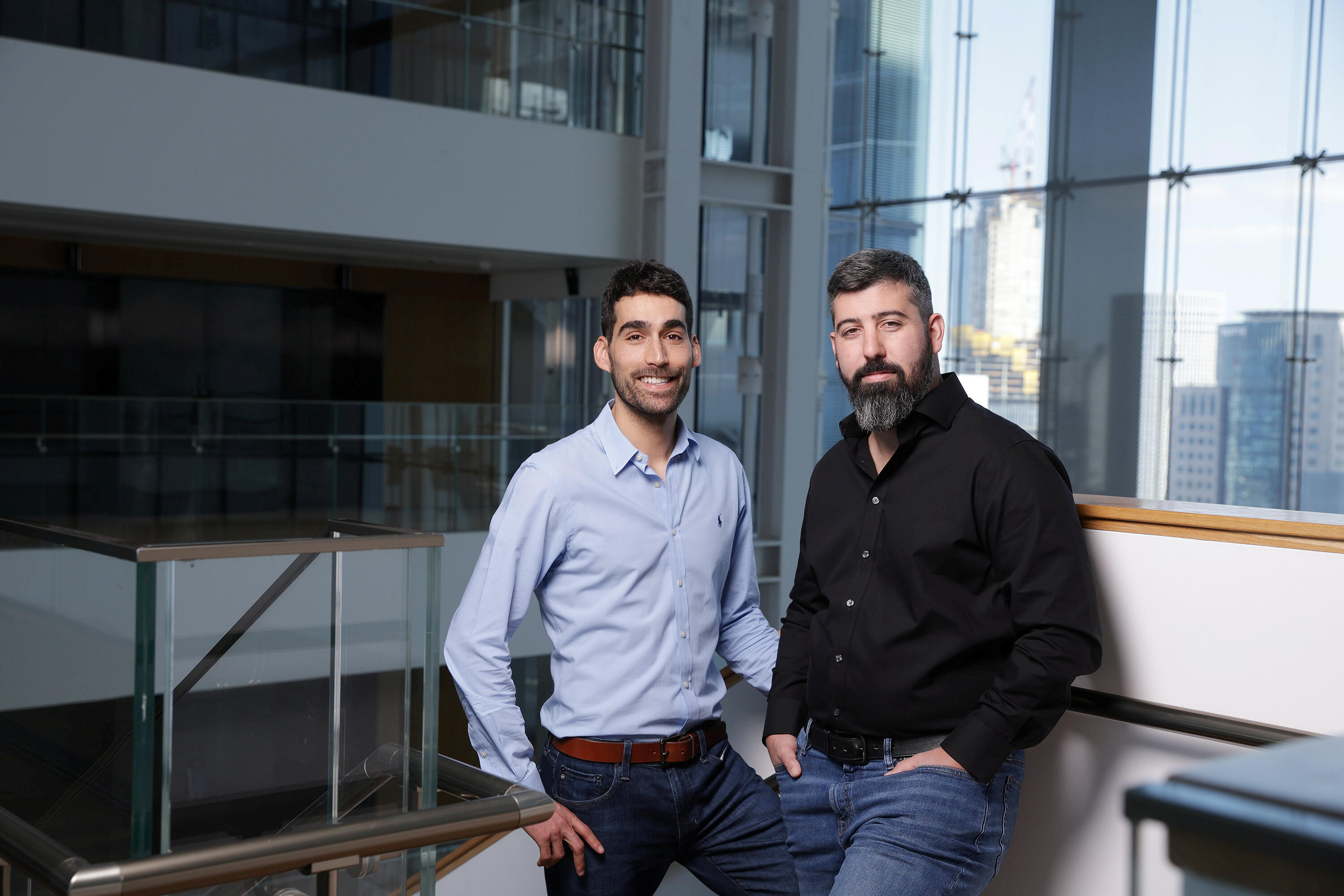
New York became Segev’s base because major customers were there. Bar-Ilan later joined him. In a joint interview, the two described a division of labor that still puts both founders in the field. Segev says Bar-Ilan is particularly good at giving customers an exact answer to a problem on the spot. He casts his own role as creating confidence that an apparently unsolved problem can be solved. That is a founder’s self-description, naturally, but it is more specific than the usual biography of vision and drive. The technical answer and the belief that someone will deliver it have to arrive in the same meeting.
The company’s third early builder, Yonatan Itai, followed a different route. Segev, Bar-Ilan and Itai had met in Talpiot, but Itai’s formal co-founder title came later. Cyera publicly recognized him in 2026 for building and leading its research and development organization from the start. Segev has called him the company’s third pillar. The adjustment of a title may sound administrative. Here it records the fact that founding work can be done before the founding paperwork catches up.
There were other relationships outside the office. Segev’s public LinkedIn profile lists volunteer work as a Big Brother beginning in 2014, and a year as a youth counselor at Manof Youth Village before university. These entries do not explain his commercial judgment. They do make the public portrait a little less like a sequence of financing announcements. He has spent years in roles that ask for consistency, in addition to urgency.
The route so far
When the buyer changed
Cyera was formed before enterprise AI became a boardroom fixation. Its original work was the unromantic mapping of sensitive information across cloud and software systems. Then companies began connecting generative models and autonomous agents to their own information. The old questions acquired a new actor. What data is sensitive? Who can reach it? What happens when the entity requesting access is software that can take action at machine speed?
Segev has described the shift with a compact line: “Our business had legs before AI. But with AI, it’s got wings.” The phrase is memorable because it leaves room for the first business to matter. His own explanation of Cyera’s growth is that AI moved data security higher on customers’ priority lists. The discovery problem had not vanished; it had become a prerequisite for deciding which information a model or agent should be allowed to use.
The company followed that logic into adjacent products. It added data loss prevention through its acquisition of Trail Security, then broadened work on identity and AI use. In June 2026, Segev announced Cyera’s $600 million Series G, saying the company wanted to govern what AI can see and do. In September, Goldman Sachs Alternatives added $400 million to the Series G, while the completed acquisition of Oasis Security joined Cyera’s data platform with Oasis’s controls for machine and agent identities. The deal was valued at $1 billion by the companies. It is a large purchase attached to a small, stubborn question: if an agent asks for access, who knows what lies behind the door?
The money does not settle the product question. A valuation is a price assigned by investors at a moment in time; a customer still has to live with the system after installation. Segev’s public writing in 2026 argued for understanding the meaning of data rather than merely applying labels, then extending that understanding to access decisions. It is a harder ambition than locating files. It also grows directly from the interviews that forced the first redesign. The customers’ original bucket now has pipes, valves and an AI agent looking for the tap.
A founder willing to redraw the map
Segev has said that he and Bar-Ilan wanted to build a company that would outlast them. By 2026, Cyera reported operations across countries, a staff well beyond its early startup size and customers among large enterprises. Segev’s stated ambition reaches further: a lasting Israeli-founded company at global scale. The scale of that wish is easy to print. The more revealing detail is the route he says brought them here: a year of asking security leaders what was broken, a product changed by their answers, and a season of sales calls made personally when the first approach stalled.
The teenage club in Alon HaGalil supplies a modest closing image. Its organizer made an idea real by persuading people to gather and return. Cyera has different stakes, more people and far less tolerance for make-believe. Still, its founder’s account returns to the same ordinary test. Do people understand the proposition? Do they find enough value to show up? And when they tell you the game is wrong, can you put down the spaceship and listen?
Explore further
Segev’s Cyera profile · LinkedIn · His Series G essay · Video interview · Cyber Inspiration conversation · 2026 joint interview