Amit Mathradas had already been to the sales kickoff. He had stood on a Las Vegas stage, his name projected behind him in letters large enough to settle any doubt about who was joining Five9. Then came his first official day as CEO, February 2, 2026, and a rather quieter promise: “Over the next 90 days, I’ll be doing a lot of listening.”
He wanted to hear from employees, customers and partners. He would learn what worked and where the business could grow. A new chief executive arrives with a title immediately; understanding takes longer. Mathradas had spent enough time inside other people’s businesses to give that distinction some room.
By the summer, he was asking a question that could make an excellent customer-service dashboard look slightly less excellent. If AI could handle 80 percent of common service issues, which 80 percent should it handle? The arithmetic looked tidy. The customer at the other end of the line might have a more complicated answer.
The brother on the other end of the phone
One of Mathradas’s recurring advisers has been his older brother. Both worked at Dell early in Amit’s career. His brother encouraged business school, and Mathradas later described calling him when a difficult decision needed another perspective.
Another education came through a chief-of-staff rotation. Paired with an executive who led through fear and intimidation, Mathradas learned what he wanted to avoid in his own management. He stayed through the assignment and treated the experience as instruction. The lesson concerned what authority could do to a team.
His formal education includes a bachelor’s degree in management and economics from Wittenberg University and an MBA from Northwestern University’s Kellogg School of Management. The subjects fit the career that followed: products, markets, operations, and the persistent problem of getting an organization to turn an intention into something a customer can use.
Fourteen years before the corner office
At Dell, Mathradas began as a product manager overseeing sales of third-party monitors and displays. The work was specific and tangible. There were products to understand and customers to serve, long before his professional vocabulary acquired agentic orchestration.
He stayed at Dell for 14 years, moving through roles that eventually included general manager of Dell Small Business. In his account of that period, serving smaller companies helped establish his interest in using technology to help merchants grow. The customers were businesses with work to finish. Software and equipment had to earn their place in that working day.
Web.com followed. From September 2013 to October 2015, he served as senior vice president and general manager at the internet-services business, again focused on small companies. In November 2015, he moved to PayPal to lead its North American small-business segment.
At PayPal, his teams covered acquisition, activation, cross-selling and retention. That list follows a customer past the initial sale. Getting a business to sign up is one task. Getting it started, helping it use more of the service and persuading it to stay are continuing responsibilities. Mathradas held the role until March 2019.
- Dell14 years
- Web.com2013
- PayPal2015
- Avalara2019
- Nintex2023
- Five92026
The unglamorous business of getting things right
In March 2019, he became Avalara’s president and chief operating officer. The company automated tax compliance, a responsibility with little of the romance that usually accompanies technology careers. Customers had obligations to calculate and work to keep moving. A tax calculation has limited patience for a stirring mission statement.
Mathradas’s remit stretched across sales, marketing, business development, customer experience and professional services. The role joined the promise made to a prospective customer with the work required to deliver it. It also put him inside a company growing well beyond the scale it had reached when he arrived.
During his tenure, Avalara grew from roughly $300 million in revenue toward $1 billion. He helped operate that expansion alongside the company’s wider leadership and teams. In 2022, Vista Equity Partners acquired Avalara for $8.4 billion. His time as president and COO ended in January 2023.
Approximate revenue scale during his time as president and COO. Vista acquired the company for $8.4bn in 2022.
His published advice to merchants was similarly concerned with the work around the transaction. His Entrepreneur articles addressed getting an online store started, preparing for Black Friday and choosing financing to stock holiday shelves. These are the problems that arrive before a business owner has much time to enjoy being called an entrepreneur.
The subjects help explain his professional territory. A merchant needs customers, payments, inventory and functioning systems. Mathradas moved between companies serving different parts of that territory, accumulating responsibility for how those services reached the businesses using them.
Too many tools, too little attention
Nintex announced Mathradas as its next CEO in March 2023, succeeding Eric Johnson. Here the product was the process itself: understanding work, automating it and improving how it moved through an organization. A form, an approval and a generated document could belong to the same piece of work even when they lived in separate tools.
Under Mathradas, Nintex expanded its AI-oriented automation offering. He described a direction that brought workflow, application development, robotic process automation, process management and document generation together. The ambition was to connect capabilities that businesses otherwise had to assemble themselves.
During a 2025 visit to Singapore, he discussed the case for building applications with low-code tools and AI instead of continually buying another specialized software subscription. The practical attraction was customization alongside consolidation. A company could address its own process and reduce the number of disconnected applications involved.
For an executive running a software business, arguing that customers might need fewer separate software purchases is an interesting position. It makes the connecting work part of the product’s value. Each additional application has to justify the complexity it adds to the working day.
His management writing followed the same concern from another direction. In July 2024, he urged leaders to delegate more strategic decisions, automate manual processes and give employees a clear understanding of success. The executive could supply direction without becoming the required destination for every decision.
A month later, he wrote about attention at work. Individuals needed room to concentrate; organizations needed processes that supported concentration. In November, he returned to software consolidation and the importance of understanding what changing a tool would do to the workflows around it. The purchase was one decision. Making the work function afterward was the continuing assignment.
First, listen
Five9 announced his appointment in December 2025, with the role taking effect the following February. He succeeded Mike Burkland, who remained on the board. Mathradas arrived as both CEO and a director, carrying operating experience across several kinds of business software into a company centered on customer conversations.
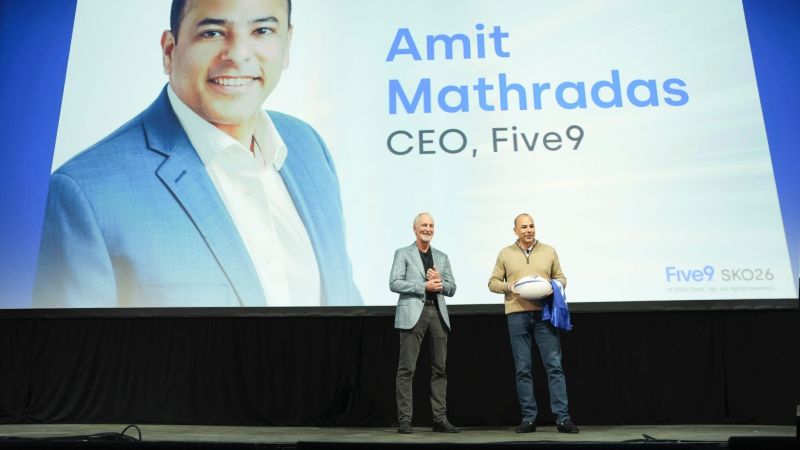
His opening message placed relationships and learning near the front of the job. He had attended the sales kickoff the previous week, but he still wanted time with the people selling, building and buying the service. The stage photograph announced an appointment. The promised conversations would help him understand the business behind it.
By August, Five9 had reported second-quarter revenue of $312.4 million, up 10 percent from a year earlier. Subscription revenue grew 14 percent. The quarter also included the launch of Voice AI Agents and a new customer agreement worth approximately $100 million in total contract value.
Those numbers describe different things. Quarterly revenue records business recognized in that period. Total contract value covers an agreement over its life. Keeping the distinction matters when assessing progress, particularly for an executive whose stated agenda includes growth and profitability.
The leadership team was changing too. Five9 appointed Niranjan Vijayaragavan as chief technology officer, Rob Hornish as chief sales officer and Sven Linsmaier to lead transformation and strategy. Mathradas’s new assignment involved the familiar operating responsibilities of people, product and execution, alongside a fresh question about the customer-service business itself.
The trouble with 80 percent
In an August 2026 essay, Mathradas examined the appeal of automating a large majority of common customer-service issues. “But here's the question that number doesn't answer: which 80%?” he asked. A count of automated interactions could leave the quality of the outcome unresolved.
“Which 80%?”
Amit Mathradas, on measuring customer-service automation
His argument gives human agents a continuing role in exceptions, escalations and complicated requests. It also asks more of the technology around them. A person taking over a conversation needs its context. A supervisor needs to see when an AI encounters trouble. An interaction should teach the system something useful when an experienced agent resolves it.
The moment on hold becomes a practical test. Can the system gather information and prepare the handoff while the customer waits? Does the next agent arrive informed? Anyone who has repeated an account problem to successive representatives can appreciate how much work sits inside that apparently modest request.
In September, he discussed Five9’s name for this arrangement, Humantic CX, combining humans and agentic AI. He described complexity, value and vulnerability as reasons an interaction might need a person, while routine requests could go through AI. He also pointed toward orchestration: coordinating the systems involved as work crosses their boundaries.
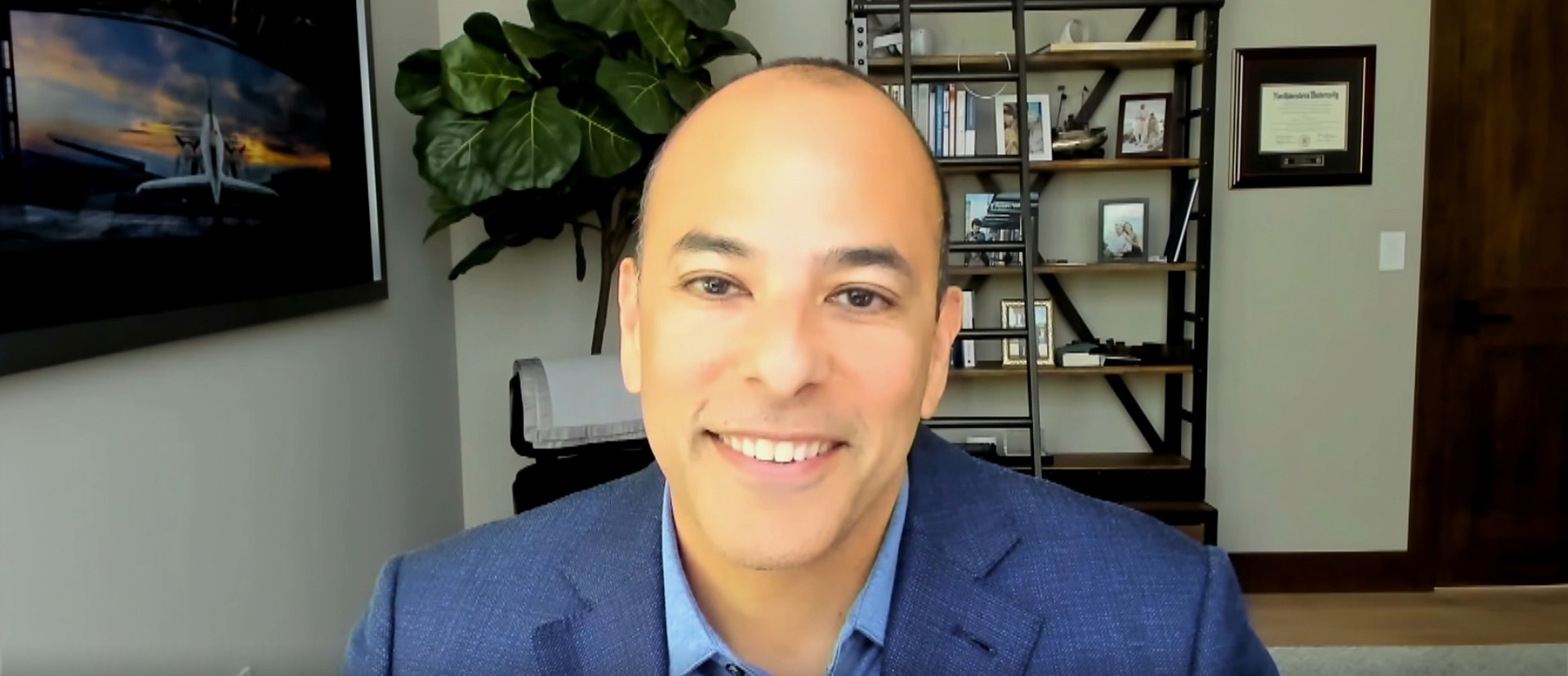
There is a recognizable sequence here, from small-business operations to tax compliance, from workflows to customer calls. Each job requires attention to what happens between the obvious steps. An executive can describe a platform in a presentation. A customer discovers its usefulness at the handoff.
That is where Mathradas has placed his current argument. The percentage may look impressive. The conversation still needs to end with the problem solved.