Three hours is a generous allowance for a first pitch. It gives a founder time to get beyond the prepared answer, and an investor time to discover whether the business is interesting after the adjectives have gone home. When Sagar K Saxena first spoke to Amit Govil about Prowrrap, there was no slide deck. Saxena later remembered a founder talking for three hours, and Govil becoming the first investor to say yes.
That recollection belongs to Saxena. It offers a useful glimpse of Govil at work: a technology entrepreneur hearing out someone building a business in procurement. By September 2025, Calance Software and Govil were named as lead investors in Prowrrap’s ₹4 crore seed round. The announcement supplied the number. The founder’s account supplied the conversation.
Govil had already spent years on the other side of the company-building exercise. Before founding Calance, he worked at Andersen Consulting and led Sapient India. His career crosses the practical terrain of technology services: assembling teams, moving knowledge between countries, buying a business and working with partners. The nouns are respectable. The verbs require considerably more effort.
“You were the first one we pitched, and the first one to say yes.”
Sagar K Saxena, Prowrrap co-founder, recalling Amit Govil
The work behind 850 people
Govil studied at Banaras Hindu University from 1983 to 1987 and earned a B.Tech in Computer Science from its Institute of Technology. His subsequent experience at Andersen Consulting involved selling and delivering complex business and technology assignments. Both activities matter in a services career. Persuading a customer to sign creates the opportunity; delivering the assignment creates the possibility of another.
At Sapient India, he served as chairman and managing director. His tenure included helping grow the operation to 850 employees. He was also a member of Sapient’s global management team. These were responsibilities inside an international consulting business, where the local office had to work as part of a larger organisation.
In June 2003, Govil explained how that arrangement worked in practice. More than 50 experienced people from Sapient’s North American offices were working in India, and more than 200 people had travelled from the United States and Europe to help the office grow. Their purpose included improving software delivery processes, sharing knowledge of clients’ industries and developing the India-based teams.
The traffic went beyond contracts and code. People arrived carrying experience that colleagues could use. Govil described the objective as creating a global delivery team for clients. It is an unshowy description, but it contains a substantial management problem: making geographically separate groups useful to one another.
- 1983–87Computer science at BHU
- Before CalanceAndersen Consulting; Sapient India leadership
- 2004Calance Software incorporated
- 2012Partners Consulting business acquired
- 2022US business joins the DTS Group
- 2025Prowrrap seed investment
An alliance gets a name
Calance’s founding idea took shape in 2003. Its name came from Customer Alliance, a compact statement of the relationship Govil wanted the business to have with its customers. The Indian company was incorporated in 2004. By then, his experience encompassed both consulting engagements and the construction of a sizeable delivery organisation.
The proposition was to offer consulting and systems integration beyond an outsourcing conversation centred mainly on lower costs. A customer could need help deciding how a system should work, putting it into service and keeping it useful afterwards. Calance sought a place across that range of work.
There is a certain ambition in naming a company after the relationship one hopes to sustain. Every missed deadline can then become an editorial comment on the stationery. The name makes an intention easy to remember; the assignments still have to justify it.
Over time, Calance’s services expanded into infrastructure management, analytics, cloud services and cybersecurity. Its current offering also includes generative AI. The range reflects the changing work available to a technology services company. The founding language remains concerned with lasting customer relationships, even as the technical vocabulary around those relationships acquires new entries.
Customer Alliance
CalanceA founding idea you can put on a business card.The company’s present geography includes a headquarters in Anaheim and offices in Boulder and Gurugram, with operations spanning the United States, Canada and India. For Govil, that international setting follows years spent working between American consulting businesses and their Indian teams. The addresses describe where work can happen. His earlier experience concerned the harder question of how people in those places work together.
The American chapter had an acquisition
The next part of the story involved a more literal form of expansion. Partners Information Technology was established in October 2011 as a subsidiary of Calance Software. In February 2012, it acquired the assets and business of Partners Consulting Services for $11 million.
That transaction gave the company an existing American business to work with. The detail is useful because company histories often make expansion sound like a matter of opening another office. Here, a new subsidiary and an acquisition were part of the machinery.
Govil’s career also included a board appointment at Global Wave Group in 2007. His remit there covered technology, strategy and marketing to financial institutions. The appointment placed his consulting experience in an advisory setting, beyond the daily running of Calance.
Taken together, these episodes show several ways his work extended through other organisations: managing delivery teams, advising a board and expanding through a business purchase. Each involved different responsibilities. All required dealing with people who brought their own knowledge, customers and expectations.
Five years before the deal
In 2017, DTS America began an alliance with Calance. The companies cooperated on building systems and introducing ERP and SAP solutions for customers. Five years later, that working relationship became the background to a change in ownership.
DTS announced an agreement in August 2022 to acquire 51% of Partners Information Technology, the US business operating under the Calance name. The acquisition was completed in October. The transaction concerned that American company, a distinction worth keeping when following the broader Calance story.
The business brought IT staffing, services and implementation support into the arrangement. Govil was identified as its chief executive. For DTS, the investment supported its plans to expand in the United States and work across a wider range of industries.
There is a practical sequence here. The companies had worked together before they committed to the ownership arrangement. A partnership had accumulated five years of experience before the announcement gave it a new corporate shape. Business relationships can be introduced in a meeting. This one had already been tested through shared work.
The cricket fan at the golf course
Before the acquisitions and investment announcements, there was a revealing detail about Govil’s television. A 2001 profile described how he followed cricket while living in the United States, using satellite television to keep up with matches. He had spent 13 years outside India and had retained his interest in the game.
The same profile mentioned reading and travel. Its list of his preferred websites included finance, investing, news and cricket. The internet was becoming part of the routine, but the sporting attachment had already survived the inconvenience of following it from abroad. Cricket, evidently, could make a sufficiently persuasive case for the subscription.
In April 2025, Govil’s public sporting connection involved a different set of clubs. Calance sponsored the inaugural Calance Open at Delhi’s Qutab Golf Course. The tournament ran from April 15 to 18 with a ₹1 crore prize purse, bringing the professional tour back to the venue after 15 years.
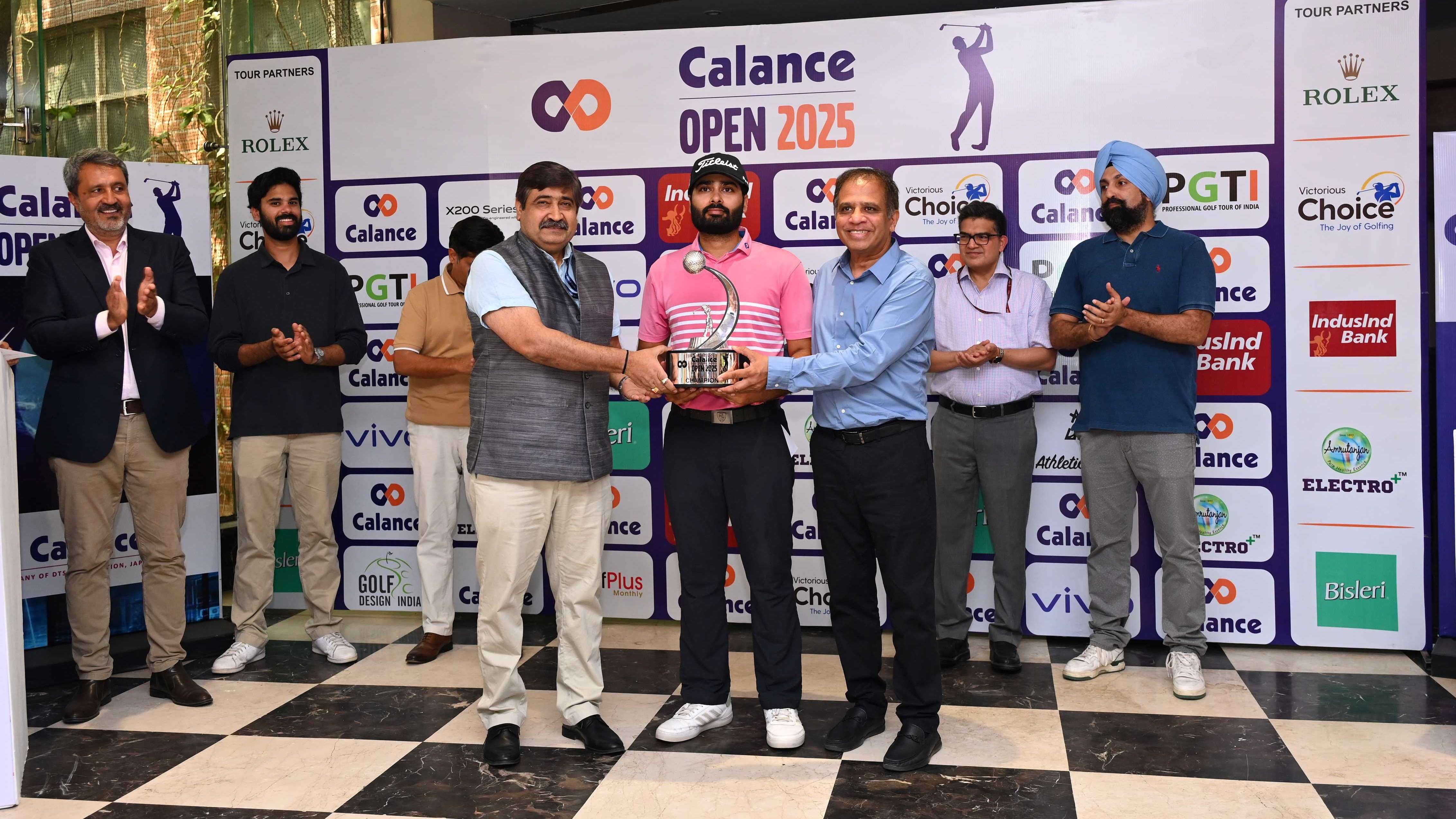
Tapendra Ghai won by a single stroke. Govil helped present the trophy alongside Vijay K Singh, the Delhi Development Authority’s vice chairman. In the photograph, the sponsor’s name fills the backdrop while the winner stands at the centre. It is an appropriate division of attention.
At the event’s launch, Govil wished the participants well. PGTI chief executive Amandeep Johl thanked him and Rohan Govil for supporting the tournament. The sponsorship gave his company a visible role in professional golf, adding a public sporting chapter to a career generally described through technology businesses.
A different kind of delivery
Later that year came Prowrrap. Founded by brothers Sagar K Saxena and Rishabh Saxena, the Delhi business works on procurement for small and growing enterprises. Its field includes packaging materials and operational assets, with a platform intended to simplify how customers obtain what their businesses need.
The September funding announcement set out plans to strengthen its technology and distribution network. Expansion to 25 cities was an ambition for the company. Those plans belonged to Prowrrap’s next stage; the round supplied resources to pursue them.
Govil’s role in that chapter was as an investor alongside Calance Software. Technology services and procurement have different daily demands, and the announcement supplies no reason to pretend otherwise. His involvement placed an established company founder in the early financing of another business.
Saxena’s public account of building Prowrrap included managing loading and unloading, sourcing, accounts and purchase orders with an early team member. He described the investment as a milestone shared with the people who had done that work. It gives the pitch a concrete background: the founder speaking to Govil had experience of the daily tasks his procurement business was trying to organise.
It is Saxena’s memory of their first conversation that makes the episode personal. After a career of building and coordinating organisations, Govil was hearing a newer founder describe his own. There was enough time for a long explanation. There was, eventually, an agreement to back it.
Customer Alliance is a tidy phrase. A founder being given three hours to make his case is a rather more tangible picture. In this particular conversation, the slides were absent. The person who would become the first investor stayed to listen.