The professor asked a simple question: What is the shape of an atom? Prasad Rao knew the idea. The English word had vanished. He had completed his intermediate education in Telugu and had just entered engineering college, where the language of the classroom had abruptly changed. “Sphere” would not arrive. “Spherical” was even farther away. So he wrote the closest construction available to him: “three-dimensional circle.”
The professor gave him full marks.
Rao recalled the quiz decades later in a public note to Silicon Valley entrepreneur Kanwal Rekhi. It is a small memory, almost a comic one, but it carries the operating logic of his career. Preserve the meaning. Improvise the route. Refuse to let a missing piece of vocabulary stop the work.
That instinct traveled a considerable distance. Rao went from NIT Warangal to the National Institute of Industrial Engineering in Mumbai, now IIM Mumbai. He became an executive, a serial technology founder and an angel investor. He led businesses through the long evolution of enterprise computing, when the industry's nouns changed from software services to networks, SAP, cloud and AI, while the customer's underlying request remained stubbornly familiar: please make this difficult system useful.
“Three-dimensional circle.”Prasad Rao's improvised answer in his first engineering science quiz
The useful answer beats the elegant delay
Rao studied at NIT Warangal from 1974 to 1979, then completed a master's degree at NITIE from 1979 to 1981. The sequence paired engineering with industrial management. It also put him at the seam where he would spend much of his working life: between technical possibility and organizational reality.
By 1989, he was president of Silverline Technologies in the United States. In 1995, he joined other technologists in promoting CyberTech Systems and Software, an India-based company designed to develop software for overseas markets and provide technical services at client sites. The model sounds ordinary now because a generation of companies made it ordinary. At the time, it required connecting talent, customers and capital across a much less forgiving global network.
CyberTech's growth produced unusually crisp markers. It appeared on the Inc. 500 list for three consecutive years, ranked 31st, then seventh, then fifth. Rao received Ernst & Young's IT Services Entrepreneur of the Year honor for Illinois and Northwest Indiana in 1999. Awards tidy a messy operating story into a plaque. The rankings hint at what the plaque leaves out: recruiting, selling, delivering and repairing at speed, three years in a row.
CyberTech's three-year Inc. 500 run
Visual scale emphasizes improvement. A smaller numerical rank means a higher position.
The next act did not retreat into ceremonial chairmanship. Rao chaired network consultancy Corliant from 2000 to 2004 and later served on the board of Prosoft Technology Group. Then came PrideVel in 2006. The name is a compact bit of corporate wordplay, combining pride and marvel. It is slightly earnest, impossible to confuse with a pharmaceutical brand, and surprisingly precise about the culture Rao wanted to install.
A business built in the plumbing
PrideVel works in technology's back rooms: enterprise migrations, SAP modernization, cloud infrastructure, application development and automation. This is where an ambitious transformation meets the ancient code that still closes the books every month. It is not cinematic work. Success may look like an upgrade that finishes, a process that runs faster or a system that simply declines to ruin anybody's weekend.
Rao's company has repeatedly aimed automation at the tedious parts of that work, including ABAP code remediation and SAP BW optimization. The strategic idea is easy to steal: laborious does not automatically mean valuable. If a machine can remove repetition while specialists keep judgment, the customer gets time back. In enterprise technology, recovered time is often the most honest form of innovation.
There is a second lesson in the company's stated values. Customer satisfaction, ethics and long-term loyalty appear before technological spectacle. One line is particularly revealing: “We believe in long-term loyalty and not in short-term gains.” It has the unfashionable ring of a rule written after somebody has watched the alternative become expensive.
Enterprise services make this trade-off visible. A vendor can win a quarter by promising an implausibly painless migration. A partner earns the following decade by admitting where the pain lives, planning for it and staying until the handoff works. The sales deck expires. The system remains.
The return to the old campus
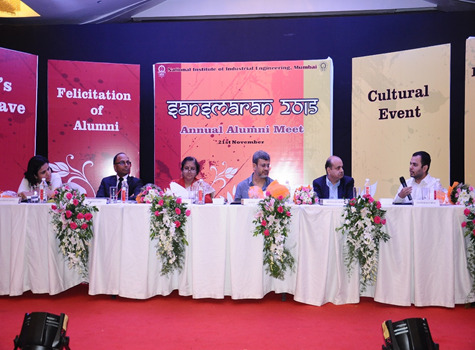
In November 2015, Rao returned to NITIE for Sansmaran, the institute's annual alumni gathering. The schedule included a campus tour, lunch, cultural performances and a CEO conclave grandly titled “Entrepreneurship Waves.” Rao sat on the panel alongside founders, an institute director and a moderator from the media world. Later, he was among three alumni given the Distinguished Alumnus Award.
The photograph from the day is wonderfully resistant to founder mythology. There is a long table, too many flowers, upright water bottles and the floral carpet of a respectable conference hotel. People sit under banners while one panelist holds a microphone. A career that crossed oceans and public markets returns to its alma mater beneath the practical glow of ballroom lights.
The event also reveals how Rao's network widened. In Silicon Valley, he became part of TiE, the entrepreneurship organization founded by Indian-origin business leaders. TiE Angels lists him on its screening committee as chairman and CEO of PrideVel Group. Screening is the less glamorous half of angel investing. It means listening before cheering, finding the useful question and distinguishing a large vocabulary from a sound idea.
President of Silverline Technologies Inc.
Co-founds CyberTech Systems and Software.
Receives a regional E&Y IT services entrepreneur award.
Chairs the board of Corliant.
Builds and leads PrideVel Group.
Receives NITIE's Distinguished Alumnus Award.
Three cities inside one operating map
Rao's professional geography explains part of his fluency as a translator. His education ran through Warangal and Mumbai. PrideVel's American footprint connects Naperville, Illinois, with Santa Clara, California, while the company also operates in Mumbai. These are not decorative pins on a global map. They sit near three different sources of leverage: technical talent, enterprise customers and the Silicon Valley network where founders and investors trade experience.
The Midwest chapter matters. Rao's 1999 Ernst & Young recognition was specifically for IT services in Illinois and Northwest Indiana. PrideVel's primary US address remains in Naperville. Silicon Valley supplies a different layer through TiE: access to people who have built, funded and occasionally repaired companies. Mumbai provides continuity with Rao's graduate education and the Indian technology businesses associated with his career. The result is a company that has never needed to choose between an Indian delivery identity and an American customer identity. Its history contains both.
This arrangement demands more than time-zone arithmetic. A services founder has to make promises in one room that teams elsewhere can keep. Product language must survive sales, architecture, implementation and support without quietly changing meaning at every border. Rao's career began with precisely that challenge at CyberTech, which was formed to connect Indian software capability with overseas projects. PrideVel continues the pattern in a newer technical vocabulary.
There is a management principle tucked inside the map: proximity has several meanings. You can be close to talent, close to capital or close to the customer. A global services business has to design for all three. Offices create presence. Trust creates the handoff between them.
The thread through four technology cycles
It is tempting to call Rao's career a series of reinventions. The stronger reading is continuity. At Silverline, CyberTech, Corliant and PrideVel, the technical objects changed. The human problem did not. Organizations had complicated systems and needed somebody to translate between what the technology could do and what the business could safely absorb.
Rao even published a LinkedIn article in 2015 called “ROAD TO HANA,” placing himself inside one of enterprise software's defining migration conversations. A road is the right metaphor. Customers rarely teleport from an old architecture into a clean future. They travel with baggage, detours and a few systems nobody remembered owning.
His early classroom anecdote makes the same point at human scale. Language was an interface. The knowledge existed, but the expected label did not. Rao constructed a bridge sturdy enough for the idea to cross. The answer lacked polish and kept its precision. A generous professor recognized the thinking.
Decades later, Rao wrote about the moment with modesty, saying he had been fortunate to do “reasonably well.” The record is less coy: several companies, public-market experience, a major growth ranking, an entrepreneur award, an alumni honor and a seat where new founders are evaluated. Still, the understatement fits. Enterprise technology trains a person to distrust the demo until the system runs.
The fashionable technology changes. The founder's job remains translation: keep the meaning, remove the friction, make the handoff work.
PrideVel's stated vision is global, secure and customer-centered. Its current language includes cloud, automation, IoT and AI. Those may be new nouns, but Rao has already lived through enough cycles to know that novelty is rented. Usefulness must be owned.
The practical playbook is hiding in plain sight. Start with the problem the customer actually has. Automate repetition, not responsibility. Treat culture as an operating system. Keep relationships longer than a sales cycle. When the perfect word fails to arrive, build a phrase that carries the idea forward.
A three-dimensional circle will not delight a geometry teacher. In the right classroom, at the right moment, it can reveal an engineer.