Chemistry
Develop a darkening material with useful colour, contrast and durability.
Company profile / Materials that move
A thin film from Ambilight lets a car roof decide how much sky to admit. The more interesting invention may be the factory process that made curved, darkening glass practical at scale.
The ordinary sunroof is a stubborn thing. On a cool morning it is the best seat in the car; at midday it can feel like a modest greenhouse. Pull a shade across it and the sky disappears. Leave it open and the cabin takes the heat. Ambilight, a materials company founded in 2017, has made a business out of refusing that little compromise.
Electrochromic material changes its optical properties when a small voltage is applied. That can turn a clear pane darker without a blind, a moving shade or permanently tinted glass. The idea itself is older than Ambilight. Its contribution is a flexible, solid-state film that the company says can be made continuously on a roll and fitted to shapes that defeated earlier approaches. Its own technical material puts the film below half a millimetre thick and the operating voltage below 1.6 volts. Those numbers are claims about its technology, not a universal specification for every installed window.
One early public outing was almost comic in its modesty: an OPPO Reno5 Pro+ special edition with a back that changed colour. It was clever and easy to show to a room. A phone back, however, is small. A curved panoramic vehicle roof asks much more of the same chemistry: broad, even tint; tolerance of heat and weather; a shape that conforms to a car; and the unromantic ability to make the thing again, thousands of times.
Ambilight appears to have seen several possible destinations for its film. Building glass was among its early imagined uses, while the OPPO project supplied an early consumer demonstration. The car became the central commercial proving ground. That sequence is useful precisely because it was not a straight line from invention to ideal buyer. A materials startup can first learn how to show a property, then find where that property solves an expensive, recurring problem.
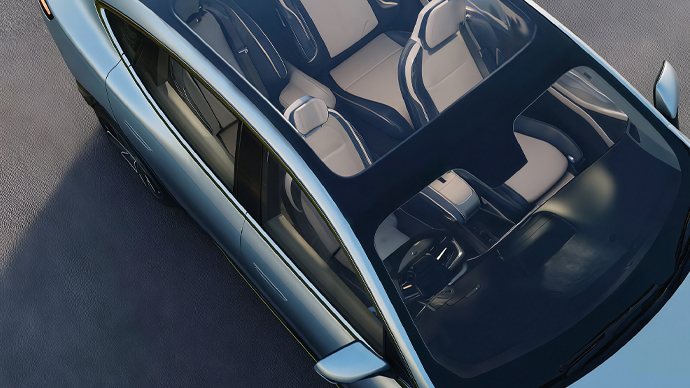
Ambilight describes its process as solution-processed, roll-to-roll manufacture of polymer-based electrochromic thin film. Picture a printing press, except its output is a functional optical layer rather than a newspaper. The analogy has limits, but it captures the business point: coating a continuous flexible substrate offers a path to scale that making each rigid pane as a bespoke piece does not. The film can be incorporated into glass or plastic and shaped for curved vehicle surfaces.
Develop a darkening material with useful colour, contrast and durability.
Coat a thin substrate continuously, then prepare it for large curved areas.
Build the film into a roof or window and connect it to cabin controls.
Ambilight's own account of older electrochromic approaches is instructive. It says early gel-based systems struggled with large areas and curved shapes, while rigid inorganic approaches were costly and difficult to curve. That is a statement of the design problem, not evidence that Ambilight's own first attempt failed. The company has not published a candid postmortem or a unit-cost breakdown. What can be seen is the engineering response: flexible substrate, solid-state electrolyte, black materials and production machinery designed to repeat the result.
A beautiful sample proves the chemistry. A carmaker asks whether the next ten thousand samples will look the same.That is the commercial question behind Ambilight's manufacturing story.
Black is a meaningful detail here. Early electrochromic glass is often associated with a blue cast. Ambilight has emphasized black and black-gray tints because a vehicle roof must look like part of the vehicle when dark, while still letting a passenger see out when bright. It says its material can change across a contrast range above 40 times, with very high light blocking in its darkest state. Those are company-published performance figures, and performance depends on the final product and test conditions.
Figures are Ambilight's public statements; they are not independent audits.
In a NIO ET7, Ambilight's roof is divided into separately controlled sections. Passengers can choose levels of brightness, and the vehicle can adjust automatically. That is a small but telling shift. The window stops being a passive hole and starts behaving like another cabin control, closer to a lamp dimmer than a curtain.
A roof brings glare and heat into the conversation. A side window adds privacy. Ambilight launched a black electrochromic side-window product in 2025, describing adjustable shading and solar protection while preserving an outward view. Its catalogue now reaches across sunroofs, side glass, rear glass and other vehicle glazing, though the company labels some parts of its wider system as still in development. Its most recent named program, announced in May 2026, is a dimming panoramic roof for the AUDI E7X.
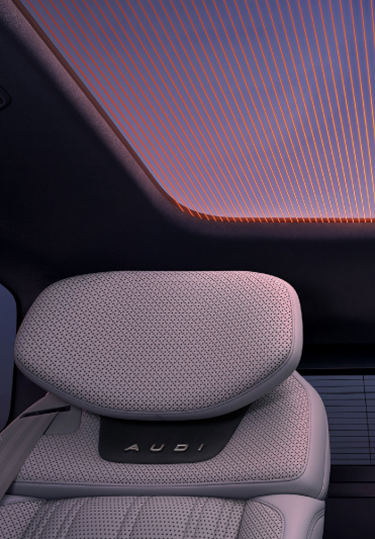
The buyer is the vehicle maker or its glass supply chain. Ambilight sells a component and the expertise to integrate it, rather than an app or a consumer subscription. Public prices and contract terms have not been disclosed. This matters when judging the opportunity: the value is not merely that a passenger can tap a button. An automaker can offer a large glass roof without relying wholly on a mechanical shade, reduce glare on demand and build new cabin modes around light. The precise energy or range benefit of any particular installation needs vehicle-specific testing.
| Choice | What it gives a buyer | The tradeoff |
|---|---|---|
| Fixed tint | Simple, permanent shading | Cannot brighten when conditions change |
| Mechanical shade | Familiar and effective light blocking | Takes space and covers the view |
| Ambilight EC film | Adjustable tint in curved glass | Requires electronics and integrated glazing |
Ambilight also presents architectural glass that can respond to light through a building control system, plus sunglasses and snow goggles whose lenses adjust to changing conditions. The same material property - controllable transmission of light - travels from a facade to a windshield to a lens. The buyers, regulations and economics do not travel with it. A building owner thinks in years of cooling loads and installation costs; an automaker thinks in model cycles, durability standards and supplier reliability; a person buying eyewear thinks about comfort in a second. The film may be common, but each market has its own examination paper.
The company is organized accordingly. It describes foundational research in Indiana, product and materials development in Shenzhen, and engineering and manufacturing in Suzhou, alongside its US presence. In 2021, Warburg Pincus led a Series C round in which BYD and NIO Capital joined as strategic investors. The exact size of that round is not reliably public. The investor mix is more revealing than an uncertain dollar figure: two potential buyers put money behind a material they might use.
Ambilight says it was in more than 20 new-energy vehicle models by mid-2025, including programs associated with BYD, NIO, Zeekr, Xiaomi and Aston Martin. In January 2026 it reported a 2025 monthly delivery milestone above 20,000 sets and more than 300,000 users. Treat those as company-reported measures, but notice what they measure. These are not downloads or registered accounts. They are physical units that had to be made, delivered and fitted into machines whose roofs meet weather every day.
There is an easy way to tell Ambilight's story: someone invented a window that goes dark. The harder, more useful version begins after that demo. The team took a material effect, found an application that could pay for it, and built a process meant to repeat it on demanding shapes. An OPPO phone back showed what the chemistry could do. Vehicle programs tested whether it could become an industrial product.
That pattern is worth copying for any hardware founder: make the property visible in a small product, then aim at the customer whose problem is costly enough to justify integration. It works only if the manufacturing yield, durability and economics survive the move. If fixed tint or a cheap shade solves the customer's problem well enough, adjustable glass has little case to make. Ambilight's wager is that more cars, buildings and wearables will treat control of light as a useful function. For now, its strongest evidence is a roof that no longer has to choose between the sky and the shade.