BREAKING Tynt swaps windows for lenses as big tech comes calling Stanford PhD turns electroplating into a dimmer switch for glass FORBES 30 UNDER 30 — 2023 0.01% to 90% light transmission, on demand $18M raised, $12M sought for AI-eyewear lens BOULDER, CO Reversible Metal Electrodeposition BREAKING Tynt swaps windows for lenses as big tech comes calling Stanford PhD turns electroplating into a dimmer switch for glass FORBES 30 UNDER 30 — 2023 0.01% to 90% light transmission, on demand $18M raised, $12M sought for AI-eyewear lens BOULDER, CO Reversible Metal Electrodeposition
The Profile · Deep Tech

Tyler
Hernandez.

He taught a pane of glass to make up its mind.

A chemist by training and a salesman by necessity, the co-founder of Tynt Technologies spent years coaxing metal to plate and un-plate on demand. The result is a film that goes clear to blackout in seconds - and the four tech giants who keep calling him want it on your face.

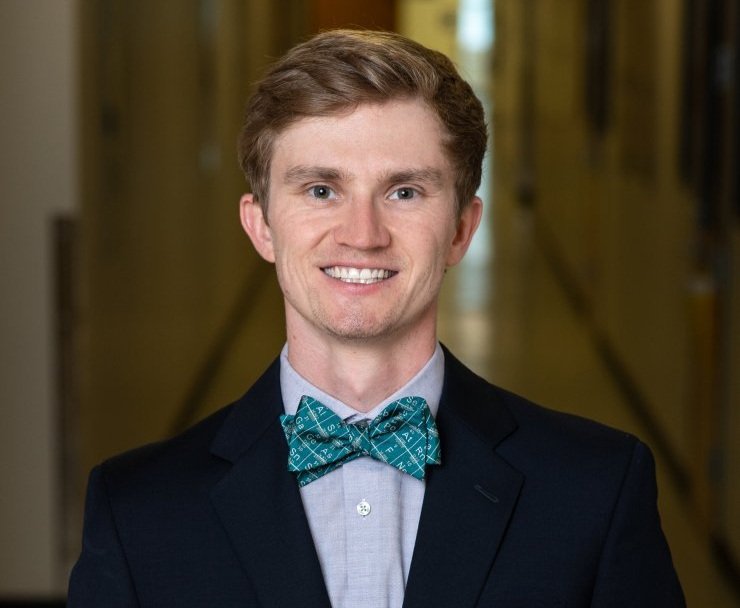
Tyler Hernandez, CEO and co-founder of Tynt Technologies
Tyler Hernandez — CEO & co-founder, Tynt Technologies. Boulder, Colorado.
<0.01%
Dark-state light let through
Seconds
Clear-to-blackout switch
$18M
Raised across grants + 2 rounds
~8%
Global CO₂ he aims to chip at
Who he is now

The man stopped selling windows. Then the giants called.

For most of a decade, Tyler Hernandez was building a better window. Energy-saving, self-tinting, climate-friendly glass that would dim the afternoon glare and quietly trim a building's air-conditioning bill. It was a noble pitch. It was also, he learned the hard way, a brutally slow market. "The window market is one, very slow to innovate, and two, people are happy with where they are," he says. Glass, it turns out, is patient. Hernandez is not.

So in 2024 he did the thing founders dread and admire in equal measure: he turned the whole company sideways. The same chemistry that dimmed a skyscraper's facade could, it happened, be shrunk, thinned, and bent around the curve of an eyeglass lens. And right as he noticed that, the calls started coming in - from Mountain View, from Menlo Park, from Cupertino. The biggest names in consumer hardware wanted to know whether his film could ride along on the next great gadget: AI-powered smart glasses.

Today Hernandez is the CEO of Tynt Technologies, a roughly seventeen-person deep-tech outfit in Boulder, Colorado, and his job description has quietly flipped. He is no longer mostly a chemist. He is the person on the investor circuit explaining, slide by slide, why a material breakthrough most people have never heard of belongs inside the eyewear they will supposedly all be wearing by the end of the decade.
We live in a dynamic world. The time of day changes, the weather changes, we spend time indoors and outdoors - and yet every surface is static. — Tyler Hernandez
The strange specific

A dimmer switch built out of plating and un-plating metal.

Here is the trick, stripped of jargon. Run a small voltage through Tynt's electrolyte and a microscopically thin layer of metal plates onto a transparent electrode, darkening the surface like a developing photograph. Reverse the voltage and the metal dissolves back into the liquid, leaving the glass clear again. Plate, dissolve, plate, dissolve. The chemists call it Reversible Metal Electrodeposition. Everyone else can call it a dimmer switch for transparency.

The numbers are what make hardware engineers lean in. The film can travel from roughly 90% visible-light transmission down to less than one-hundredth of a percent - clear glass to a near-total blackout. It can flip to a switchable mirror. It does this in seconds. And it is bi-stable: once it lands on a state, it holds there with no continuous power draw, which is precisely the kind of stinginess a battery-powered pair of glasses demands.

"For lenses especially, you need something lightweight. You need something thin. You need something that can mold to the curvature of lenses."
Infographic · the swing

From blackout to clarity

One film, the full range of light. The same RME chemistry covers privacy blackout, an on-demand mirror, and crystal clarity.

<0.01% (blackout)90% (clear)
blackout mirroring clarity · low haze no continuous power
How he got here

Lab bench to balance sheet.

Hernandez did not back into chemistry. He double-majored in chemistry and mathematics at the University of South Carolina and graduated summa cum laude, then headed west to Stanford for a PhD under Professor Mike McGehee, a star of materials science. There, as an NSF Graduate Fellow, he helped co-author the foundational research - work that landed in journals like Nature Energy and Advanced Energy Materials - that proved reversible metal electrodeposition could power a real, large-scale dynamic window.

In 2020, still a student, he turned the paper into a company. He co-founded Tynt with McGehee, his own advisor, and fellow student Michael Strand, then won CU Boulder's Lab Venture Challenge and moved the operation to Colorado. The early identity was unmistakably climate: dim the windows, cut the air-conditioning, shave a meaningful slice off building emissions. "Reducing HVAC loads on buildings is a big thing," he says. "We realized we could potentially reduce CO₂ emissions by about 8%. That's a great sliver to attack."

The slice was real. The sales cycle was not cooperating. Windows are sold through construction, and construction does not hurry. By the time Hernandez took the CEO seat in 2026 - after previous chief executive Ameen Saafir departed - the company had already begun aiming its film at a target that moves a great deal faster than a building: your face.

  • 2019Co-authors the foundational RME dynamic-window research at Stanford (Nature Energy).
  • 2020Co-founds Tynt with advisor Mike McGehee and Michael Strand; wins CU Boulder's Lab Venture Challenge.
  • 2021Tynt sets up headquarters in Boulder and closes an early raise.
  • 2022Metal-mesh electrode work pushes dark-state transmission below 0.1% (Advanced Energy Materials).
  • 2023Named to the Forbes 30 Under 30 list.
  • 2024The pivot: from smart windows to lenses for AI-powered eyewear.
  • 2026Becomes CEO; signs a licensing deal with a major tech company and raises toward an eyewear-ready lens.
The bet

Why a windows company is suddenly an eyewear company.

The pivot was not a pivot away from the technology. It was a pivot toward the moment. As Hernandez tells it, the same buzzword reshaping every boardroom reshaped his roadmap too. "We started realizing that there was this massive surge in the biggest buzzword in the world right now, which is AI." AI needs a face to live on, and the industry's chosen face is a pair of glasses. Glasses need lenses that can dim for a bright street, an immersive overlay, or a moment of privacy - which is, conveniently, the one thing Tynt's film does better than almost anything.

Who's interested

The four-letter callers

Hernandez says the dimming technology has caught the attention of the biggest names in consumer hardware - and that a licensing deal with one of them was signed at the start of 2026.

GoogleMetaAppleSamsung

A Mountain View, California company - widely read as Google - is reported to have invested. Hernandez plans to deliver a lens ready for AI-enabled eyewear by next year.

The money

Patient capital for an impatient man

$18M raised to date, from government grants plus two rounds in 2021 and 2024. $400K in early revenue arrived through a partnership with skylight maker Velux. Now Hernandez is on the road seeking roughly $12M more to get the smart-glasses program fully rolled out and to keep scaling beyond it.

"Deep tech takes time, but lasts forever."
I want to look back 20 years from now, and everybody has these glasses in their cars, in their lenses, in their commercial buildings - and they're like, "Remember when we used to use blinds and shades?" — Tyler Hernandez on the future he's selling
The character

A founder who treats patience as a feature.

Most startup stories run on speed. Hernandez built his career on the opposite virtue. RME is the kind of science that does not yield to a hackathon; it took years of plating experiments, electrolyte tweaks, and electrode redesigns to get a dark state black enough and a clear state clear enough. He has made that slowness part of the brand, arguing publicly that deep tech's long fuse is exactly what makes its eventual blast worth waiting for.

There is a tidy irony in the founding team, too. Hernandez's co-founder is also his former PhD advisor, Mike McGehee - now Tynt's chief scientist - which makes the company a rare case of a student hiring his professor. The name "Tynt" is a wink at the single trick the whole enterprise performs: tint, deployed across windows, mirrors, and now lenses. One verb, a very large ambition.

What he is selling, underneath the chemistry, is a complaint about the built world: that we live in motion while our surfaces sit frozen. The pitch lands because it is true. The window beside you cannot read the weather. The lens on your face cannot read the room. Hernandez has spent his entire adult life on the wager that both of them should, and soon will.

Five things worth knowing

The footnotes that stick.

1
His film swings from 0.01% to 90% light transmission - clear glass to near-total blackout, in the same pane.
2
The tint is bi-stable: set a state and it stays there with no continuous power. Perfect for a battery on your face.
3
The same chemistry can turn a surface into an on-demand mirror, not just a shade.
4
He double-majored in chemistry and mathematics and graduated summa cum laude before Stanford.
5
His co-founder is his former PhD advisor, Mike McGehee - the student ended up building the company around his professor.