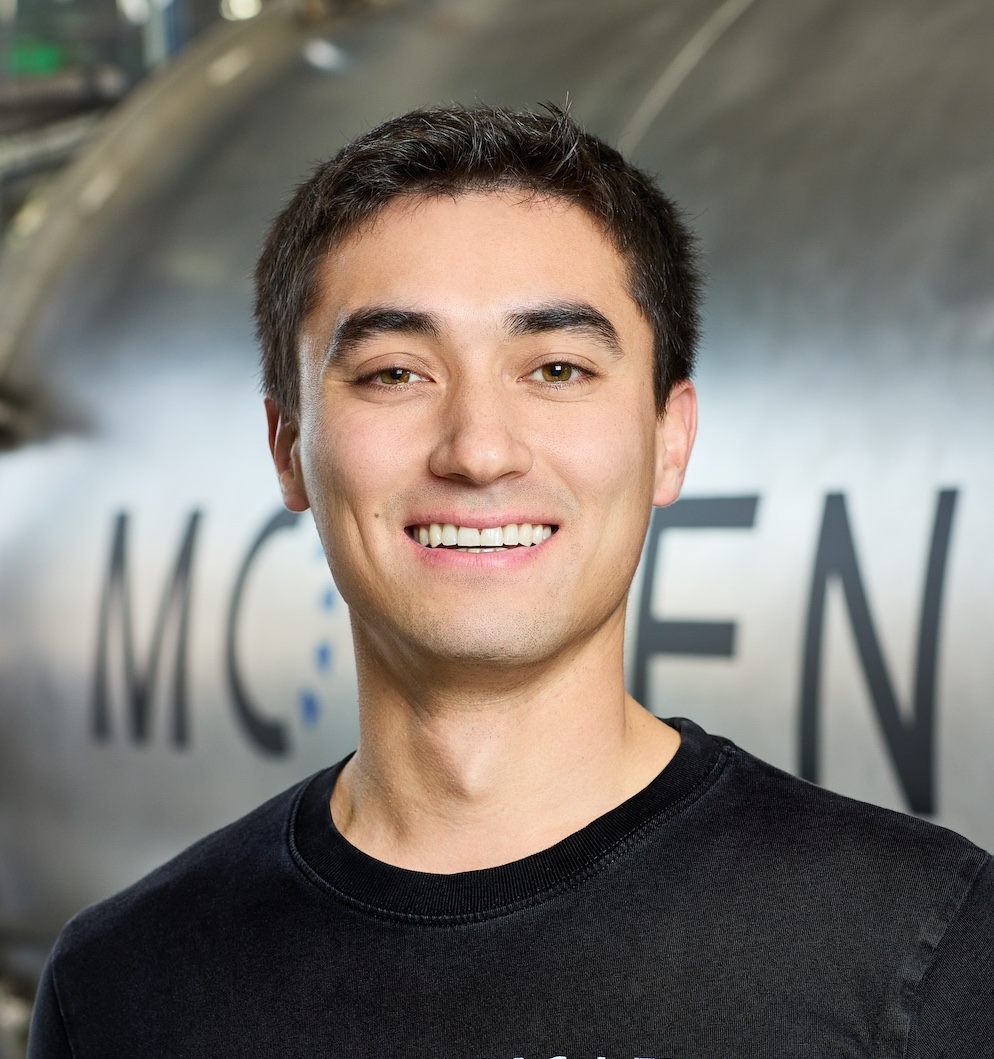
Walk into the pilot plant in West Oakland and Kevin Bush will tell you the reactor works like a toaster. Electrical resistive heating, a wire that glows, heat where you want it. Except this toaster does not brown bread. It splits natural gas down to its atoms - hydrogen floating off as clean fuel, carbon settling out as high-purity synthetic graphite. Two products, one machine, no carbon dioxide going up a stack.
That is methane pyrolysis, and Bush has staked his company on it. Molten Industries, which he co-founded in 2021 with fellow Stanford PhD Caleb Boyd, claims its process sips roughly seven times less energy than electrolysis, the conventional route to clean hydrogen. The hydrogen is bound for steel mills. The graphite is bound for lithium-ion batteries. Bush likes that the two outputs land in two industries America keeps saying it wants to rebuild at home.
The pitch lands because Bush is not a tourist in materials science. He arrived at Molten with a decade of receipts.
Before the methane, the sun
At Stanford he chased perovskites - the crystal that solar researchers treat as both promise and heartbreak. Bush developed record-efficiency perovskite-on-silicon tandem cells and built the world's first perovskite-on-perovskite tandems. He co-authored 25 papers in three and a half years and collected more than 5,000 citations along the way. Then he co-founded Swift Solar to commercialize lightweight, flexible perovskite cells, the kind you could imagine wrapping around surfaces that conventional panels would never fit.
Rewind further and the pattern is the same: a kid who liked to build things that should not work. As a mechanical engineering undergrad at Vanderbilt he put together anaerobic digestion systems, a biodiesel-powered subsonic ramjet engine that won a NASA student launch competition, and an amphibious vehicle for a DARPA project. The throughline was never the specific machine. It was energy, and the stubborn belief that you could engineer your way to a cleaner version of it.
Working on climate change is something I'm really passionate about. It feels meaningful; I can't imagine doing anything else with my life.
- Kevin Bush
The garage, then the grind
Molten started where a lot of hardware companies start and most fail: a garage. Bush and Boyd, both members of the Breakthrough Energy Fellows program, began building chemical reactors at Stanford with a vision to decarbonize heavy industry. Bush's prototyping ritual was almost comically analog. Order parts from McMaster-Carr, get them next day, iterate, repeat - for months.
The original goal was narrower than what Molten sells today. The team wanted the lowest-cost hydrogen from the most energy-efficient reactor it could design. The graphite was a surprise. Somewhere in the experiments they realized the carbon coming out was not useless soot but battery-grade material - the stuff that goes into anodes, the stuff the United States overwhelmingly imports. A cost center became a second product line.
That accidental discovery reframed the whole company. Hydrogen alone is a commodity in a brutal market. Hydrogen plus graphite is a business with two revenue streams and two strategic narratives, and investors noticed.
Money, steel, and a full circle
In June 2024 Molten closed a $25 million Series A led by Breakthrough Energy Ventures, with Sozo Ventures, Steelhead Capital, and Mark Heising joining a roster that already included Union Square Ventures, 50 Years, Moai Capital, UVC Partners, and longevity physician Peter Attia. The money funds Molten's first modular commercial reactor in Oakland. Total funding for the company sits around $32.4 million.
Then came the steel. Molten led a strategic partnership with U.S. Steel and CPFD Software to pioneer carbon-neutral steel production - the kind of validation a deep-tech founder cannot manufacture in a garage. For Bush it closes a loop he describes with something like wonder: graphite for batteries pulls him back toward his first dream of impacting energy storage, while clean hydrogen flows into steel, an industry he insists America needs to keep making.
He is a Forbes 30 Under 30 honoree in Energy, a Breakthrough Energy Fellow, and holds seven patents. None of which, he would probably argue, matters as much as how fast the next experiment runs.